

Hi everyone,
This week included a quick trip to Vermont, where I am in search of a smaller, simpler hideaway in which to write Part Two of Beautiful Possibility. And more than that, it’s a very specific kind of hideaway I’m in search of.
As some of you probably know (maybe even firsthand), Vermont was the east coast epicentre for the “back to the land” movement — a collective reaction to the collapse of the Love Revolution that began in the late ‘60s and ended (sort of) in the early 1980s, in which young people rejected contemporary Western culture and sought to build the new and better world the Sixties had shown them was possible.
As part of my research into that part of the story, I recently read Kate Daloz’s 2016 book We Are As Gods. Daloz was the daughter of back-to-the-landers, and she writes a vivid and gorgeously honest (and often laugh-out-loud funny) account of the back-to-the-land community in northeastern Vermont that her parents were part of.
I was especially struck by this observation in Daloz’ book—
“The 1970s remain the only moment in the nation’s history when more people moved to rural areas than into the cities, briefly reversing two hundred years of steady urbanization. But despite the huge numbers, the decision to go back to the land felt so personal that many had no idea others were doing the same. “Only afterward was it called a movement,” wrote Robert Houriet, one of the period’s keenest observers. “At the outset, it was the gut reaction of a generation.”1
When Daloz describes the back-to-the-land movement as “the gut reaction of a generation,” she’s not exaggerating. Some estimates suggest that at its peak, almost two million young people were actively part of the movement.2
My parents were two of those young people. Despite their hard-won college educations, they traded a life in the city with all of its conveniences and economic advantages for 15 acres in rural Oregon, where they raised chickens, grew their own vegetables (along with their own weed), taught history (my father) and made pottery (my mother).
All of which brings us back to my trip to Vermont — because many of the houses and cabins that the back-to-the-landers built during the 1970s are still standing and are occasionally for sale. For example, this one that I went to see this week—
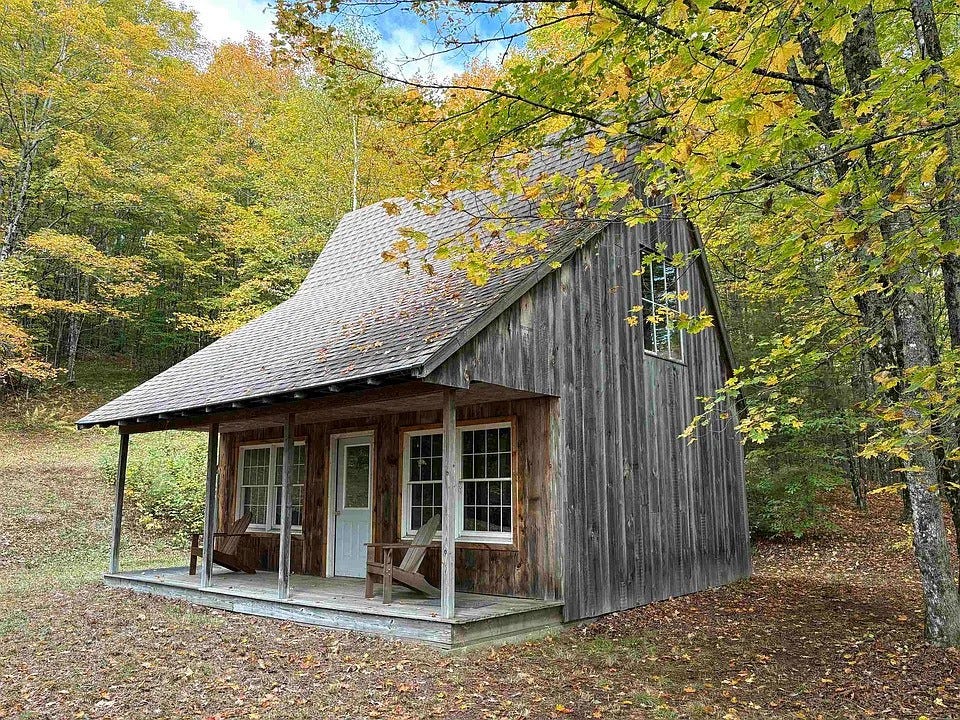
Because, you see, I have fallen in love with the romantic notion of writing the next parts of Beautiful Possibility in one of those cabins, enfolded in the living expression of one of the most profound and beautiful chapters of the Love Revolution (and a chapter from my own history as well, albeit on the opposite side of the country).
We’ll see how the story unfolds. (meanwhile, if you happen to know of a back-to-the-land era house/cabin for sale, rent or loan, in Vermont or elsewhere, please email fab research assistant Robyn).
As for the back-to-the-land movement, we will, of course, talk about that story when we get there in Beautiful Possibility. First, because it’s an important — and powerfuly mythological — part of the story of the Sixties. And second, because it’s an important part of the story of The Beatles — Paul and Linda were early pioneers of the back-to-the-land” movement, and easily its most high-profile participants, and that had major implications for the relationship between Paul and John.
And as for my parents, that story ended more or less the way most back-to-the-land stories ended—
‘Most of the back-to-the-landers] had intended to live simply and stay with the basics, [but] kept advancing to more complicated systems…They started with outhouses and ended up with composting toilets, or started with wood heat and ended up with solar panels. One-room homes grew into five-room homes as additions popped up over the years. Kerosene lanterns gave way to electricity, and hand-dug wells were retired in favor of motorized pumps from deep wells. Either all of us had been irreversibly socialized by American culture to seek the next greater stage of comfort, or we could not escape our atavistic impulses to invent and explore, taking the simple and transforming it into the complex. Or possibly most of us, unlike truly impoverished people, simply had the wherewithal and connections to raise the capital necessary for home improvements if we wanted them.”3
Until next week.
Peace, love, and strawberry fields,
Faith 🍓
We Are As Gods: Back to the Land in the 1970s on the Quest for a New America, Kate Daloz, Public Affairs, 2016.
The back-to-the-land movement, along with the upswell in the collective unconscious that set it in motion, is also a deeply mythological — and also one of the most beautiful and profound — parts of the story of the Love Revolution. I’m looking forward to talking about all of that with y’all when we get there in Beautiful Possibility.
Back From The Land: how young Americans went to nature in the 1970s, and why they came back, Eleanor Agnew, Ivan R. Dee Press, 2004.
full quote: “As I reflect on the log cabin’s plumbing, as well other areas of our lives, I find it revealing that Kent and I, who had intended to live simply and stay with the basics, kept advancing to more complicated systems. This is true for most people who went to the land. They started with outhouses and ended up with composting toilets, or started with wood heat and ended up with solar panels. One-room homes grew into five-room homes as additions popped up over the years. Kerosene lanterns gave way to electricity, and hand-dug wells were retired in favor of motorized pumps from deep wells. Either all of us had been irreversibly socialized by American culture to seek the next greater stage of comfort, or we could not escape our atavistic impulses to invent and explore, taking the simple and transforming it into the complex. Or possibly most of us, unlike truly impoverished people, simply had the wherewithal and connections to raise the capital necessary for home improvements if we wanted them.”
