

Happy John Met Paul Day, everyone!
I wish I had a splendiferous update with which to honour the occasion, but alas I do not. Life interfers.
My little house in the Maine woods isn’t quite as “little” as I’d like it to be, so I’m in the midst of significantly downsizing to something much smaller and much simpler. The good news is that this downsizing will free up a lot more time and focus for work on Part Two of Beautiful Possibility. The bad news is that for the next couple of months, updates are liable to be fairly simple — probably mostly just little pieces of research and such that caught my eye.
So this week, let’s take a quick look at one of those pieces of research.
In the Wrap-Up to Seven Levels, we saw that when it comes to reliable primary research, exact language matters a lot — and especially relative to the emotional truth of their lives, it matters maybe more than anything else. And I suggested that the best source of that exact, unedited language from John and Paul is, of course, their lyrics. And I also pointed out that we can find exact, unedited language/thoughts on their lives from John and Paul — with no adjustments whatsoever by anyone else — in John’s books, letters and artwork, and Paul’s books, poetry and paintings.
This list is mostly accurate — but it’s a bit of an overgeneralization, relative to John’s books.
For example, here’s John’s original manuscript for “Liddypool,” one of the pieces in his first book, In His Own Write1 —
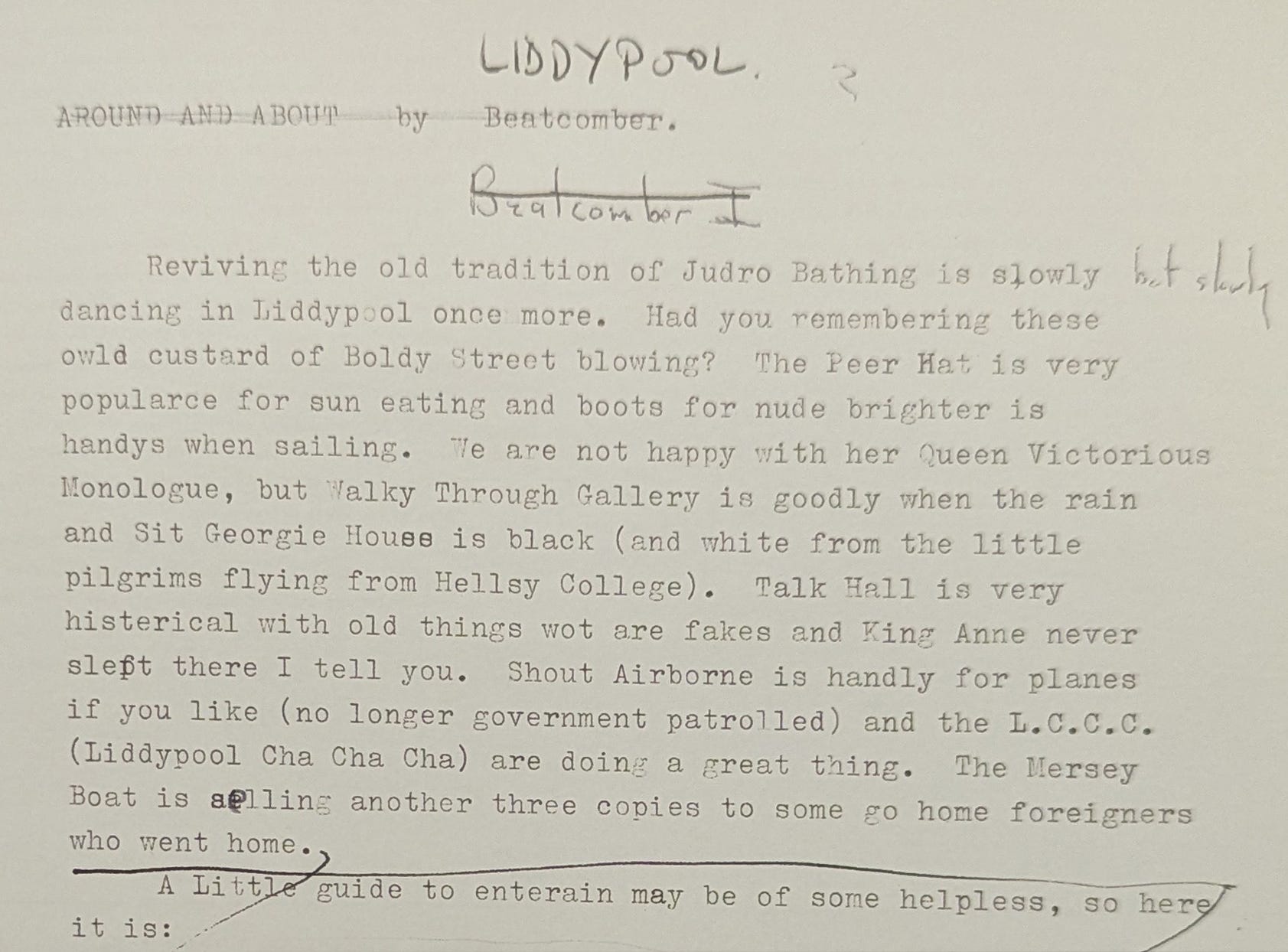
Notice the piece continues, but that whatever follows is crossed out. That’s not John’s pen doing the crossing out — it’s the pen of the editor at the publishing house. Here’s the description of further editorial changes —
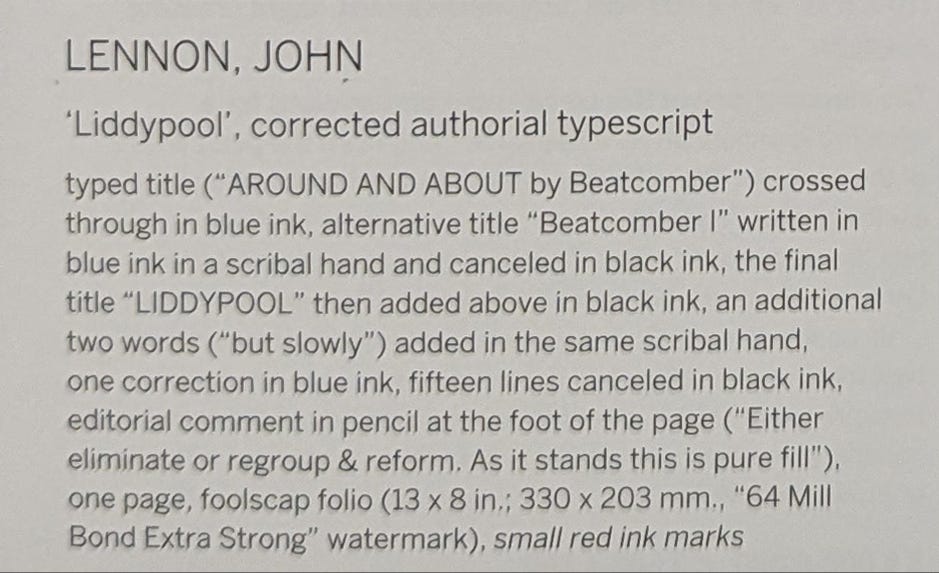
In 1964, when this was written, John did not yet carry enough weight (as it were) to insist on his words being printed exactly as he wrote them — “Liddypool” as published cuts off exactly where the editor’s mark suggests it should.
This tells us that even In His Own Write and Spaniard in the Works are not necessarily John’s exact words just as he intended them to be read.2
John’s third book, Skywriting By Word Of Mouth, was presumably not subject to the edits of the publishing house because, of course, by then John was John Lennon and no editor at any publishing house would likely have altered so much as a single word. But without John there in person to oversee its publication (if indeed he chose to publish it at all), Skywriting was posthumously edited by Yoko Ono. So that book, too, is not John’s exact words exactly as he intended them.
None of which is to say that looking at John’s prose writing doesn’t yield valuable insights — of course it does. But it does mean that — except in cases like “Liddypool,” where we have access to John’s original manuscript — there’s no way to know for sure if what we’re reading in the published books is exactly as John intended it to be read. And that, in turn, means that while parts of John’s books can be taken as exact language, much of it can’t be. And that makes those books significantly less valuable to us as primary source material than they might otherwise be.
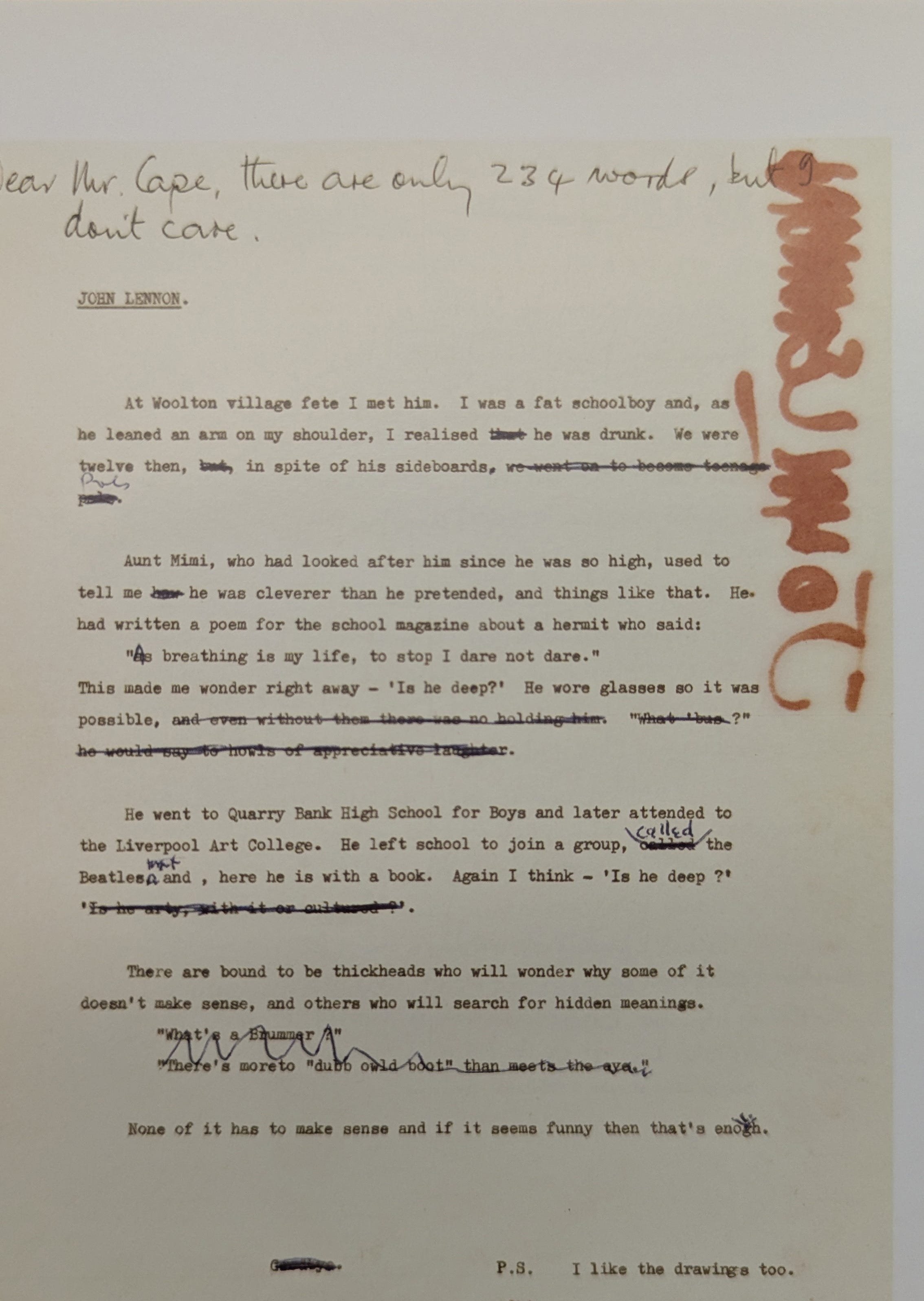
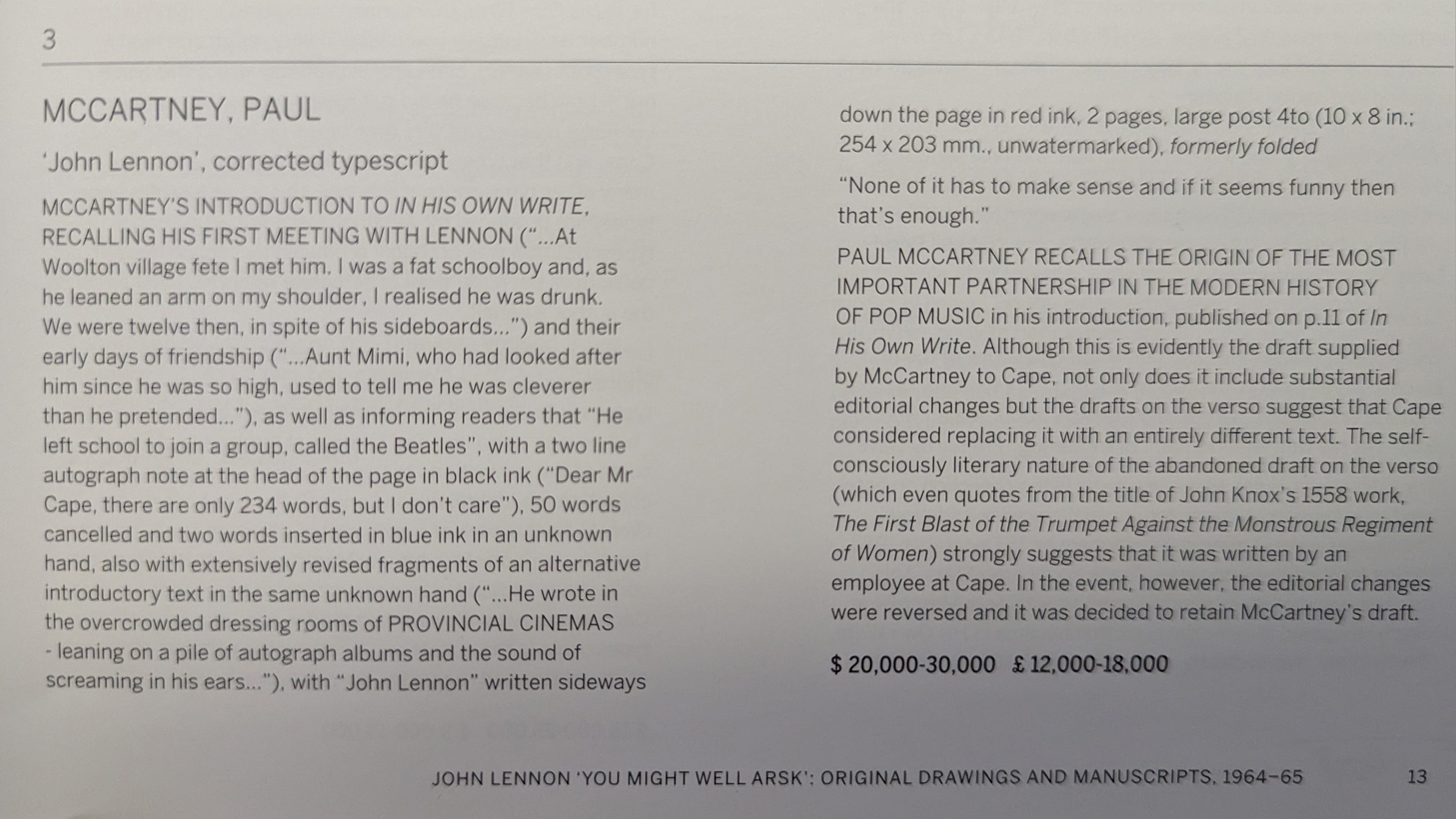
BTW, Paul’s introduction to In His Own Write, in which he briefly recounts meeting John at the Woolton Fete, was also subject to the publisher’s editorial pen. But interestingly, the introduction was ultimately printed exactly as Paul intended it, despite the suggested changes on the original draft below —
Until next week.
Peace, love, and strawberry fields,
Faith 🍓
PS — In the spirit of the day, here’s an account of my experience standing on the very spot John and Paul met—

All material in this update taken from John Lennon: You Might Well Arske: Original Drawings and Manuscripts 1964-5, Sotheby’s auction catalog, June 4 2014. (Northwestern University Special Collections)
Whether the editor was correct in his assessment that “Liddypool” is a stronger piece without whatever follows isn’t relevant here — for our purposes, what matters is that John’s words as published have been altered by someone other than John.
