

“In August 1964, Bob Dylan was taken to meet The Beatles in Manhattan.
It was not a casual arrangement. It was at night, with the curtains closed, in a hotel suite thick with anticipation and smoke.
Having misheard the phrase ‘I can’t hide’ in ‘I Want to Hold Your Hand’ as ‘I get high’, Bob Dylan, who did, thought they did. But they didn’t. So the young poet and his friends, Al Aronowitz and Victor Maymudes, rolled up to the Delmonico Hotel, rolled up a storm and made sure it was a night to remember for The Beatles.
Neil Aspinall, Mal Evans and Brian Epstein were there, and it changed their lives, too.
I was in the suite next door, running a very courtly, if tense, holding operation with a lot of extremely nice Greenwich Villagers and suchlike who were eager to get to hang out with The Beatles, these Rough and Tumble Exquisites from over the ocean. At that time I didn’t know anything at all about marijuana except what I’d heard in legend and the yellow press: that foreigners gave it in ‘reefers’ to unsuspecting virgins in drinking-dens in seaports and ruined their lives.
Scarcely able to restrain my guests, and knowing that under no circumstances were the experimenting Beatles to be ‘invaded’, I went next door alone to find out what was going on and try to arrange some wider access later.
In The Beatles’ lair, I was immediately aware of a very unusual atmosphere. In the middle of it, somehow epitomising it, was the bright eyed Dylan: very thin, dressed in black, and laughing; a mysterious fragile bird of youth.
‘It’s as if we’re up there,’ Paul said to me, grabbing my arm and pointing to the ceiling. ‘Up there, looking down on us!’ George Harrison, the Quiet One of Beatles Myth, wrote later: ‘It was an amazing night and I woke up the next day thinking: “What was that? Something happened last night. I felt really good. That was a hell of a night.’”
Now, if they could not hide, The Beatles could and did get high. It was a great day’s night.”1

This is how the story is told — on August 28 1964, at the Delmonico Hotel in New York City, Bob Dylan met The Beatles for the first time, and introduced them to cannabis.
This telling of the story — the version above is from former Beatles publicist Derek Taylor — is taken as definitive in virtually every book and documentary about The Beatles.
That word “definitive” is tossed around a lot in mainstream Beatles writing, usually by PR departments at publishing companies who know they can lure buyers — not to mention fluff up the egos of their writers — by splashing that word on book jackets.
But “definitive” is a dangerous and foolish word to use in proximity to the story of The Beatles. And as we’re about to discover, the story of The Beatles, Dylan, and the Delmonico Hotel is a very good example of why.
In researching the events of August 28 1964, I’ve discovered that almost nothing we’ve been told about those events is quite what it’s been said to be. And that there’s a deeper and more profound story hidden in plain sight beneath the version of the story that’s been told all these years.
Untangling this deeper story will take us from pre-fame Liverpool to the eye of the storm of Beatlemania to the studios of Abbey Road and eventually — although we will snip the thread before we get there in this series — to the breakup of The Beatles and the breakdown of the relationship between John and Paul.
Before we get started with all of that, a few meta notes.
First, if you haven’t yet read the Preface to Seven Levels, I encourage you to do so before continuing on with this chapter. While I get the desire to skip the introductory formalities, I think you will be happier if you begin at the beginning, because this series is a little unusual—
—as we talked about in the Preface, Seven Levels is something of a hybrid. It’s a bridge between Part One and Part Two of Beautiful Possibility and it’s also a standalone series all on its own.
That means that you do not need to be familiar with Beautiful Possibility to follow along with Seven Levels. But at the same time, because Seven Levels builds on what we covered in Part One of Beautiful Possibility, you will, of course, have a richer experience if you’re familiar with what came before.
Much of what we talked about in Part One of Beautiful Possibility was complex and often delicate, and required all of Part One to step through. As such, it’s difficult and often impossible to summarize that material in a respectful and accurate way. That said, for those of you who are not yet familiar with Beautiful Possibility, I’ll do my best to help you out with some quick summaries as we go along — in the main text if it’s not too distracting, and in footnotes otherwise.
Those of you who are already familiar with Beautiful Possibility will notice that in these initial chapters, we’re going to hold back any discussion of the major themes of Part One — most notably about the relationship between John and Paul. This is not because we’re backing away from progress made in Part One. It’s to give new people a chance to get to know and hopefully trust what we’re doing here on The Abbey before venturing into more provocative territory. But we will catch up with what we talked about in Beautiful Possibility beginning in Chapter Three.
The other obvious question, of course, is why I’m choosing to tell this story on its own instead of folding it into Part Two of Beautiful Possibility.
Answering that question will need to wait until the end of Seven Levels, when we’ll put all of the pieces together, including why this series is what and when it is relative to Part Two. Until then — as I did in Part One — I ask for your patience and trust that we’re doing things the way we’re doing them for a reason.
Finally, before we get started on our trip back to August of 1964, I should caution you up front that we’re going to need to get a bit egg-heady for most of this first chapter and a bit of the second. Some of you enjoy that part of things, and bless you for it because so do I. But I know others of you are here for less wonky reasons. So again, I ask for your patience and trust that there’s a reason for the way we’re doing things — and we’ll get to that reason at the end of the series.
To help make our story easier to follow and also because these are going to mostly be longer-than-usual chapters, I’ve put most of the supporting research throughout the entire series in the footnotes, rather than in the main text.
So with all of that said, it’s time to get started by winding the clock back to New York City on August 28 1964, where The Beatles and their royal court are ensconced in a luxury suite at the Delmonico Hotel.
Before we can tell the deeper story hidden beneath that accepted story, we first need to understand what’s wrong with the accepted story. And that means we need to take a look at what the primary research — meaning the research from people who claim to have been there — tells us about the events of August 28 1964, or what we’ll shorthand as “the Dylan story.”
Of the four Beatles, only Paul seems to have told the Dylan story in any kind of detail, at least as far as I can tell from my research — so let’s begin with his telling of it.
Paul tells an extended version of the Dylan story in his 1997 quasi-memoir Many Years From Now and a shorter but still detailed version in his 2022 book, The Lyrics, and also occasionally in interview. He’s been rock-solid consistent with how he tells it over the years — which is in and of itself unusual when it comes to anything the Fabs say about their own story.
Here’s the first part of Paul’s most recent telling of the Dylan story, from The Lyrics (edited for length) —
“Until we happened upon marijuana, we’d been drinking men. We were introduced to grass when we were in the US, and it blew our tiny little minds... We were just drinking, as usual, having a little party. We’d ordered drinks from room service — Scotch and Coke and French wine were our thing back then — and Bob had disappeared into a back room. We thought maybe he’d gone to the toilet, but then Ringo came out of that back room, looking a bit strange. He said, ‘I’ve just been with Bob, and he’s got some pot,’ or whatever you called it then. And we said, ‘Oh, what’s it like?’ and he said, ‘Well, the ceiling is kind of moving; it’s sort of coming down.’ And that was enough.”2
Paul has a lot more to say about this night, and we’ll get to that in the next chapter — because what he has to say is different from the other three Beatles in ways that are going to become important.
For now, let’s notice again that Paul has been both specific and consistent over the years — in both of his published memoirs and, as far as I can tell, in interview — in claiming that The Beatles were introduced to cannabis by Bob Dylan during their first American tour in 1964 — though he doesn’t specify a date — and that the Great Initiation took place in Manhattan at the Delmonico Hotel.
Paul’s detailed and consistent account of the Dylan story makes it understandable that his version is considered definitive in Beatles writing — both mainstream and countercultural. In fact, Paul’s telling of the story is so detailed and consistent that even mainstream writers who are otherwise not in any way inclined to ever believe Paul about anything else believe Paul’s version of the Dylan story.3
But as usual when it comes to the story of The Beatles, things are not quite what they seem. And to understand what I mean, let’s for the moment set aside Paul’s version of the Dylan story and consider what the others who were there have to say about that infamous night.
We’ll come back to what John, George, and Ringo have to say about all of this — because John, George, and Ringo’s versions are also not what they seem. For now, let’s consider the accounts of those in The Beatles’ royal court who were reportedly there that night — Beatles’ manager Brian Epstein, roadies/personal assistants Neil Aspinall and Mal Evans, and press agent Derek Taylor.
Neither Brian, Neil, nor Mal appear to have ever publicly told the Dylan story — which isn’t surprising, given the extreme vigilance all three of them demonstrated in protecting The Beatles from any hint of scandal.4 Remember that in mainstream culture during Brian, Mal, and even Neil’s lifetimes, smoking cannabis was both very scandalous and very illegal.
That sort of thing did not, it seems, trouble press agent Derek Taylor. We began this chapter with Taylor’s telling of the story, and you might remember that he begins with, “It was not a casual arrangement. It was at night, with the curtains closed, in a hotel suite thick with anticipation and smoke...” which is vintage Derek Taylor-style storytelling in that it’s light on detail and heavy on ambience.
And that means that already things are tricky, because even beyond his tendency to sacrifice precision for poetry, taking Derek Taylor as a reliable primary source is an iffy proposition.
On one hand, he seems to possess the unique ability to be both unfazed by the dazzle of his proximity to The Beatles, while still somehow being fully in thrall to that dazzle. This duality gives Taylor a certain passionately dispassionate clarity of vision absent from that of most primary sources.
But Derek Taylor was also a publicist, not just by profession but — it seems — by natural temperament. In modern parlance, he’d be termed a spin doctor — but what he more truly was, I think, was an especially good storyteller. And that means that — by his own admission — he sometimes nudged a story a little bit to get it where he wanted it to go. And that means that despite his overall ability to see past the stars in his eyes, Derek Taylor is a source to be careful with when it comes to taking his words literally.5
All of that said, what detail Taylor does offer is consistent with the accepted version of the story — The Beatles, Dylan, the Delmonico Hotel, the introduction to cannabis.
Beyond the Beatles’ royal court, there is, of course, Bob Dylan, who was obviously there as well, and whom one might think would have something to say about all of this. But it seems not. Dylan doesn’t mention the story in his autobiography, nor in any of the interviews I’ve found — though admittedly since I’m not a Dylan scholar, I’m probably not looking in the best places.
Instead, we’re left to consider Dylan’s take on the Great Initiation based on what others have said about what Dylan said — which is, of course, less than ideal, but it’s what we’ve got.
Derek Taylor talks in It Was Twenty Years Ago Today about reconnecting with Dylan in 1986, and Dylan asking him for the name of the hotel where Dylan and The Beatles first met. “The Delmonico,” Taylor reminds him. “That was it!” Dylan reportedly replies. “That was a night!”6
It’s tempting to take Dylan’s “That was a night!” as confirmation of the accepted version of the Dylan story, especially since Taylor shares his conversation with Dylan as the grand finale of his own telling of that story. And it’s possible that’s exactly what it is. But we can’t know for sure, because Dylan’’s “That was a night!” is non-specific — it’s a generic comment on the vibe of the evening, and Taylor doesn’t give us enough information to know what Dylan was specifically referring to.
You might be thinking that all of this is splitting hairs — of course Dylan was including the Great Initiation in his pronouncement. And I’m inclined to agree — except consider this story from musician Mike Campbell, formerly of Tom Petty’s Heartbreakers.
Campbell remembers being in the studio with George and Dylan in 1987, and George teasing Dylan about having turned The Beatles on to cannabis in New York. Campbell describes George and Dylan going “back and forth about it like old pals on a park bench, laughing and squabbling,” and the exchange ending with Dylan looking over to Mike Campbell, shaking his head, and “dismissing [the suggestion] completely.”7
Campbell also specifically remembers George telling Dylan that “we came to New York and you turned us all on to grass,” which is probably not an exact quote given Campbell is writing in 2025 about a conversation in 1987. But it’s nonetheless weak confirmation of the accepted version of the Dylan story — albeit from George, not Dylan.
We’ll come back to George later in this chapter. What we’re concerned with here is the contradiction between Mike Campbell and Derek Taylor. In Campbell’s account, Dylan flatly denies the Delmonico story, and in Taylor’s account, Dylan enthusiastically recalls it. And there’s no particular reason to think one version is more credible than the other — because while we know something about Derek Taylor as a source, I don’t know much about Mike Campbell as a source and I don’t know how reliable he is compared to Derek Taylor.
There are multiple potential ways of resolving this contradiction. We won’t go through all of them, but here’s the one I think is most plausible—
Paul mentions in a 2020 podcast interview that he’s heard that Dylan doesn’t like being labeled as the person who introduced The Beatles to pot.8 Paul’s reference to having “heard” this piece of information suggests it’s a bit of gossip that he’s getting second or third or fourth hand, rather than something he heard directly from Dylan. If that gossip is true, then Dylan’s reluctance to be identified with the Delmonico story might be why he denied it to George in the Campbell anecdote, and also why he didn’t mention it in his autobiography or — again, as far as I know — in interview.
As far as why Dylan might have been willing to acknowledge the Great Initiation to Derek Taylor but not to George, the difference might be between a private and a public setting.
Derek Taylor’s exchange with Dylan appears to have been a private conversation between two old friends who’d shared a unique experience that night in 1964.
Conversely, the conversation with George — obviously also an old friend who’d been there that night in 1964 — was in a recording studio in the presence of Campbell, who might have been an old friend (I don’t know), but who was not there when the events happened. If Dylan doesn’t like being known as the person who turned The Beatles on to pot, it’s possible — and even likely — that he was performing his denial for Campbell’s benefit (and also maybe to take the mick out of George).
Dylan’s road manager Victor Maymudes (basically Dylan’s “Mal Evans”) doesn’t seem to have shared Dylan’s reluctance about telling the story of the Great Initiation. Again, not being a Dylan scholar, I don’t know how reliable Maymudes is as a source — but in recordings made before his death in 2001, Maymudes tells a detailed story of the events of August 28 1964.
Maymudes’ story is similar to the accepted version — that Dylan met The Beatles for the first time at the Delmonico Hotel in Manhattan during The Beatles’ 1964 tour, and turned them on to cannabis. In fact, Maymudes claims he was the one carrying the weed, a not-inconsiderable risk, in 1964.9
But Maymudes’ version of the story differs from Paul’s and Derek Taylor’s versions in one notable way — Maymudes claims Dylan did not smoke a joint at the Delmonico. Instead, “Bob had a couple of drinks and within an hour, he passed out on the floor.”10
Given that Maymudes was essentially Dylan’s Mal Evans, he was presumably not inclined to make up details that make Dylan look less than cool. So it seems likely this is an accurate recollection, and also maybe why Dylan doesn’t like telling the story.
To conclude our roll call of people claiming to be in attendance (conscious or otherwise) at the Delmonico Hotel on that historic occasion — minus the other three Beatles, which we will get to — there seems to have been at least one journalist present. And this is in and of itself odd, given the potential consequences if word about The Beatles (and Dylan) smoking cannabis had gotten out at the time. But then again, maybe it’s not so odd, given the general discretion of the journalists around The Beatles at the time.
Saturday Evening Post writer Al Aronowitz claims in his 2003 self-published book that he was the one who orchestrated the first meeting between The Beatles and Dylan, and that — again — the Great Initiation took place at the Delmonico Hotel in New York City, on August 28 1964, and that Aronowitz was present for that meeting.
This is consistent with the version of the story told by Paul, Derek Taylor and Victor Maymudes, minus the part about Dylan passing out, and also maybe consistent with Dylan’s version if Derek Taylor is right, and George’s version, if Mike Campbell is right and Dylan was taking the mick.
So if Paul and Derek Taylor and maybe George say Dylan introduced them to cannabis in New York in 1964 at the Delmonico Hotel, and if Victor Maymudes and Al Aronowitz agree, then what’s the problem? And with all due respect, Faith, why are you bothering us about all of this?
This is more or less the position that Beatles writers — mainstream and countercultural — tend to take. And in light of all this agreement, it’s easy to see why this version of the Dylan story is considered definitive in Beatles writing.
But as I’ve suggested, things are a bit more complicated than they might seem.
For one thing, there’s the matter of Ivor Davis, a freelance investigative journalist who was embedded with The Beatles on their 1964 US tour.
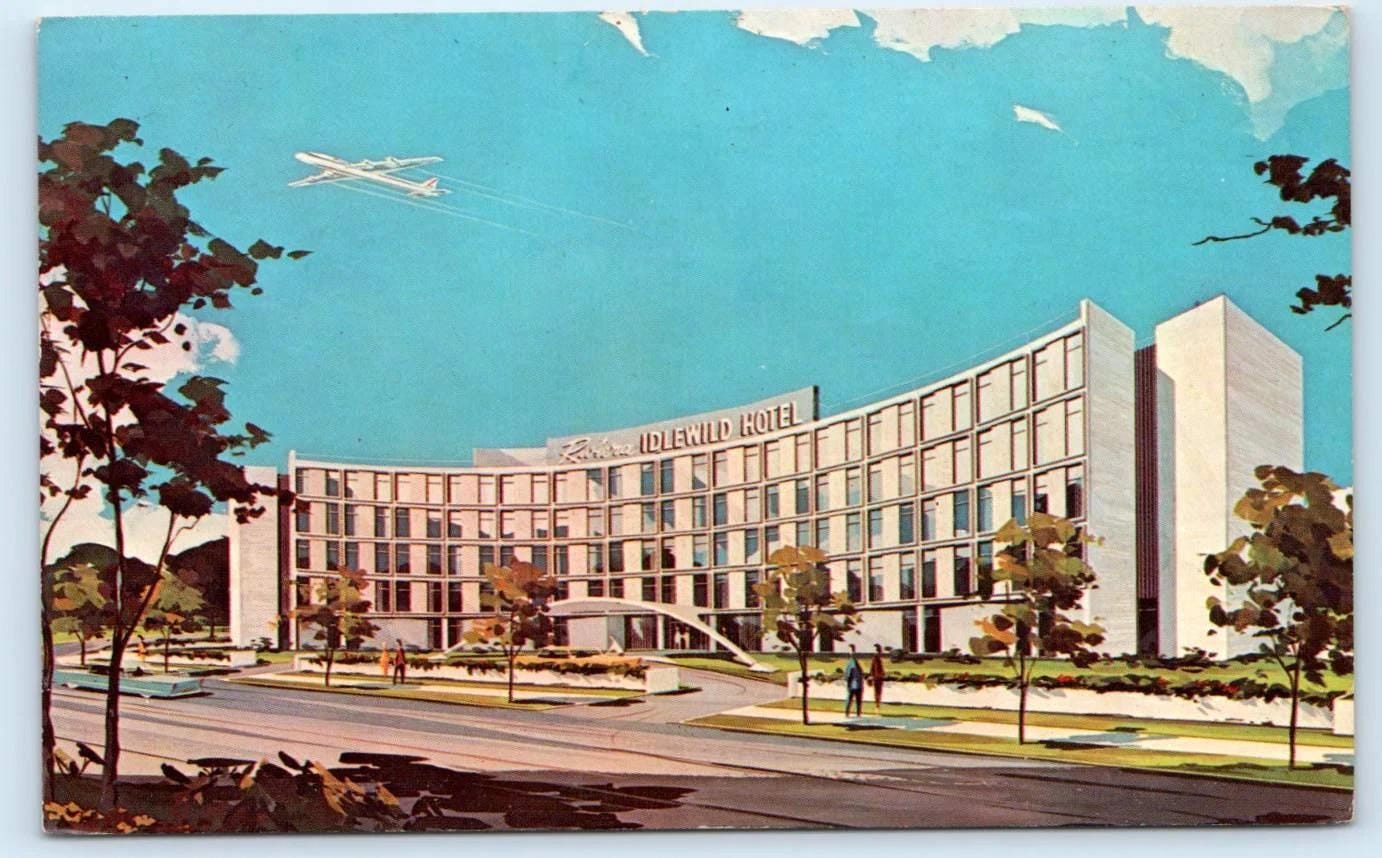
Davis agrees that Dylan and The Beatles smoked pot together in 1964. But Davis claims — with a significant amount of credible detail to support his claim — that while Dylan did first meet The Beatles at the Delmonico, the Great Initiation happened not in August of 1964 at the Delmonico Hotel in Manhattan, but a month later at the “unpretentious Riviera Idlewild Motel” in — wait for it — Jamaica, New York, on their final night of the tour.
Oh, and Davis claims he was the only journalist present for that occasion, and that Al Aronowitz is making his version of the story up.11
Davis and Aronowitz’s accounts of the Great Initiation are, obviously, mutually exclusive. The first time The Beatles smoked pot with Dylan was either in August at the Delmonico Hotel in Manhattan or in September at the Riviera Idlewild Motel in Jamaica (New York) — but it can’t be both.
So what gives? How is it possible for anyone — especially a journalist supposedly trained in the powers of accurate observation — to be flat-out wrong about whether they were in attendance when Bob Dylan turned The Beatles on to pot?
I doubt very much that this is a simple failure of memory on either Davis or Aronowitz’s part. Paul and Derek Taylor might simply be getting their dates and places confused, because if you’re Fab — or even Fab-adjacent — in 1964, even the historic occasion of being introduced to pot by Bob Dylan would have been just another very busy day in the life, with almost every night in a different city, and all of it at the white hot centre of the global firestorm of Beatlemania.
But the Dylan story would not have been just another day in the life of a humble journalist — be it Davis or Aronowitz — who was privileged to witness the event. So what’s going on here?
The obvious explanation for the disparity in the two journalists’ accounts of the Dylan story is, of course, ego — or to put it more charitably, the desire to bask in the reflected glory of having been there when it happened—
—which is exactly what Davis accuses Aronowitz of, relative to the Dylan story.
There’s a lot of reflected glory in being able to claim that you were present at a culturally significant event — especially when you’re a journalist, and especially when that culturally significant event involves being present in a 1964 hotel room with The Beatles, Bob Dylan, and a fat baggie of Acapulco Gold.12
This gets to what we talked about in Part One relative to the challenge with primary sources — that virtually everyone in a position to have anything first-hand to say about The Beatles is continually angling to position themselves as having been closer to the centre of the circle than the next person. And often closer than they themselves actually were.
The math here is simple — the closer to the center of the circle, the more cultural status is up for grabs, and the more authoritative the person in question can claim their version of events to be. This is easily seen in the disproportionate number of book promos that begin with “______ was there when The Beatles ______.”13
And indeed, the title of Aronowitz’s book is Bob Dylan and The Beatles, and the first words are “In which I introduce the Beatles to both Bob Dylan and the evil weed, something that makes me believe (here he goes to ALL CAPS) — THE ‘60S WOULDN’T HAVE BEEN THE SAME WITHOUT ME.” And the first line of Aronowitz’s Wikipedia entry tells us that “he was best known for introducing the Beatles to Bob Dylan.”
But this is a bit of a pot/kettle/black situation. Because Davis, too, has built his professional brand on having been present at culturally significant events. In fact, the opening paragraph of his biography on his website describes him as “a hybrid Forrest Gump” — Forrest Gump, of course, being shorthand for accidental presence at multiple culturally significant events.14 The title of the documentary made about Davis’ life is I Was There — A Reporter’s Story. And the title of Davis’ own book is The Beatles and Me On Tour, which is another way of saying “Ivor Davis was there when The Beatles...”
To be clear, there’s absolutely nothing wrong with any of this in and of itself. Assuming that what’s being reported is accurate, being present at culturally significant events and then writing about them is literally what journalists are supposed to do. And as a Beatles scholar, I’m grateful that both Davis and Aronowitz have chosen to share their stories, even if they are contradictory. Also, if I’d been the one to introduce the Fabs to both Bob Dylan and weed, I’d likely be eager to bask in some reflected glory, too.
The problem is that just because someone could plausibly have been present for a culturally significant event doesn’t mean they actually were. And given the cultural status (and book sales) up for grabs, it’s easy to give in to the very human temptation to embellish — or just flat out invent — first-hand knowledge of the events of the story.
By definition, this is what either Aronowitz or Davis (or maybe both) are doing with the Dylan story. Because again, the first time Dylan smoked pot with The Beatles was either in August at the Delmonico Hotel in Manhattan or in September at the Riviera Idlewild Motel in Jamaica (New York), but it can’t be both.
To try to sort this out, let’s first notice that even before we get to the Dylan story, there’s a significant credibility gap between Aronowitz and Davis.
Al Aronowitz lived an undeniably colourful life as a rock journalist who managed the Velvet Underground and hung out with Ginsberg and Kerouac, and of course, Bob Dylan, and maybe one night, also with The Beatles. Unlike Davis, when it came to the 1964 tour, Aronowitz was not an embedded journalist with inside access, except insofar as he was friends with Dylan — not that Davis probably had that much inside information either, given the famously impenetrable Beatles’ inner circle and their tendency to play games with the press.
Also, Aronowitz acknowledges in his book that in later years, both Dylan and Maymudes stopped returning his phone calls. Maybe that’s because Aronowitz made up stories about having been there when Dylan turned The Beatles on to weed, or maybe for some other reason. But it certainly suggests that neither Dylan or Maymudes was happy with what Aronowitz wrote about his time with Dylan.
Davis, on the other hand, was an investigative journalist and New York Times correspondent back when that actually meant something. He was on the ground during the Watts Riots of 1965, covered the assassination of Robert Kennedy in 1968,15 and embedded himself undercover with the Manson family in 1969 — an assignment, btw, not without its dangers. And Davis was among the handful of press embedded with The Beatles on the 1964 tour, and he was also reportedly present the following year when The Beatles met Elvis.16
Davis’ version of the Dylan story is also semi-corroborated by Victor Maymudes, who mentions the Riviera Idlewild Motel in his book, though not by name—
“Later on that week, Bob and I were at a hotel with the Beatles by the airport in Brooklyn. Brian Epstein was hanging out with us now, mainly because the schmoozing was over and it was just the guys, Bob and me. All the other celebrities and industry people had left. John and Paul talked Brian into getting stoned, so he had a couple of hits and then went bananas! He was instantly in the corner freaking out and telling people to leave him alone. He went nuts; he was an extremely insecure guy and the pot exposed that.”17
I say semi-corroborated because it’s not clear to me what Maymudes is claiming in this passage. He makes no specific reference to anyone other than Brian getting high — and while we’re on the subject, his version differs from the accepted narrative in two ways—
First, it places Brian’s newbie weed freak-out at the Riviera Idlewild rather than at the Delmonico. And second, it frames Brian’s newbie weed freak-out as a newbie weed freak-out — a negative experience for Brian, rather than the positive one that’s usually related in the accepted story.
As for The Beatles themselves, presumably John and Paul talking Brian into partaking means that they, too, inhaled, along with Dylan and maybe George and Ringo. And that’s what Maymudes seems to be implying. But again, he doesn’t say that in so many words. Still, it’s weak confirmation of Davis’ version of the story.
But by far the strongest reason to trust Davis over Aronowitz might be what Davis himself has to say about that in his book—
“Among other things, it is most unlikely that Dylan and crew would have risked bringing pot into a five-star hotel under the vigilant eye of not only upwards of one hundred of New York’s finest, but also the intense scrutiny of a beefed-up army of security guards. Additionally, smoking it, even in the privacy of their suite, certainly would have been hazardous to their legal status at a time when arrests for possession of marijuana were frequent and could lead to sentences slightly less than life without possibility of parole.
Then there was Brian — a constant nervous Nellie forever worrying that any bad publicity might capsize not only the spitting-clean image of his boys, but the whole tour. The Beatles were barely a third of the way into a long tour; they had a concert to perform in less than a day, and while uppers and downers were part of their daily diet, any further experimentation could have been considered a tad too reckless.”18
That all sounds about right — and it also matches up with Maymudes’ observation about Brian being willing to let his guard down at the Riviera because it was the conclusion of the tour.
Davis’ analysis gets us to what — for me — is by far the most convincing reason the Delmonico story isn’t credible — which has less to do with primary sources and more to do with simple common sense. As Davis points out, the Delmonico story contradicts virtually everything we know about The Beatles, and especially The Beatles in 1964.
It’s easy to forget that in New York in 1964, possession of cannabis was a serious crime that risked serious prison time — as Davis put it, “slightly less than life without parole,” which isn’t much of an exaggeration. And even if The Beatles avoided prison by virtue of being Fab — which they might well have in 1964 — an arrest for cannabis possession would have made it difficult, if not impossible, to return to America on a future tour, as John, Paul, and George all discovered in the 1970s.
All of this matters, when it comes to the credibility of the Delmonico story — especially given this was America, the “toppermost of the poppermost” that The Beatles had dreamed of and worked towards since 1957.
And if we need a reminder of just how much America meant to them, consider this story from Joe Flannery, an early days Liverpool friend of the Fabs (edited for length) —
“[John and I] would frequently drive down to the Pier Head... and stand at the railings, eating one of those terrible meat pies that they used to sell there and looking out over the narrow expanse of the River Mersey and the vaster margins of the Irish Sea. John was forever dreaming of America. It was as if his spiritual home was across the Atlantic; he ached to play in the USA, the great source of his inspiration...: “I want to be over there; I can almost taste it now... With Brian it feels like it might just happen.”19
In pursuit of their American dream of the toppermost, The Beatles endured the filth of Hamburg, countless low-paying gigs at often violent dance halls, the punishing pace of the touring schedule Brian set for them, and the indignities of their sanitized “mop top” image — all in service of reaching and ultimately redefining that toppermost.
What’s more, in 1964, Beatlemania was still shiny and new and the Fabs weren’t yet jaded and cynical over the frenzy. Consider their celebration in Paris, when “I Want To Hold Your Hand” reached #1 on the US charts — by all accounts an all-night affair overflowing with triumph and joy.
What I’m saying is, The Beatles were not in any way whatsoever motivated to fuck this situation up by getting themselves arrested for weed during the tour or at any other time.
There’s more, too, as Davis also points out.
When The Beatles stayed at the Delmonico in August 1964, they were in the middle of their first and most important tour of the US. They had a performance the following day at Forest Hills Stadium, which was without question the most important concert of the tour because it was in New York City, which was without question the most important city of the tour, because New York at that time was without question the most culturally important city in the world.
Obviously, The Beatles took much of their unprecedented fame with a wink and a snarky comment, which is part of why the world’s press fell in love with them. But the one thing they never seem to have done — ever — was to be intentionally careless or unprofessional with their music, either in the studio or in concert. Whatever else was happening between and around them, The Beatles took their music seriously and they were fiercely protective of their ability to make that music, rejecting anything they believed would compromise the recording and performance of it.
I’m not sure how much we need to document that protectiveness, but here are just a few of many examples—
When The Beatles signed with Brian, they made clear that he was not allowed to mess with their music, which was notably different from other management-artist relationships of the time.20
During their first recording session at EMI in June 1963, instead of going to lunch during the midday break, The Beatles stayed behind in the studio to rehearse— something the studio staff has said they’d never heard of any group ever having done before.21
After the 1965 Shea Stadium concert, immediately upon leaving the stage, Paul reportedly told photojournalist Robert Whitaker that “I wish we could have given them more.”22
Even in later years, when The Beatles became jaded and cynical about the absurdities and indignities of touring, that professionalism and dedication to the music never wavered.
When an unexpectedly respectful Japanese audience allowed their music to be heard rather than screamed over, The Beatles realised their musicianship had slipped. They fit an extra rehearsal into their tight schedule so they could perform the following night’s concert at the standard they expected of themselves.23
And at the end of the ‘66 tour, when The Beatles made the decision to stop touring and to focus exclusively on studio work, that decision was made in large part because the public hysteria was compromising their musicianship.24
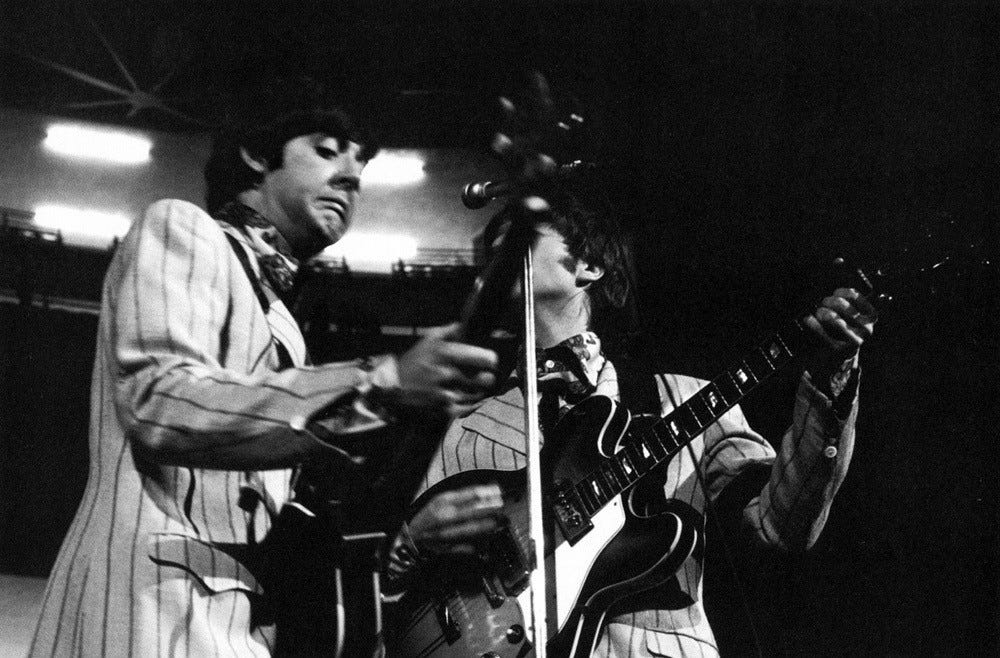
In the studio, The Beatles had a strict policy of not allowing their experiments with mind-altering substances to compromise their music. If anything — as we’ll talk about in the next chapter — their primary motivation for experimenting was to enhance their creative process.25
It’s true that The Beatles have acknowledged being too stoned to function on the set of the movie Help! — which was not long after the end of the 1964 tour.26 But there are no reports whatsoever — during the recording of the soundtrack for Help! or at any other time — of the Fabs being too stoned to record their music in the studio — with one accidental exception, which we’ll get to in a later chapter. Maybe there were occasions like that, and maybe those occasions were covered up — but I don’t think so. I think it’s simply not who The Beatles were, either as a band or as individuals.
The Beatles’ commitment to the quality of their performance was demonstrably true even in the midst of the breakup. The White Album, the Get Back sessions, and Abbey Road speak for themselves. And as Ringo told Dan Rather in 2018, “We had rows. But it never got in the way of the music. No matter how bad the row was, once the count-in, we all gave our best.”27
And if all of that was true during the worst of their times together — when they were burned out and exhausted and estranged — then it was certainly true in 1964, when they were still savouring having not only reached, but redefined, “the toppermost of the poppermost,” the focus of their aspiration and ambition since the first notes they ever played together.
And even if all of that wasn’t true, in 1964 The Beatles were still obedient to their subversive “mop top” image, and to Brian’s directives on maintaining that image.28 And as Davis points out, it’s highly unlikely that Brian — assuming he was indeed present for the Delmonico party — would have allowed “his boys” to risk everything just for the sake of an experiment in altered consciousness.29
This is, of course, speculation — on Davis’ part and on mine — but I think only just barely. Simply put, the Delmonico version of the story is contrary to common sense, emotional truth, and The Beatles’ own careful stewardship of their image and — more importantly — their music.
On the other hand, the Riviera Idlewild Motel was after the conclusion of the tour, on The Beatles’ final night in America — an out-of-the-way motel near the airport and far from the spotlight of downtown Manhattan. There are no reports of fans or press (other than Davis) discovering their location, and no reports of the massive police and security presence that accompanied them at the Delmonico.
And with the pressure of a triumphant, history-making tour behind them and no immediate need to perform or record, The Beatles would almost certainly have been ready to unwind and celebrate, and free to do a little lifestyle experimenting with minimal risk to their image, their music, and for that matter, their personal freedom.
All of which is to say that I don’t think there’s any doubt that the Riviera Idlewild is the more credible setting for the Dylan story, and by a large margin.
But if you’re thinking this clears everything up, it doesn’t—
—because none of that common sense reasoning explains Derek Taylor agreeing with Aronowitz and Victor Maymudes that the Great Initiation happened at the Delmonico. Nor does it explain George insisting to Dylan that it happened at the Delmonico — if Campbell’s story is accurate. And it doesn’t explain Paul insisting for at least the past three decades that the Great Initiation happened at the Delmonico. For sure, The Beatles don’t need to feed their egos by claiming to have been present at a culturally-significant event. The Beatles are the culturally-significant event.
One possible explanation is that the Fabs’ memory of the two nights could have blurred together into a single night.
It’s easy to see how this might have happened, and it goes back to that “just another day in the life” situation. Meeting Dylan at the Delmonico vs getting high with Dylan at the Riviera Idlewild Motel might be a relevant difference to a journalist or a Beatles historian. But it’s maybe not such a relevant difference if you’re a Beatle — or a Beatle press agent — on that first tour of America in 1964 in the eye of the global tsunami of Beatlemania, during which being introduced to weed by Bob Dylan was just one in a seemingly endless succession of extraordinary, unprecedented events.
The problem is that an accidental blurring of two nights into one doesn’t explain why Paul, George, Derek Taylor — and for that matter, Al Aronowitz — all individually conflated those two nights into a single night in almost exactly the same way — especially since Maymudes, Aronowitz and Davis were not Beatles. And for anyone who was not either Fab or Bob Dylan, being there when The Beatles were introduced to weed by Bob Dylan would not have been just one in a seemingly endless succession of extraordinary, unprecedented events that all blur together — but rather a peak experience that would define their professional identities for the rest of their career (as it has for both Aronowitz and Davis).
So maybe the conflation from two nights into one wasn’t accidental, but intentional. Maybe The Beatles decided it was simpler to leave the Riviera Idlewild out of the Dylan story entirely and set the whole of it at the Delmonico. And maybe The Beatles instructed their inner circle — which by a loose definition included Derek Taylor — to go along with the revised story.
But that doesn’t work, either. Because if the conflation of the two nights into one night was intentional, that doesn’t explain why Maymudes claims the Great Initiation was at the Delmonico, if that’s not where it actually happened.
Maymudes wasn’t anywhere close to being in The Beatles’ inner circle, and he was thus not subject to any edicts the Fabs may have handed down to their royal court on how to tell the story. For the intentional conflating of two nights into one explanation to work, Maymudes would need to be misremembering those events accidentally in exactly the same way that The Beatles were rewriting them intentionally—
—because while it’s theoretically possible that Maymudes was asked to alter his version of events, it seems beyond unlikely that The Beatles would have bothered to chase down every single person who was with them at either the Delmonico or the Riviera Idlewild to make sure everyone had their stories straight. That would be weird — weird enough that by now we’d probably have heard about it from someone. Probably Ivor Davis.
All of which is to say that I don’t think we’re ever going to know for sure whether the Great Initiation happened at the Delmonico or the Riviera Idlewild Motel or both or some whole other place. Nor are we likely to know who inhaled on which of the two nights.
I got us lost in this maze of contradictions so you’d have a real-time, felt experience of the way primary sources jostle to position themselves as close as possible to The Beatles — and how that makes researching The Beatles deeply problematic. And this is a relatively simple and contained example that doesn’t even factor in the overall biases we talked about at length in Part One of Beautiful Possibility — the distorted narrative and the fear of softness and the refusal to consider other aspects of The Beatles story that challenge the established narrative.
We’re not quite done with the primary sources for the Dylan story — because even if we could determine for sure where and when the Great Initiation happened and who was there, it’s not at all clear that it even was a Great Initiation at all.
And that brings us — at last — to what John, George, and Ringo have to say about all of this. But if you’re thinking they’re going to swoop in and fix the inconsistencies, well — not exactly.

If you’ve read Anthology recently, you might remember that while John agrees that The Beatles met Dylan in 1964 in New York and a good time was had by all, John does not agree that the occasion was their introduction to cannabis—
“The drugs were around a long time. All the jazz musicians had been into heavy dope for years and years — it’s just that they got in the media in the Sixties. People were smoking marijuana in Liverpool when we were still kids, though I wasn’t too aware of it at that period. All these black guys were from Jamaica, or their parents were, and there was a lot of marijuana around. The beatnik thing had just happened. Some guy was showing us pot in Liverpool in 1960, with twigs in it. And we smoked it and we didn’t know what it was. We were drunk.”30
George also doesn’t seem to think that 1964 was The Beatles’ first time smoking pot. Here’s his version of the story, also from Anthology—
“We first got marijuana from an older drummer with another group in Liverpool. We didn’t actually try it until after we’d been to Hamburg. I remember we smoked it in the band room in a gig in Southport and we all learnt to do the Twist that night, which was popular at the time. We were all seeing if we could do it. Everybody was saying, ‘This stuff isn’t doing anything.’ It was like that old joke where a party is going on and two hippies are up floating on the ceiling, and one is saying to the other, ‘This stuff doesn’t work, man.’”31
George doesn’t give us a specific timeframe for this memory, but we can take a pretty good guess. Assuming he’s got the venue right, The Beatles played Southport regularly between 1960 and 1963, and given the Twist reference, George’s memory is most likely from sometime in 1962.
And then there’s Ringo, whose telling of the Dylan story closely matches Paul’s version — except that it doesn’t.
Ringo doesn’t speak to the Dylan story in the printed version of Anthology, but he has occasionally told the story in interviews. And when he does, his version loosely matches the accepted narrative — Dylan at The Delmonico in 1964.32 But in episode four of Anthology, Ringo also says that New York in 1964 was the first time he “really” smoked pot, implying that there was at least one time before the Dylan story that wasn’t quite so “really.”33
Ringo’s account might be somewhat less relevant here, because he’s speaking only for himself — “the first time I really smoked pot” — whereas both John and George are speaking for the band as a whole, with their use of “we.” Since Ringo didn’t become a Beatle until the latter half of 1962, he might not have been part of that “whole band” experience that John and George describe, which may pre-date Ringo’s joining the band.34
So let’s focus on John and George’s stories, which are similar enough and imprecise enough about timeframe that they’re likely both remembering the same occasion, in recollections offered decades apart and distorted through the vagaries of memory, time, and the haze of pot smoke.
The generally accepted way in which John and George’s Anthology quotes are reconciled with the Dylan story is what we’ll call the Bad Weed Theory.
Victor Maymudes subscribes to the Bad Weed Theory, so I’ll let him give us the details—
“That first night wasn’t actually [The Beatles’] first time trying it, like everyone believes. They had tried it before but they didn’t get high. The stuff they had was cheap and low quality. They knew about hash, that kind of stuff was more popular in Europe. But until that night, they never had the rush. They’d never laughed till tears rolled down their faces.”35
Maymudes’ description is a bad summary of the effects of weed and a good summary of the Bad Weed Theory.
The problem is that Maymudes doesn’t tell us how he came by his information — at least not in his book. It’s possible and maybe even likely that The Beatles told him directly — it’s certainly consistent with the Anthology quotes. But since Maymudes’ recordings were made shortly after the publication of Anthology, it’s also possible he’s adding the Bad Weed Theory after the fact, based on Anthology. Maymudes died in 2001, so there’s probably no way to know.
That said, you can probably already see that the Bad Weed Theory has some merit.
John’s reference to “twigs” certainly suggests they were smoking low potency ‘stems-and-seeds’ rather than the good stuff. And George’s description of whatever they smoked in early days Liverpool “not doing much” suggests the Baby Fabs were not especially inspired by the experience. That is, until 1964, when— so the theory goes — Dylan showed up in New York with the grade-A good stuff and — as Paul puts it — “blew our tiny little minds.”
But based on just John and George’s accounts, the Bad Weed Theory is far from solid.
George’s likening of their early days experience to the two hippies floating on the ceiling saying“this stuff doesn’t work man” suggests that the cannabis they smoked in Liverpool worked just fine and they simply didn’t realise it. And the reason for that might be found in John’s observation that “we were drunk.” Because while for most people, being drunk is a markedly distinct experience from being high, it’s also generally a much more brute-force experience that can easily mask the more subtle effects of cannabis — especially if you’re new to those effects.
Whether or not The Beatles actually experienced the more nuanced effects of a cannabis high during their early days experiment matters. Because there’s a big difference between Dylan “introducing” The Beatles to cannabis and Dylan “turning the Beatles on” to cannabis — and that difference is going to become important in future chapters.36
Up till now, we’ve been using the terms “introduced to” and “turned on to” somewhat interchangeably. But those two terms are not actually interchangeable. Being “introduced to” vs “turned on to” cannabis are as different from one another as losing your virginity vs having your first orgasm — two experiences that, for a woman, rarely, if ever, coincide.37
Either way — “introduced to” or “turned on to” — at the least, the John and George Bad Weed quotes seem to make clear that The Beatles were introduced to cannabis well before they met Dylan. And you might be wondering why it’s taken us so long to get to those quotes. After all, both are from Anthology, which is the official story of The Beatles, told by The Beatles in their own words. When it comes to primary sources, that’s as good as it gets, right?
Well... here’s where we need to talk about Anthology — which I keep putting off because Anthology gets me grouchy because, really, it gets me sad and I get grouchy when I’m sad, which is why I keep putting off talking about Anthology.
But we need to talk about Anthology to get to the bottom of the Bad Weed Theory — because these two quotes seem to be the only extant examples of John and George talking about their early days Liverpool cannabis experiments.38
So let’s take a few minutes now and do that, and then we’ll get back to talking about what the Baby Fabs might have got up to in early days Liverpool.
And while we’re here, a reminder that while we still need to be wonky for a bit longer, all of what we’re talking about here are necessary steps on the way to unfolding the deeper, more complex story hidden beneath all of this madness.

“During an interview with Paul McCartney, he explained how nearly forty years ago the Beatles agreed on a “version of the facts” that would serve as their story, and they stuck to — and embroidered upon — it ever since.” — Beatles biographer Bob Spitz writing in 200839
As most of us know, Anthology is made up entirely of direct quotes, mostly from the Fabs and occasionally from others in the inner circle. It’s literally intended to be The Beatles telling their own story in their own words. The back cover of the original book even says so, in almost exactly those words. And that means Anthology is often cited by both mainstream and countercultural scholars as a rock solid primary research source.
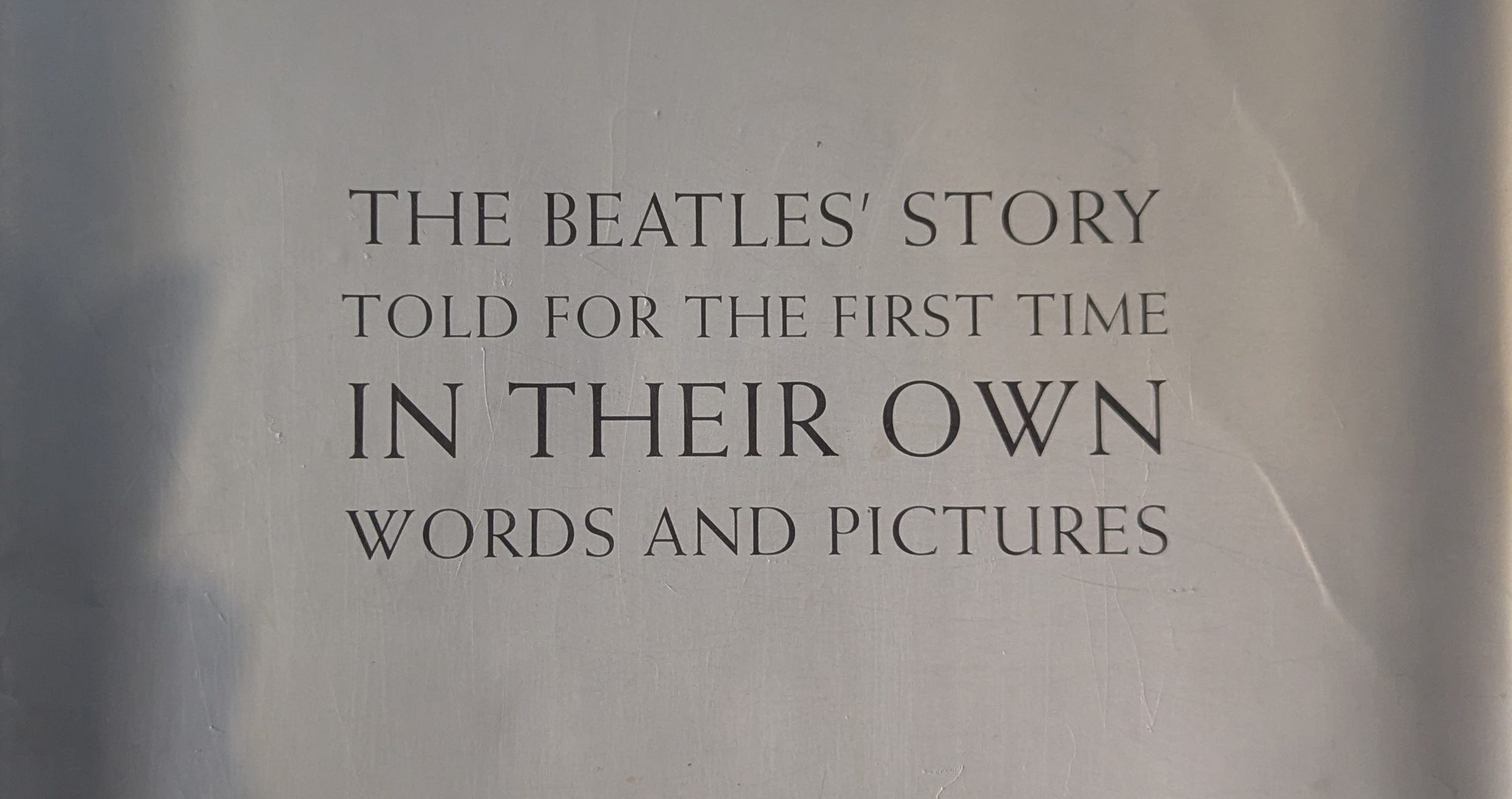
And oh, if only that were true. But as usual, things are not quite that simple.
Some of you might already know that there are two different kinds of quotes in Anthology.
The first kind has a small number at the end of it that looks exactly like a footnote. These footnote-like numbers appear on all of John’s quotes — including the one about The Beatles having first tried cannabis in early days Liverpool — and also on some of Paul, George, and Ringo’s quotes.
One might reasonably assume these footnote-like numbers are, well, footnotes. But they are not footnotes. Instead, they’re the year in which the Beatle being quoted allegedly said the thing he’s quoted as saying. And that in turn tells us that these quotes are from an external interview, rather than from the interviews Paul, George, and Ringo did specifically for Anthology.
Put another way, that means the original source for these quotes is not Anthology, but the publication or program where the quote first appeared.
This matters, because since these “footnoted” quotes are not original to Anthology, they’re not primary research. And that means that to meet the research standard for Beautiful Possibility, we need to be able to verify them at their original source.
The problem is that without actual functional footnotes and with only the year to go on, finding the original source of these quotes is the proverbial needle in a haystack situation.
So for example, John’s early days bad weed quote is “footnoted” as being from 1975. That’s useful — but only just barely, because it doesn’t narrow the search down much. Without an actual footnote, the only way to verify John’s quote is to search through every interview John did in 1975 — which is not reasonably possible, even for a highly motivated researcher who is literally willing to cross oceans for the cause. Many interviews seem to be either no longer available at all, or only available in archives that require special access that the majority of Beatles writers and researchers — including me — do not have.
We won’t go down the rabbit hole of my lengthy search for John’s early days bad weed quote. For those of you interested in the gory details, I’ll put them in a footnote. 40The summary is that the search yielded no results whatsoever, though I did have a nice chat with a very helpful archivist at the National Audiovisual Institute in France.
And that dead-end search means that John’s early days bad weed quote remains — for me, at least — unverified research, despite its inclusion in Anthology.
You might reasonably be questioning why we’d need to verify Anthology quotes at all. This is The Beatles, telling their own story in their own words. Surely the monkey business that happens elsewhere in Beatles writing isn’t happening in Anthology. It’s not like we’re dealing with, oh... say for example, Mark Lewisohn and his history of manufacturing frankenquotes.
But, in fact, that’s exactly who we’re dealing with — Mark Lewisohn is the one who compiled the research for Anthology. And this is why talking about Anthology gets me grouchy-but-really-sad.
We talked in Part One of Beautiful Possibility about the problems with Lewisohn’s research. As I mentioned then, the work done to uncover those problems is not my work — so if you’re interested in those gory details, I’ll put the link in a footnote so you can read the original research.41
The short version is that Mark Lewisohn has a well-documented, decades-long habit of creating “frankenquotes” by gluing together different quotes from different interviews — sometimes years apart — into a single quote and presenting that quote as if it was the exact words that the person being quoted actually said in a single interview at a single point in time, when that is not in fact the case. And to be clear, frankenquoting of the kind Lewisohn engages in is an absolute no-no in any kind of legitimate, credible research and scholarship.
It would be lovely to think that these frankenquotes do not occur in Anthology. But it seems pretty clear that they do.
For example, John’s description of The Beatles smoking pot with Dylan in New York is almost certainly a frankenquote — which is why I haven’t used it in this chapter. As far as I can tell, John never said the words he’s quoted as saying in a single interview. Instead, his Anthology quote about the Dylan story is manufactured from at least two and maybe three different interviews, glued together and presented as if it’s a single quote.42
If there’s one frankenquote in Anthology, there’s almost certainly more. And that means we absolutely do need to verify these quotes before we can trust them as usable primary research. Until and unless we can do that, they’re essentially “ghost quotes” — quotes that might be legitimate, but that can’t be verified.43
And then there’s George’s early days bad weed story, which belongs to the second category of Anthology quotes. These are the quotes taken from the on-camera interviews done with Paul, George, and Ringo specifically for Anthology — the same interviews we see in the Anthology documentary series. In theory, that makes these quotes primary research.
I say “in theory” because we don’t have access to all of the filmed Anthology interview footage — only what was included in the documentary series. The book includes a lot more material than the series does, which by definition means that most of the quotes included in the book aren’t included in the documentary. And that, in turn, means we can only assume that the non-”footnoted” quotes are from those Anthology interviews. And that might not be a safe assumption.
Beatles scholar Jonathan Knott has found a quote from George about The Beatles’ Greek trip that’s supposedly from the Anthology interviews, but that differs from what George says on camera in significant ways that change the meaning of the quote.44 Most likely, this is simply an alternate take of the interview. The problem is that without access to that footage, there’s no way to know for sure. And once again, if there’s one quote like this, there’s likely to be more.
So how do we solve a problem like Anthology?
Well, one thing we do know for sure is that Paul, George, and Ringo signed off on every word of Anthology. And that means that even if we don’t know for sure the original source of much of that material, and even if some of the quotes are frankenquotes, they’re still words that Paul, George, and Ringo agreed to as part of the story they chose to tell — at least at the time Anthology was published. And that includes George’s bad weed quote.
But it doesn’t include John’s bad weed quote, because John wasn’t there to participate in the making of Anthology — so he obviously couldn’t sign off on what was in it. Instead, John’s quotes were approved by — it seems — Yoko, and also, I’d guess/hope, Paul, George, and Ringo, given they were the ones who were actually there for the events John describes.
Now obviously Paul, George, Ringo, and Yoko all knew John intimately, each in their own way. But however well they knew John, none of them are John. And no one other than John can know for sure how he intended his words at the time he said them, or how he’d want them presented — if it all — two decades later. This is true of anyone, but it’s especially true of John—
In Part One of Beautiful Possibility, we took a close look at John’s interviews, especially during and after the breakup. And we discovered that John frequently expressed frustration that the press and public insisted on holding him to things he’d said in interview as if they were true for ever and ever, when oftentimes he didn’t even mean what he said in the moment he said it.
Let me add here that I’m not in any way intending to suggest Paul, George, and Ringo did anything wrong in including John’s quotes in Anthology. Obviously Anthology wouldn’t have been possible without including John’s voice. And the only way to do that, short of a seance, was to pull from his past interviews — even if they aren’t interviews he’d necessarily have stood by twenty-plus years in the future, when the book version of Anthology was first published.
And fortunately, Anthology does a good job of working around the worst of John’s distorted breakup-era interviews — probably because Paul, George, and Ringo knew John well enough to understand what was happening with those interviews and that he didn’t mean most of what he said at the time.45
Nonetheless, we’d be wise to treat John’s contributions to Anthology with the same caution as everything else he ever said to the press — as a snapshot of what John felt like saying in the moment and not necessarily reflective of his more considered thoughts on the subject. And more than that, many of John’s Anthology quotes are likely to be frankenquotes and thus not the words he actually said in the order and context in which he said them — and thus not usable at all in the form in which they appear in the book version of Anthology.
So what does all of this mean for Anthology as a whole? Is it even possible to use it as a research source at all?
I think the answer is yes — but only if we adjust our expectations for what it is and what it isn’t.
Despite The Beatles’ stated desire to set the record straight about their own story, Anthology is not a work of scholarship and was never intended to be — hence the lack of footnotes and sources. Nor is it an objective biography — not that there is such a thing anyway.
What Anthology is, is The Beatles telling their own story. And anyone who tells their own story — Fab or otherwise — gets to decide how to tell that story. And that includes which words to use and in what order and from which sources and whether to tell all of the story or just part of it and whether or not to tell it 100% accurately.
The Beatles have told us in as many words that they have chosen not to tell their story accurately.
Paul has been candid in acknowledging that as much as half of the story as told in Anthology is fiction, mutually agreed on by the four Fabs as far back as 1967, in order to — as Paul put it to Beatles biographer Bob Spitz — “protect the wives and girlfriends.”46
That is, by any measure, an unusual and startling admission. And it obviously begs the question, why would The Beatles feel the need to fictionalize up to half of their story, and to stick with that fictionalized story for fifty years and counting?
Those of you familiar with Part One of Beautiful Possibility probably have a pretty good idea of why The Beatles might have felt the need to fictionalize half the story to “protect wives and girlfriends.” But regardless of the motivation, what matters here is that a third to a half of Anthology being fiction is — by any standard — a lot. And given Paul’s tendency to understate, it might be even more than that.
In the end, what Anthology is, is a beautifully presented “attractive nuisance,” to borrow a piece of legal lingo. A tantalizing, hard-to-resist confection of spun sugar and sleight of hand that looks like a primary source, but is mostly a work of speculative fiction — aka, a fanfic — set in an alternate universe constructed by the Fabs and based loosely on, but not identical to, real events. And that fictionalizing on the part of the Fabs may or may not include the Bad Weed Theory — we simply don’t have enough information to know.
But all of that said, while Anthology can’t tell us the facts of what happened, and while virtually all of John’s Anthology quotes have to be thrown out unless they can be verified as single quotes and not frankenquotes, Paul, George, and Ringo’s quotes are a different story. They’re valuable — not because they tell us the literal truth, necessarily, but because they tell us how Paul, George, and Ringo have chosen to tell the story. And as we’ll see in the next chapter, sometimes how people choose to tell their story is as insightful as the literal facts of the matter.
So what does all this mean for the Bad Weed Theory? Did Dylan introduce The Beatles to cannabis or turn them on to it or both or neither?
To answer those questions, let’s next take a look at what others have said about what the Baby Beatles got up to, in those pre-fab Liverpool days.

In 2008, Cavern compère Bob Wooler had this to say about music scene in Liverpool in the late ‘50s and early ‘60s—
“We didn’t have a strong drug scene by any means. Originally, it was just purple hearts, amphetamines, speed or whatever you want to call it. When the Beatles went down south, they sometimes brought back cannabis and gradually the drug scene developed in Liverpool.”47
In his later years, Bob Wooler regularly expressed frustration with primary sources who embellished their stories. And indeed, Wooler built his brand on his claim to be a trustworthy source who absolutely did not distort or exaggerate his recollections of The Beatles in any way.
That would be lovely — and a bit of a singular miracle — if it were true. And since Wooler is an important early days primary source, let’s give him the benefit of the doubt and explore the scenario he’s proposing.
Bringing cannabis to Liverpool from ”down south” would, of course, require The Beatles to travel “down south.” There is a bit of research to suggest that John and original Beatles bass player Stu Sutcliffe made a few trips to London during John’s art school years. And, of course, John and Paul traveled together at least twice to southern England to stay with Paul’s cousin Betty and her husband Mike.
But since Wooler is talking about The Beatles as a whole, not just John and Paul or John and Stu, the most likely timeframe for the scenario Wooler is describing is sometime after The Beatles began to tour extensively on the national dance hall circuit. And that would be consistent with John and George’s Anthology timeframe. By 1962, The Beatles were traveling semi-regularly throughout the country, including “down south.”
So far so good for Wooler’s claim.
If The Beatles were motivated to bring cannabis up from the south of England, that means they were having a good enough time smoking it that they’d be motivated to bring cannabis up from the south of England. That, too, weighs in favour of Wooler’s story. But it also weighs against the Bad Weed Theory — there’s little point in taking the risk of acquiring illegal marijuana if you don’t enjoy its effects.48
The thing is, though, Wooler doesn’t just suggest that The Beatles were bringing weed up from “down south” for their personal enjoyment. He’s also claiming they were importing it in sufficient quantities to create — all on their own — a “drug scene” among Liverpool musicians. Given the rapidly expanding Liverpool music scene in 1962, on the cusp of the Merseybeat explosion,49 that’s a lot of weed. You could start to see why they needed Neil Aspinall’s van.
I don’t know about you, but I’m somewhat charmed by this wildly implausible scenario. So let’s have a little fun and continue to explore how what Wooler is proposing might have happened.
It’s doubtful the perpetually strapped-for-cash Baby Beatles were keeping the Liverpool music scene supplied with weed out of the goodness of their hearts. Like all successful supply-and-demand capitalists, they’d need to sell it to afford to keep buying it.
The Baby Fabs keeping themselves in cigarettes and guitar strings by dealing pot to the Liverpool music community is an intriguing and romantic vision, but there are — obviously — a few problems with Wooler’s scenario.
Just as in New York in 1964 — and like today, only more so — dealing in cannabis in 1960s Britain was extremely illegal. The Beatles would have risked serious prison time for a weed smuggling operation, even if they had the organizational skills to pull it off — which they demonstrably did not. These are the same four people who would, less than a decade later, be responsible for the psychedelic trainwreck of Apple when they tried to “play businessman” and who shot a whole feature film with only a hand-drawn pie chart as their guide.
Mostly, though, the reason we’d be wise to be sceptical of Wooler’s suggestion that the Baby Fabs are responsible for introducing the Liverpool music scene to weed is that the Liverpool music scene had already been introduced to weed — and by a much more likely source than The Beatles.
Liverpool club owner and early Beatles quasi-manager Allan Williams has this story to tell about managing his club, The Jacaranda, which was a regular early days haunt of The Beatles—
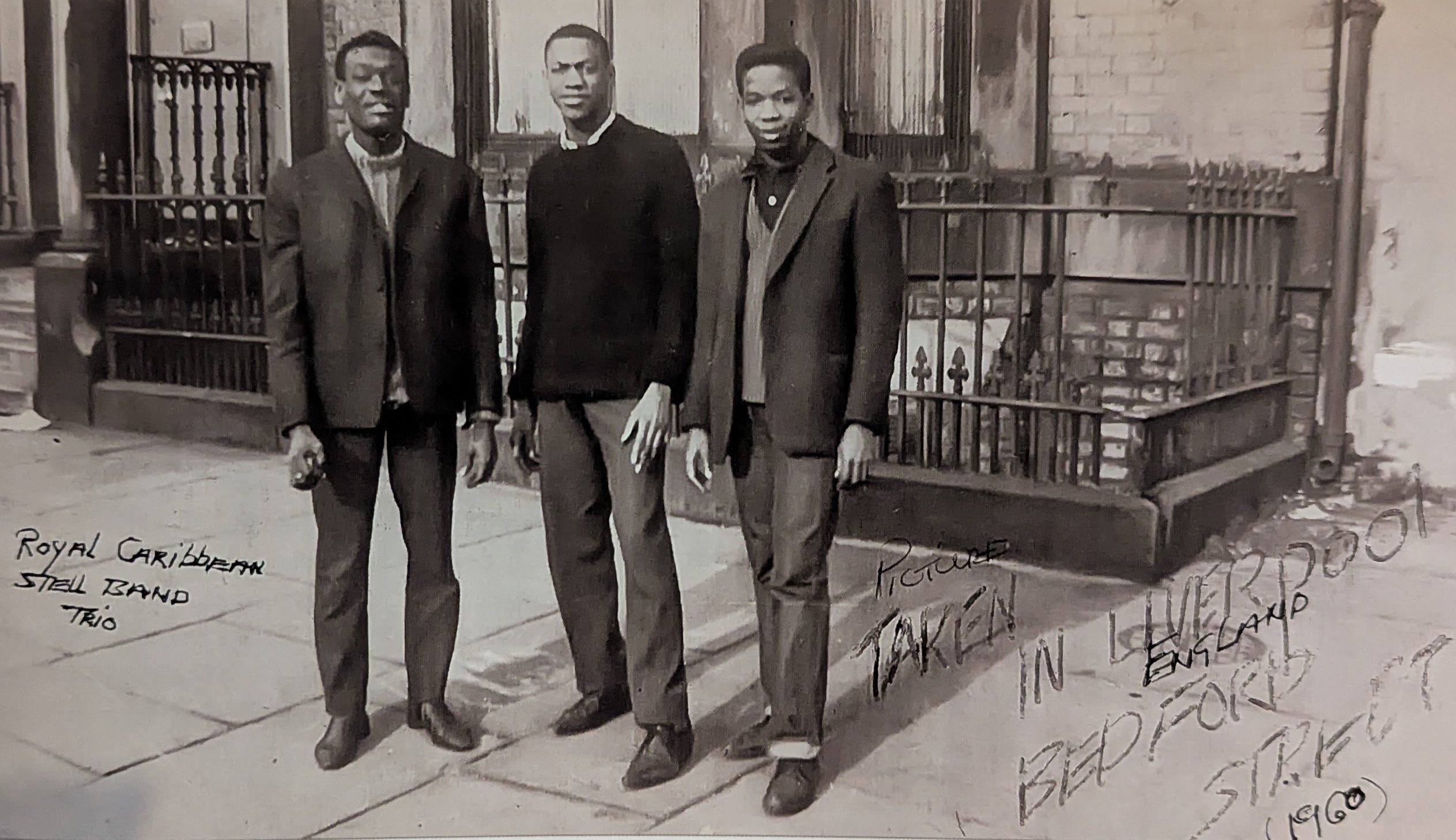
“When things at the door became a little less hectic I went down to the basement to see what was going on. You could hardly see across the room for the cigarette smoke. Now and then there was a strong whiff of the very distinctive smell of marijuana. My West Indian boys in the steel band were partial to the stuff, and as long as they didn’t pass it round I made no fuss. Lots of people in Liverpool were on the stuff for years before it became trendy.”50
Now it must be said that Allan Williams has a reputation in Beatles circles for his, shall we say, creative embellishment of the truth — and he does not categorically deny this. In this sense, Williams is like the anti-Bob Wooler. And in fact, Williams is the person Bob Wooler mostly carps about when it comes to primary sources making stuff up in exchange for some reflected glory — although a lot of this rivalry seems to have been mach shau (aka, making a show).
But just as Bob Wooler isn’t quite as rock-solid credible as he claims to be, Allan Williams isn’t quite as not-credible as he’s accused of being — at least not with regard to the Liverpool weed scene.
As a major port city, Liverpool in the late ‘50s and early ‘60s had a significant Caribbean music scene. And Williams’ suggestion that the Caribbean musicians brought cannabis culture with them from their homeland when they arrived in Liverpool isn’t especially farfetched. That’s how cannabis has always traveled throughout the world, and there’s no reason to think Liverpool — again, a major port city — would be an exception. And of course, John and Paul were regular visitors to the Jacaranda during this time period.51
Pre-Fab Liverpool also had a thriving African music scene, and there was significant overlap between the Caribbean and African musicians who were part of both of those scenes. And it’s well-documented by the musicians themselves that John and Paul, usually together, were frequent visitors to Liverpool’s African music and social clubs during the early pre-fame days.52
While I’ve found no specific research to indicate that cannabis was part of the Liverpool African music community, it seems highly likely that it was. First, because the Caribbean and African communities were intertwined and cannabis culture is inherently social.
And second, because the smoking of cannabis has deep roots in African culture — in fact, the idea of smoking cannabis in a water pipe originates in prehistoric Africa.53 And if the Caribbean musicians continued that tradition in Liverpool, it seems likely the African musicians did as well.
Now, as John and George have pointed out in their Anthology quotes (such as they are), just because there was cannabis in Liverpool in the early 1960s doesn’t mean it was any good. It’s possible that supply chain issues to what was then considered the remote wilds of northern England meant good quality cannabis wasn’t readily available.
But cut-rate weed is still weed. And it’s a stretch to think anyone would bother smoking it regularly — as Williams claims was happening at the Jacaranda — if it didn’t have any effects. And again, cannabis culture is inherently social — it’s built around, as Williams also observed, “passing it around.”
So it seems highly likely The Beatles tried it at least once, and highly unlikely that they were only offered a single opportunity to partake — or that they didn’t have good coaching on how to smoke even cut-rate weed properly, given William’s recollection that the Caribbean musicians were well-versed in the ways of the leaf.
All of this is plausible. But again, it’s not that simple.
Contrary to William’s recollection, Royal Caribbean Steel Band founder Everett Estridge is adamant that in all of the times his group played the Jacaranda, he never encountered any cannabis whatsoever.54
And Al Aronowitz claims that The Beatles “sort of considered pot smokers to be the same as junkies. Like the DEA, they put-grass into the same category as heroin,” which suggests that The Beatles did not try it prior to Dylan schooling them otherwise—55
—which is maybe why, in an early 1980s interview with Peter Brown and Steven Gaines, Allan Wiliams claims that despite the ubiquitous presence of cannabis in his club, The Beatles didn’t get into cannabis until 1964 — by which time they were no longer in Liverpool, and which is, of course, the year they met Dylan.56
But while this might be, Williams’ assertion that he knows for sure that The Beatles did not inhale in pre-fame Liverpool is nonetheless a logical fallacy — and a common one in Beatles scholarship.
While it’s possible for Allan Williams to know for sure that The Beatles did smoke pot in Liverpool, it’s not possible for him to know for sure that they didn’t — unless for some reason The Beatles made a habit of checking in with Allan Williams every time they smoked pot. After all, they told Al Aronowitz they’d never smoked pot before, too, and that probably isn’t actually true.57
So here’s what we’ve got, in terms of primary research on the Dylan story—
Paul says The Beatles’ introduction to cannabis was in New York with Dylan in 1964.
John and George claim The Beatles (possibly without Ringo) were introduced to cannabis by an unnamed source in pre-fame Liverpool — but we only know that because it’s in Anthology, which means we don’t actually know that.
Ringo more or less tells the traditional story, but he also hints that it wasn’t his first time, though he isn’t specific beyond that.
Derek Taylor says the Great Initiation took place at the Delmonico Hotel in Manhattan in August of ‘64.
Journalist Al Aronowitz agrees that the Great Initiation happened at the Delmonico, and says he was there and arranged the whole thing, and that it was The Beatles’ first experience with cannabis.
Victor Maymudes mostly agrees with Aronowitz, except that Maymudes also agrees with John and George that it wasn’t the first time The Beatles had tried pot — though he doesn’t say where he gets this information from.
Journalist Ivor Davis says Aronowitz (and by extension, Paul, Victor Maymudes, and Derek Taylor) is full of bollocks, and that the introduction to cannabis took place a month later at the end of the tour at the Riviera Idlewild Motel in Jamaica (New York) and that Davis was there and Aronowitz wasn’t.
Allan Williams agrees with Paul, Derek Taylor and Al Aronowitz that The Beatles first smoked pot with Dylan in 1964, but he also doesn’t say how he knows this — which isn’t surprising because there’d be no reasonable way for him to know this.
Everett Estridge doesn’t think there was any pot to smoke in Liverpool in the first place.
Bob Wooler thinks there wasn’t any pot in Liverpool, either — until The Beatles started some kind of ad hoc smuggling operation to import it from the south of England.
Brian, Neil Aspinall, and Mal have nothing to say about it whatsoever.58
And neither does Dylan, apparently, except that Derek Taylor thinks that Dylan thinks he smoked pot with The Beatles at the Delmonico, and Mike Campbell thinks that Dylan doesn’t think this ever happened at all.
And finally, just to put a cap on all of this, Dylan was asked in a 1978 Playboy interview about a press report that he turned Ringo (and thus the Fabs) on to pot by sharing a joint with Ringo at JFK Airport. In the interview, Dylan flatly denied this story, but in a testament to how the game of telephone works, a 1985 book on the history of LSD repeats the airport story — except this time it’s John at Heathrow instead of Ringo at JFK.59
Let’s pause here while the room stops spinning. And also to point out that the Dylan story is a very good case study for why even careful consideration of the primary research does not necessarily resolve the inconsistencies and contradictions in the story of The Beatles.
If at this point, you’re expecting me to pull a rabbit out of the hat and offer you an explanation that resolves all of these inconsistencies into a single, coherent version of events, I don’t have one. Unless I’m missing something — always possible — these contradictions do not appear to be resolvable.
So does all of this mean we need to reconcile ourselves to never knowing the factual truth of the Dylan story — or for that matter, the factual truth of the story of The Beatles as a whole?
Well... yes, actually, that’s exactly what it means.
While most of the first-hand accounts of the Dylan story are plausible, the biases of the people involved, along with the vagaries of memory and the individual agendas in the mix, means there’s no way to know for certain which — if any — of these accounts is actually true.
What’s more, further research likely wouldn’t resolve those contradictions and inconsistencies. If there is credible research on either side — as there is with the Dylan story — all more research is likely to do is pile more information on either side of those contradictions.
As for the desire on the part of primary sources to position themselves as close to The Beatles as they can — even when doing so requires claiming to have been witness to an event they weren’t present for — that desire is a testament to how strong of a hold this story has on our collective psyche. And that desire is virtually always going to get in the way of being able to rely too heavily on traditional research — even limiting it to primary sources.
And that means that there can be no “definitive” version of the Dylan story — and anyone who claims otherwise is doing so in ignorance — willful or otherwise — of the actual research.
What most Beatles writers do with the Dylan story is ignore these contradictions and inconsistencies and simply pick a version — virtually always the traditionally told version — and assert it as fact.
But the reality is that when writers claim that The Beatles were introduced to pot by Bob Dylan at the Delmonico Hotel in 1964, there’s actually no part of that that’s consistent and verifiable in the primary research — other than Dylan’s presence at the Delmonico on August 28 1964, which we know for sure mostly because we have a photo of it. And since history deals with what actually happened, if we aren’t able to verify what actually happened, the Dylan story is — by definition — not a historical event. And it makes little sense to write about it as if it were.
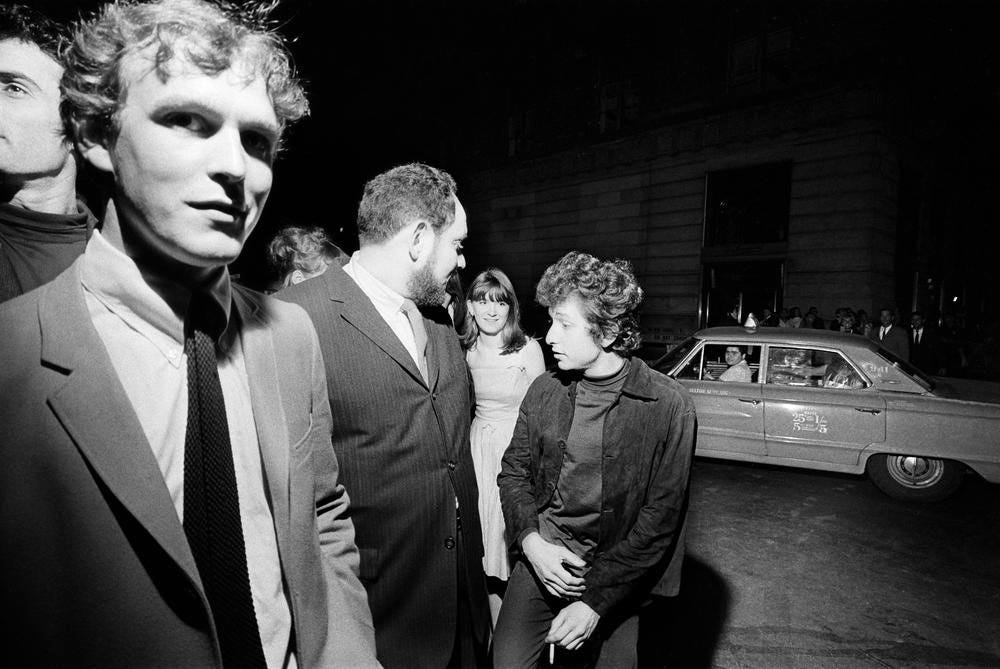
The Dylan story is not an isolated example of this sort of contradictory and unverifiable research. When it comes to the story of The Beatles, it’s more or less situation normal — and also somewhat inevitable, given that Paul has acknowledged that as much as half or more of the story of The Beatles as it’s told in all those “definitive” books is fiction.
This is, in effect, one of the hard limits of the traditional tools of history, biography and journalism. There’s rarely a way to know much of anything for sure, based only on writing down what people have said happened and taking them at their word, because — and I realise this is shocking news — people do not always tell the truth when they talk to journalists and biographers.
And that’s perhaps especially true when it comes to the story of The Beatles — because while writing down what people say is true is a useful approach for a news article or an oral history project, it’s woefully insufficient when it comes to untangling a complex story in which everyone involved has a motivation to distort the truth one way or the other, and when the people at the centre of that story have told us that as much as half of what they’ve told us about that story is fiction.
Having said all of that, I want to clarify something before we move on.
I know that many of you reading are historians, and I want to emphasize that I’m not intending in any way to diminish the value of history as a discipline. Remember, my father was a historian, and I grew up with a deep respect and appreciation for the importance and the beauty of history as a way of understanding our world and ourselves.
But as I’ve talked about frequently in Part One of Beautiful Possibility, I think history is the wrong perspective from which to understand The Beatles. And I mean that in several ways. And here is where if you’re not familiar with Beautiful Possiblity, I might lose some of you for a few minutes. Please bear with me.
First, as I hope I’ve succeeded in showing in Part One, by far the most significant and enduring impact of The Beatles on our world is mythological rather than historical. The impact of The Beatles is simply too big to be understood with the smaller and more limited perspective of history.
And second, I think things get problematic when history is used to understand the actual story of The Beatles. As I hope I’ve shown you in this chapter through the example of the Dylan story, there’s simply not enough consistent, reliable, accessible primary source research to be able to use traditional historical methods to tell any kind of coherent, accurate story.
And third, as I’ve also suggested several times in Part One of Beautiful Possibility, the tools and the worldview required to understand art — and especially great art — and the artists who create that art are fundamentally different from those required for studying history. Historians, like journalists, are trained to be dispassionate observers of factual events.
But artists — and especially artists important enough to be worth studying — are anything but dispassionate. Artists — and especially great artists — live in the world of passionate expression of their art. And that requires a softer, more nuanced set of tools than the study of history generally allows for or requires.
And finally, more than most stories, the story of The Beatles is — as we began to explore in Part One of Beautiful Possibility — first and foremost, a story of human relationships, primarily between John, Paul, George, and Ringo, but also between the four of them and those in their inner circle. And the (theoretically) impartial gaze of history is simply not suitable for understanding the complexities of the human heart any more than history is suited to understand the passionate expression of those relationships in art.
What I’m suggesting is not that history isn’t valuable or important — it is — but that when it comes to understanding The Beatles, history is simply the wrong tool for the job, in the same way one wouldn’t use a power drill to fix a broken wristwatch, or a thermometer to measure the speed of a train.

Stories are the current of meaning, the river through which consciousness and culture move.60 — Dawna Markova, PhD.
There are multiple reasons why we took such a detailed look at the primary research relative to the Dylan story. Some of those reasons need to wait until the end of Seven Levels when we have the necessary context to talk about them.
But there is one reason I want to share with you now, in light of what we’ve stepped through in this chapter.
In Part One of Beautiful Possibility, we talked at length about how the story of The Beatles, intertwined with the story of the Sixties, has evolved from a historical event into a mythological story — and more than that, how these two intertwined stories form the foundational mythological “riverbed” that shapes our modern culture and all of our individual lives.61
By doing a deep dive into the Dylan story, I wanted to offer you a specific, tangible example of how the story of The Beatles has evolved in our collective experience from history into mythology. Because it’s one thing for me to tell you that evolution is happening, it’s another for you to see — and maybe even experience — it happening in real time.
A better understanding of that evolution might be helpful in understanding on a deeper level much of what we talked about in Part One of Beautiful Possibility, relative to the mythological role of The Beatles in shaping our culture. And that better understanding will for sure be helpful when we get to Part Two, when we’ll re-tell the story of The Beatles — and specifically the story of Lennon/McCartney — in part through that mythological frame.
I chose to focus us on the Dylan story because it’s a self-contained and especially strong example of the way history sometimes evolves into mythology. The sorts of contradictions and inconsistencies that we just stepped through are among the earliest signs of that evolution.
In the earliest stages of the evolution of a historical event into a mythological story, the complexities of historical fact begin to blur into a simpler — and often internally contradictory — version of the story.
Over time — if there’s enough mythological mojo in the story for it to endure in the collective zeitgeist — the small-t truth of a historical event continues to decompose. The fine detail is smoothed over and all but the most vivid and essential details fade, until only the elemental bones of the original historical event remain.
This loss of detail and cohesion tends to make historians uncomfortable, and understandably so. That’s one of the clear, bright lines between history and mythology, and why I keep reminding y’all that I’m not a historian, but a mythologist. Because when it comes to history, this lack of detail and cohesion is a bug. But when it comes to mythology, it’s a defining feature — at least in the early stages.
If that story is vital enough to a culture, and if it affects enough people, over time, those elemental bones re-knit themselves into a new story — a fuzzy, fragmented, and often not-quite-cohesive telling of what used to be a historical event, but is now part of the mythological tradition of that culture.
When I suggested in Part One that history shapes mythology and in turn mythology shapes history, this is part of what I meant. And we could also add that if a mythological story is big enough and consequential enough, it not only shapes, but replaces history.
One way to understand how this works is to bring it down to a more individual level.
Think of someone you know — a friend or relative or maybe you yourself — who is a particularly adept storyteller. When that storytelling friend or relative tells a story about the past, they instinctively shape that story away from the more prosaic reality of the situation and towards a better story — erasing the boring parts, smoothing over the bumps, and enhancing the best parts, aka the parts that make it a story worth telling in the first place. Oftentimes, the sequence of events is reshuffled to make those events less coincidental and more interconnected — to make it a better story.
Eventually, over repeated tellings, as the actual events that inspired the story fade further into the past, the story of those events becomes more real and more present in our lives than the events themselves — and therefore far more influential than the actual factual events in shaping our perception of — and our reaction to — those events. And when eventually there’s no one left who remembers the actual events, the story itself replaces those actual events in our collective memory.62
In Part One of Beautiful Possibility, we talked about how this transmutation happened on a grand scale, relative to the Love Revolution. Within the timespan of less than a decade — and even while it was still in the process of unfolding — the complex and messy history of the 1960s softened and blurred into the simplified, romanticized story of the era that most of us now experience as “the Sixties.” So stunningly fast did this evolution — but really revolution — happen, and so radical was the change that even as it was still happening, the Love Revolution became the new foundational mythology of our culture.63
The Dylan story is set within the larger mythological universe of both the Love Revolution and The Beatles. And as such, its telling has evolved in much the same way as the story of the Love Revolution and The Beatles — albeit on a much smaller scale.
The passage of time and the mythological stature of those involved have combined to smooth over the complex and contradictory details of the research. We’re left instead with a simplified, bare bones, and rearranged version of the actual events.
We opened this chapter with a telling of the Dylan story from Derek Taylor — storyteller and mythologizer extraordinaire. And I’d like to close this chapter with another telling of the Dylan story, again from Derek Taylor, this time from FIfty Years Adrift—
“The room was quite dark, lit only by a couple of lamps and some candles; the atmosphere was thick and fragrant with incense. Epstein, reeling around holding a flower, appeared to have gone mad. The visitors stood in a mystic threesome by a small table. The bearded and stout Aronowitz, my dear practical friend, was still recognisably sensible, though silent, immobile and beaming. The saturnine Maymudes was a romantic figure in exotic clothes; while between the two of them, thin and beaked, with the beady-eyed gaze of a little bird, stood Bob Dylan. Strange, thin cigarettes were being passed round and everyone looked very happy. Brian came over to me and said I must try it, this wonderful stuff that made everything seem to float upwards.”64
After our long way around through the first-hand accounts of the two possible settings for the Great Initiation — the Delmonico Hotel and the Riviera Idlewild — you might recognise in Taylor’s account the individual traces of the two nights. The presence of Aronowitz from the Delmonico, Brian Epstein’s newbie weed freak-out (now transmuted to the positive) and the now-practiced ritual passing of the joint from the Riviera Idlewild — all of it softened in its detail, blurring together from two nights into a single night. A single story — that on August 28 1964, Bob Dylan met The Beatles at the Delmonico Hotel and introduced them to cannabis.
There is, at this point in the evolution of the Dylan story, almost certainly no untangling these threads from one another. Like the entangled form of Lennon/McCartney that we talked about in Part One of Beautiful Possibility, the events of the Delmonico and the Riviera Idlewild have grown roots around one another that reach deep into the individual agendas and memories of those telling the story, and deep into our collective cultural imagination.
In this way, the Dylan story as it’s told is becoming truer in our collective experience than the actual events themselves. And with every re-telling, it continues to shed its small-t truth of detail and fact, blurring... softening... from history into a folktale, loosely based on historical events. A mythological story, communicating a larger, Capital-T truth about who we are as a culture.65
The question hanging unanswered in all of this is, why did The Beatles choose to set the Dylan story at the Delmonico, rather than the Riviera Idlewild? And given the lack of definitive research as to when and where the Great Initiation took place, why is it the Delmonico that’s become rooted in our collective imagination?
In the next chapter, we’ll discover a possible answer for those questions, when we begin our unfolding of that deeper story I’ve been hinting at — by turning our attention to the second half of Paul’s account of the Dylan story, and to the song he says he wrote about that night.
Until next week.
Peace, love, and strawberry fields,
Faith 🍓
It Was Twenty Years Ago Today, Derek Taylor, Bantam, 1987.
Paul McCartney, The Lyrics, Liveright 2022
full quote:
“Until we happened upon marijuana, we’d been drinking men. We were introduced to grass when we were in the US, and it blew our tiny little minds.
I’ve touched on this before, but exactly what happened is that we were in a hotel suite, maybe in New York around the summer of 1964, and Bob Dylan turned up with his roadie, the kind of guy who was more than a roadie – an assistant, friend, sidekick. He’d just released Another Side of Bob Dylan. We were just drinking, as usual, having a little party. We’d ordered drinks from room service – scotch and Coke and French wine were our thing back then – and Bob had disappeared into a back room. We thought maybe he’d gone to the toilet, but then Ringo came out of that back room, looking a bit strange. He said, ‘I’ve just been with Bob, and he’s got some pot,’ or whatever you called it then. And we said, ‘Oh, what’s it like?’ and he said, ‘Well, the ceiling is kind of moving; it’s sort of coming down.’ And that was enough."
After Ringo said that, the other three of us all leapt into the back room where Dylan was, and he gave us a puff on the joint. And you know how a lot of people take a puff and think it’s not working? We expected something instantaneous, so we kept puffing away and saying, ‘It’s not working, is it?’ And suddenly it was working. And we were giggling, laughing at each other. I remember George trying to get away, and I was sort of running after him. It was hilarious, like a cartoon chase. We thought, ‘Wow, this is pretty amazing, this stuff.’ And so it became part of our repertoire from then on.
How did we get our pot? To tell you the truth, it just showed up. There were certain people you could get it from. You just had to know who had some.”
This is a reference to the distorted “John vs Paul” narrative that we talked about at length in Part One of Beautiful Possibility. It’s a major theme of Part One, and too complex to summarize here — but all you need to know for Seven Levels is that as a result of “John vs Paul,” Beatles scholars have historically tended to believe John’s version of events over Paul’s.
Brian did sign the July 1967 Times ad calling for the legalization of pot. But that was a different situation in which he was protecting The Beatles by adding his name to theirs. We’ll come back to that ad in the next chapter.
Mal Evans’ biographer Ken Womack details the events in his book based on Mal’s diaries — for which Mal himself had a publishing contract at the time of his death. But Womack’s book, Living The Beatles Legend, is not a book by Mal Evans as is often assumed. It is based on Mal’s diaries, but it’s written as a traditional biography. In it, Womack tells the Dylan story in third person without any direct quotes from Mal or any references to his diaries, which suggests that Mal did not write about the Dylan story in his diaries — maybe for the same reason Brian didn’t speak of it, out of a desire to protect The Beatles from scandal or legal trouble. Womack’s version of the story sounds similar enough in detail to Paul’s that it seems likely he took it from Paul’s telling.
Neil Aspinall rarely gave interviews and is, notably, the only member of the inner circle who didn’t write a book.
Journalist Ivor Davis has this to say about Derek Taylor as a source—
“[Beatles biographer Bob] Spitz in his own end notes, suggested that Anthology should be renamed Mythology, because roadies “Big” Mal Evans and Neil Aspinall answered phone questions posing as John and Paul, and that some of the material should be taken with a pinch of salt. My own personal experiences with Derek [Taylor] indicated that lots of salt was liberally sprinkled around the band’s history.” (The Beatles and Me On Tour, Ivor Davis, Cockney Kid Publishing, 2014.)
NOTE: We’ll come back to both Ivor Davis and Anthology later in this chapter, because both have their own credibility problems.
It Was Twenty Years Ago Today, Derek Taylor, Bantam, 1987.
full quote:
“In 1986, having lost touch with Dylan in the 1970s, I met him again.
We talked about that first night. ‘That hotel,’ Dylan suddenly remarked. ‘What was the name of that hotel?’
‘Del Monico.’
‘That was it!’ he said. ‘The Del Monico. That was a night!’”
NOTE: The original version of this chapter mistakenly placed the reconnection of Taylor and Dylan in the' 70s, rather than in 1986. as the quote actually reads. Thank you to a regular reader of The Abbey for pointing out the error. It’s still, for now at least, incorrect in the audio, because that’s more difficult to fix.
Also, my creative partner, who has many years of experience dealing with high-profile public figures, tells me that “That was a night!” is a standard generic reply used by famous people when they encounter someone who regales them with the story of a party that the “someone” remembers but the famous person doesn’t. Being a publicist, it seems likely Taylor would be familiar with this use of the phrase, so it’s certainly possible that’s what’s happening here. But it seems to me unlikely — given Dylan and Derek Taylor were friends and the Delmonico wasn’t just any party. In truth, we aren't given enough information in Taylor’s book to know one way or the other.
Heartbreaker: A Memoir, Mike Campbell with Ari Surdoval, De Capo, 2025.
full quote:
“Once, I was at the console showing Bob something when George started telling a story about when the Beatles first came to New York and Bob turned them on to pot.
Bob looked up.
‘What? I did what?’
‘We came to New York and you turned us all on to grass.’
‘That is not true.’
‘Of course it is.’
‘I did nothing of the kind.’
‘You most certainly did.’
They went back and forth about it like old pals on a park bench, laughing and squabbling. Bob dismissed it completely. George insisted. Bob turned to me and shook his head and mouthed, ‘No.’”
Adam Buxton, 12-11-2020, ep. 144.
full quote begins at 31:30
AB: With Bob Dylan though, there was a moment with Bob Dylan that captured a lot of people’s imaginations when you first met, in the, uh, Delmonico Hotel—
PM: Oh yeah.
AB: —New York, 1964 I believe.
PM: Mm-hmm.
AB: And that’s one of those meetings that’s kinda gone down in pop-cultural music history.
PM: Mmm.
AB: Do you have a sort of first-hand memory of it now, or is your memory of that informed by just what people have written and said about it?
PM: No, I— I remember it pretty well, you know. We were staying in that hotel, uh and I think we were on tour. So we were all together in the hotel suite. And we’re having a drink. And then Bob arrived, and we said hi. And he, he vanished into a back room, one of the rooms off the suite. So we just carried on, thought, ooh, I dunno, he must be doing something, whatever. Well Ringo went back to see him. And then after a couple of minutes Ringo came back in, looking a little bit dazed and confused. And we said, “What’s up?” He said, “Oh, Bob’s smoking pot back there.” And we said, “Oh.” ‘Cause we didn’t, we’d never had it. And we said, “Oh. So what’s it like?” And Ringo said, “Wellllll, the ceiling feels like it’s sort of coming down a bit.” And we go, “Whoa!” We all just dashed in the back room to partake of the, uh, evil substance. And that was quite an evening, you know. It was crazy, it was quite fun. I’m not sure Bob is keen on being labeled as the guy who turned The Beatles on.”
AB: Mmm.
PM: I’ve heard that he’s sort of, (inaudible) tries to play it down a bit. But whatever, that’s the truth. And we met him on other occasions under those kind of circumstances, you know. But it was, it was very nice, you know. So I, I hung out with Bob a few times. He came to see us for dinner when we were in the hotel and stuff. So we had some good times together, he’s a great bloke.
Another Side of Bob Dylan: a personal history on the road and off the tracks, Victor Maymudes & Jacob Maymudes, St. Martin’s, 2015. (NOTE: Maymudes died in 2001. The book was written by his son based on Maymudes’ recordings.)
“Bob had a couple of drinks and within an hour, he passed out on the floor! By this time, Paul was laughing so hard that tears were streaming out of his eyes. This was their very first encounter and Bob passed out! This wasn’t entirely because of the booze either. We were up all the time; he was exhausted. He might have been up nonstop the three days beforehand. But the booze didn’t help; it shoots you up and then crashes you down.”
With Bob sleeping on the floor, one by one John, Paul, George and Ringo talked to me. We discussed life and politics. They wanted to know about everyone and everything: who was in our scene, what it was like in New York.” (Another Side of Bob Dylan: a personal history on the road and off the tracks, Victor Maymudes & Jacob Maymudes, St. Martin’s, 2015.
“Much has been written about their summit in New York. But some of the popular myths that have taken hold over almost half a century differ greatly from what I personally saw play out.
As has been correctly reported, Mr. Tambourine Man was driven by his road manager, Victor Maymudes, from his home in Woodstock, New York, to meet the Beatles at Hotel Delmonico on the evening of August 28. Joining them was Saturday Evening Post writer Al Aronowitz.
As legend has it, the meeting at the Delmonico was a landmark event—where a member of Dylan’s entourage brought out a stash of marijuana and the Beatles (and Brian) climbed aboard the THC train.
Not so. In fact, the Delmonico was little more than a brief encounter for Dylan and the Beatles, a swapping of stories, a mutual admiration society, without the aid of any altered states. The real bonding actually occurred three weeks later, in the less auspicious surroundings of the Riviera Idlewild Motel, on the edge of John F. Kennedy International Airport in Jamaica, New York.
What about the Delmonico? The blame for the confusion most likely falls on the immodest Aronowitz, who enjoyed placing himself center stage in sixties rock history. Perhaps he wanted to take matchmaking credit, or maybe the writer, who had quite the reputation for imbibing, had one too many of something that tainted his memory. Whichever, the facts got tangled.” (Ivor Davis, The Beatles and Me On Tour, Cockney Kid Publishing, 2014.
NOTE: Derek Taylor, too, mentions the Riviera Idlewyld Motel in a 1965 self-authored Datebook article. But since he’s writing and publishing in 1965 when cannabis is illegal and The Beatles were still maintaining their “mop top” image, he’s obviously not going to mention the whole cannabis situation regardless of where and when it happened—
“By the time we reached the Riviera Motel at Kennedy International Airport in New York on the eve of departure for England, neither the Beatles nor Epstein nor I were much prepared to put up with much.” (Derek Taylor, “Inside The Beatles,” Datebook, Fall 1965.)
NOTE: The reference to Taylor and Brian “not being willing to put up with much” relates to the two of them being on the outs with one another following a blow-up during the tour. According to Taylor, he’d resigned his position by the time they reached the Riviera Idlewild Motel.
This is a bit of specificity in service of lyrical writing. I do not know for sure that it was Acapulco Gold, but it seems likely to have been.
Regardless, Aronowitz himself acknowledged his interest in being witness to culturally significant events in a 1992 interview—
“It’s true that I had youthful ambitions of one day claiming far greater contributions to contemporary culture than that, but I certainly feel honored to have played at least that role.” (New York Planet, December 9 1992.)
Two examples of the temptations of reflected glory—
Journalist Larry Kane was embedded with The Beatles on the 1964 tour during which the Dylan story happened. He wasn’t present for the Great Initiation, so he has nothing to contribute other than agreeing that Dylan did indeed meet with The Beatles at the Delmonico and saying that he’d been told by The Beatles that the Great Pot Initiation had happened during this visit.
But Kane does have a good account in his book about the lifetime “spillover fame” he experienced as a result of having been part of The Beatles’ entourage, even if only in the outermost circle and only briefly—
“For each of us, this spillover fame actually spilled over into our lives away from the tour. When Art Schreiber returned home to Cleveland, for instance, he was flabbergasted by the attention paid to him. ‘Kids came to my house to kiss my door. In restaurants, young people would fight over my cigarette butts. I was invited to give speeches at birthday parties, and the parents were as interested as the kids. Universities called for lectures. I, a radio newsman, was a certifiable celebrity, and the deejays at my station were green with envy.’
“As for me, when I returned to Miami, the sales department at WFUN Radio sent me out on tour. I appeared in rallies at five Miami malls, including the huge Dadeland Mall in Southwest Miami. The ads said, “Meet the Man Who Met the Beatles!” The crowds were so large, a small army of security guards had to be brought in. High schools and colleges offered invitations to speak, and my mail never stopped. In all, I answered a thousand letters from around the nation. In subsequent years, at college campuses, churches, synagogues and even political forums, I have been confronted by questions about the Beatles. Whenever my bio is read at personal appearances, my experience of covering the Beatles draws more oohs and ahs than my interviews with presidents.”
Ticket to Ride: Inside the Beatles’ 1964 and 1965 Tours That Changed the World, Larry Kane, Running Press, 2003.
By far the saddest casualty of the temptations of reflected glory might be the tragic story of Bernard Purdie.
Purdie is a noted jazz drummer who was contracted by Polydor Records to overdub Pete Best’s drums on the 1961 Tony Sheridan recordings. (The versions of the Sheridan/Beatles recordings that you’re familiar with are almost certainly the overdubbed versions on which Purdie plays over Best’s drum tracks. (What I would like to know is which versions are on Anthology. If anyone has credible information on this, I’d be grateful if you’d email Robyn.)
But despite a decades-long career as an accomplished sideman for some of the biggest names in music, this reflected glory apparently wasn’t enough for Purdie. He insists to this day that he not only overdubbed Pete Best on the Polydor recordings, but that he overdubbed Ringo on twenty-one of The Beatles’ earliest recordings with George Martin at Parlophone — which would include the entire Please Please Me album.
Songwriter/producer Jim Vallance has done an excellent job of debunking Purdie’s claim — a claim that I hasten to add should not in any way be taken as legitimate—
http://www.jimvallance.com/03-projects-folder/purdie-project-folder/pg-purdie.html
Vallance’s analysis is a fascinating read, and also a deeply sad example of how direct contact with a powerful mythological story can break a fragile psyche. We’ll talk more about that in Part Two, relative to John.
“In an almost sixty-year career, journalist and investigative reporter Ivor Davis has spent his life on the inside, covering music, murder, politics, and Hollywood. One day, he woke up to realize he had been an eyewitness to some of the most incredible moments in US history. A colleague described him as “A hybrid Forrest Gump and Zelig.” (Ivor Davis website, retrieved 4/9/25)
A regular listener of The Abbey pointed out that the initial version of this chapter added a “jr.” to Robert Kennedy, which is, of course, inaccurate in many, many ways. That error remains in the audio, but it’s corrected here.
Journalist Chris Hutchins claims in his memoir, The Beatles: Messages from John, Paul, George and Ringo, Neville Ness House, 2015.) to have been the one to arrange the meeting with Elvis. Ivor Davis claims Hutchins is overclaiming, and that it was Brian Epstein who made the meeting happen.
I haven’t pursued the details on the Davis vs Hutchins situation relative to the meeting with Elvis, beyond reading each of their books. uBt I suspect it’s a similar situation to the Davis vs Aronowitz situation relative to the meeting with Dylan, and also that a similar piece to this one could be written about the primary research on the Beatles/Elvis meeting (absent the weed).
The Beatles and Me On Tour, Ivor Davis, Cockney Kid Publishing, 2014.
The Beatles and Me On Tour, Ivor Davis, Cockney Kid Publishing, 2014.
Joe Flannery, Standing In The Wings, The History Press, 2013.
full quote: “[John and I] would frequently drive down to the Pier Head in my Vauxhall (as, indeed, Brian and I would do)and stand at the railings, eating one of those terrible meat pies that they used to sell there and looking out over the narrow expanse of the River Mersey and the vaster margins of the Irish Sea. John was forever dreaming of America. It was as if his spiritual home was across the Atlantic; he ached to play in the USA, the great source of his inspiration. On this occasion, he told me that he was not going to let Mona Best get in the way: “I want to be over there; I can almost taste it now, Joe. Brian’s going to be good for us. It works. He might be a bit of a snob and all that, but we click. With Mona around it’ll always stay just a dream. With Brian it feels like it might just happen.”
NOTE: We will talk a lot more about the relationship between John and Brian in Part Two of Beautiful Possibility.
[re: Jan 24, 1962 signing of the second contract with Brian/NEMS]: “Paul, gazing in that disturbingly wide-eyed way, asked, ‘Will it make much difference to us? I mean, it won’t make any difference to the way we play.”
“‘Course it won’t. I’m very pleased anyway,” I said without the slightest idea of the disappointments ahead before I could contemplate taking a penny in manager’s fees. I started with the Beatles as I have with all my artistes — running them at a loss until they earn enough to afford to lose a percentage.
We all sat and looked at one another for a moment or two, none of us really knowing what to say next. Then John broke the silence: “Right, then, Brian. Manage us, now. Where’s the contract? I’ll sign it.”
(Brian Epstein (ghostwritten by Derek Taylor), A Cellarful of Noise, Souvenir Press, 1964.)
NOTE: Citing Cellarful of Noise is dubious, I admit — not only because it was written more as a PR piece than an actual biography, and also because Derek Taylor has acknowledged that he wrote it in two weeks drawing heavily from fan magazines of the period, which are often blatant works of fiction themselves.
But putting aside the dubious accuracy of A Cellarful Of Noise —that Brian had no say in the music is self-evidently true in looking at what actually transpired. Brian did briefly interfere when he made his poor song selections for the failed Decca audition — and that was, it seems, the end of that. There’s no further indication that Brian had any say at all in anything related to their music. In fact, quite the contrary.
Here’s Brian again in his 1964 book, in a story that’s been corroborated by others who witnessed it—
“Sometimes [John] has been abominably rude to me. I remember once attending a recording session at EMI studios in St. John’s Wood. The Beatles were on the studio floor and I was with their recording manager George Martin in the control room. The intercom was on and I remarked that there was some sort of flaw in Paul’s voice in the number, “Till There Was You.” John heard it and bellowed back, “We’ll make the record. You just go on counting your percentages.” And he meant it.”
And here’s that same story from a more objective and probably more accurate point of view, NEMS employee Tony Bramwell, who was in the studio when the incident happened—
“Poor Brian was constantly overacting and reacting, as when he made a fool of himself one night by turning up at Abbey Road with a boyfriend, trying to show off a bit to demonstrate to the boy how he exerted influence over the Beatles and knew his way around the studio. He flipped the intercom switch and told John that the vocals he’d just done weren’t “quite right.” Whether he was trying to make a joke, or being flippant, I’ll never know. Everybody, including me, winced and cringed and waited for the inevitable, which came swiftly. John just looked up at him without smiling and said, “You take care of the money, Brian, and we’ll take care of the music.” (Tony Bramwell, Magical Mystery Tours,St. Martin’s Press, 2005)
“During the morning session, they recorded several takes of the wistful “There’s a Place,” with Lennon on lead vocals, as well as McCartney singing “Seventeen,” the working title for “I Saw Her Standing There,” the rave-up tune that Martin would select to lead off the album. After completing work on the first two original Lennon-McCartney numbers, Martin announced that their lunch break had arrived, and he retired, along with Smith and second engineer Richard Langham, “for a pie and a pint” at the nearby Heroes of Alma pub. For their part, the Beatles lingered behind, sustaining themselves on milk—along with the throat lozenges and cigarettes. Langham was shocked to discover that, upon the EMI staffers’ return, the band had been “playing right through. We couldn’t believe it. We had never seen a group work right through their lunch break before.” (Maximum Volume: The Life of Beatles Producer George Martin, The Early Years, 1926–1966, Kenneth Womack, Chicago Review Press, 2017.)
NOTE: Langham is mentioned in the acknowledgements as having granted Womack an interview for the book. Since this passage isn’t footnoted, it’s reasonable to assume it’s from that interview. Also, Geoff Emerick indirectly confirms Langham’s story in his own book—
“I harbored a slim hope that I’d get picked to assist, but Richard landed the plum job—hardly surprising, considering that he was senior to me and had developed a strong working relationship with both George and Norman. So I had to content myself with hearing the stories in the canteen and in the pub, as Richard regaled us with tales of the four Beatles working straight through their lunch break (unheard of in those days), and a hoarse Lennon, stripped to the waist despite the winter damp and cold, nearly shredding his voice at the end of the night with a blistering version of “Twist And Shout.” I had no means to hear the tapes—unauthorized playbacks by staff were strictly forbidden—but based on Richard’s description and my own previous experience with the group, I hoped that some kind of opportunity would arise for me to get a preview.” (Geoff Emerick, Here, There, and Everywhere: My Life Recording the Music of the Beatles, Gotham Books, 2006.)
“I probably spent less time talking to Paul than any of the other Beatles, but I certainly admired his talent for writing brilliant music and words. Out of all of them Paul seemed to have the strongest passion for performing. An enduring memory of him is from one of the group’s previous tours in America. He came off stage after playing Shea Stadium, which must have been an incredible experience, and said “God, I wish we could have given them more.” (Robert Whitaker with Maricus Heam, Eight Days A Week: Inside the Beatles Final World Tour, Metro Books, 2008.)
“The Beatles were aware that they had been out of tune during their first concert at the Budokan. They didn’t take this sort of thing lightly, so prior to the show on 1 July there was a lengthy rehearsal in their spacious dressing room. Here were four guys who were genuinely trying to give a great performance. They realized something was wrong so they tried to put it right.” (Eight Days A Week: Inside The Beatles’ Final World Tour, Robert Whitaker with Marcus Hearn, Metro Books, 2008.)
JOHN: “We toured for four years. And of course there were great moments and... (sic) whenever we talk about it, it’s all laughs. But when you get down to the physical reality, it was all pain. Because there was nothing in the music. We weren’t getting any feedback. We’d just go on, and we weren’t improving; we were just turning out the same old . . . half the time we’d just mime on the mic, because your voice had gone, and the kids would just be howling. You’d get kicked, beaten up, walked into walls, hustled, pushed, and all that.” (interview with John Lennon, December 17, 1969, Mississauga, Ontario, Canada, broadcast December 1969, WABC-FM (New York), reprinted in Lennon on Lennon: Conversations with John Lennon, edited by Jeff Burger, Chicago Review Press, 2017.)
“GEORGE: I just had such a good time just playing, you know. That’s what I miss. Even when we sold records and started doing a lot of tours, it was a bit of a drag because we’d go on the road and we’d play the same tunes to different people and then we’d drop a few and add the new ones all the time, but basically it was the same old tunes. It got stale. I felt stale, you know because you play the same riffs da-da-da-ding-ding-dow, you know, “Twist and Shout” and things.” (George Harrison interviewed in Crawdaddy, February 1977.)
“PAUL: It wasn’t that that made us stop touring, it wasn’t the woman who predicted Kennedy’s death saying we were going to die on a flight into Denver; we still got on the plane. We didn’t listen to stuff like that, we still went ahead. But at the end of that particular tour it had started to become less enjoyable. There were all these other things to contend with, plus the screaming rather than someone watching the chords, and the craftsmanship going a bit. We began to lose respect for the live act, and everyone started to become a bit disgruntled.” (Many Years From Now, Barry Miles, H. Holt, 1997.)
RINGO: We found out very early on if you played stoned or derelict in any way it was really shitty music. So we would have the experiences and then bring that into the music later. (The Making of Sgt. Pepper, The South Bank Show, broadcast June 14 1992.)
and here’s Paul:
”I mean, obviously we had to be in such a state as to be able to record. You don’t want to do vocals when you’re scared to do vocals. So it had to be controlled, and I think it was, but I think the idea that music can be enhanced by marijuana was definitely being researched at the time, so you would smoke a joint and then sit down at the piano and think, Oh, this might be a great idea! I’m not saying that was the only way to work because before that we worked completely straight, completely clean, no alcohol or anything, and had a bunch of very good ideas under those circumstances.
It was the discipline of EMI. We had a certain attitude towards EMI, that it was a workplace, that was always there underneath it all, although we would often party. There was George Martin himself, who was fairly practical, and the engineers. You didn’t want to mess around. Then there was our own controlling factor. We didn’t want to be lying around unable to do anything. We knew why we were doing it: it was to enhance the whole thing. I think if we found something wasn’t enhancing it, booze for instance, we gave it up. Once or twice we’d try a little wine when people were around, but generally you’d fuck up solos and you couldn’t be bothered to think of a little complex musical thing that would have sounded great. You might have wanted to think of a harmony part to something and now it was a bit of a chore and tuning up is a bit of a chore when you’re stoned.” (Paul McCartney, Many Years From Now, H. Holt, 1997.)
“There’s one scene in the film where Victor Spinetti and whoever else is in the scene and they’re doing that curling, and one of them of course has a bomb in it. We find out about this, so it’s gonna blow up and we have to run. Well, Paul and I ran about seven miles. (laughs) We just ran and ran, so we could stop and have a joint and, and come back. We were just off. Y’know, we’d run to Switzerland, yeah, hell of a laugh. But it was a lot of— Dick Lester knew that very little would get done after lunch.” (RIngo Starr on-camera interview, Anthology, director’s cut, 2004, episode 6, 33:05.)
full quote: “We didn’t get along. We were four guys; we had rows. But it never got in the way of the music. No matter how bad the row was, once the count-in, we all gave our best.” (Ringo Starr interviewed by Dan Rather, The Big Interview, airdate October 2, 2018.)
NOTE: Ringo goes on to qualify that when he says, “we didn’t get along,” he’s talking about the breakup years. But of course, “we didn’t get along” is what’s used as clickbait — taken out of context and ignoring Ringo’s qualifier — on YouTube videos, etc. to further the distorted narrative.
This is an example of why it’s wise to be careful with YouTube videos as sources if they don’t include the entire interview. And even when they do include the entire interview, video interviews, like print interviews, are almost always heavily edited. That means something that’s presented as a complete thought is not necessarily the way it was spoken by the person being interviewed.
In the case of Ringo’s quote, we see him on camera for the entire duration of the quote — which means that it’s what he actually intended to say in the order in which he intended to say it. (With AI, this is, sadly, no longer a given.)
Also, yes, I mispronounced “row” — it is what it is.
“As the drug use increased, Epstein and others in the party took great pains to hide it. Epstein was especially sensitive. He was, after all, the boss. But he was also, as we would learn after his death, enchanted with the world of drugs himself. I remember one night in particular that exemplified this approach.
Hours after the final concert of 1965 in San Francisco, the promoter held a small cocktail party at our hotel in Palo Alto. It was a lively affair, with the Beatles upbeat about the tour’s end, waiters roaming the room with finger food, and some glamorous young women setting their eyes on the boys. In a corner, John sat quietly and reached into his jacket for his cigarettes. He pulled out a thinner cigarette from his pack, a marijuana joint, and thumbed his lighter to start it. But before he was able to light the joint, Brian Epstein took a quick detour away from chatting with me and a few others, walked over to John, and glowered at him, shaking his head. John slipped the object of his desire back into his jacket pocket, pulled out a legal smoke from his pack and lit up.” (Larry Kane, Ticket to Ride: Inside the Beatles’ 1964 and 1965 Tours That Changed the World, Running Press, 2003.)
In his book, Maymudes suggests that while Brian was present for the Delmonico party, he didn’t partake until the Riviera Idlewild, on the grounds that he needed to be focused for the tour. But oddly, Maymudes doesn’t then extend this line of reasoning to explain why The Beatles would have been any less careful or professional.
Anthology, Chronicle Books, 2000.
I’m citing this as Anthology, but for reasons we’re about to get to, this is not a valid source citation and we’d be wise not to quote it as such — though virtually everyone does. But again, we’re getting ahead of ourselves.
Anthology, Chronicle Books, 2000.
Ringo Starr on Late Night with Conan O’Brien, March 25, 2003.
“That was the first time for me that I’d really smoked marijuana. And I laughed, and I laughed, and I laughed. It was fabulous.” (Ringo Starr, on-camera interview, Anthology, director’s cut , 2004, episode 2, 11:49.)
It’s perhaps a mark of the enduring depth of their bond that when any of the four Fabs are talking about their Beatles years and use the word “we,” they’re virtually always speaking for the whole band. This is, of course, especially in the context of Anthology, given it’s the story of the band.
The Beatles using “we” to refer to the band even long after the breakup is so common that I’ve found two references to it from journalists in two different interviews. This doesn’t seem the kind of thing that needs the actual quotes — they’re not from the Fabs, just observations from the interviewer. But if you want those quotes, email Robyn and she’ll hook you up.
Another Side of Bob Dylan: A Personal History on the Road and off the Tracks, Victor Maymudes & Jacob Maymudes, St. Martin’s, 2015. (NOTE: Maymudes died in 2001. The book was written by his son based on Maymudes’ recordings.)
Which might be why John tends to use the term “turned on” rather than “introduced,” when talking about the Dylan story. Paul doesn’t seem to make the distinction — he uses both somewhat interchangeably.
I can’t leave this metaphor behind without mentioning musician/poet Robyn Hitchcock, who refers to this experience of getting turned on by cannabis for the first time as “losing one’s psychic virginity.” That’s a very good description, based on my own personal experience.
“I finally managed to lose my psychic virginity—I got stoned, which was an overwhelming joy for a while.” (Robyn Hitchcock, 1967: How I Got There and Why I Never Left, Akashic Books, 2024.)
NOTE: Notice also Hitchcock’s mention of “overwhelming joy.” We’ll come back to that in the next chapter.
As noted in an earlier footnote, John allegedly gave a similar quote in a May 5,1971 interview with the Trinidad Express — “A guy brought us some grass but we didn’t know anything about it and anyway we were already pissed.” But despite inquiries to various archives in Trinidad (and elsewhere), I’ve had no luck finding that one, either., other than in Mark Lewisohn’s Tune In (Little Brown, 2013) — which of course is not at all helpful.
The Beatles, Bob Spitz, Little Brown, 2006.
The general thinking is that John’s quote is from an April 1975 interview that he did for French television. That interview as broadcast seems to be available in full online, but the Anthology quote doesn’t appear in that broadcast.
I’ve found no way to contact the original interviewer, so my next step was to contact ITA, the French media company that owns the footage. ITA did answer my email, but the only footage they claim to have in their possession is the edited interview as it was broadcast — which we already have and which doesn’t include the quote. And that means that if John’s quote is from this interview, it’s from footage that ended up on the cutting room floor.
And indeed, further research brings up a Beatles blog that claims that “sections of the interview where John speaks frankly about sex and drugs were deemed too risky for transmission and were never screened.” Maybe this “risky” material includes the Anthology quote, although it seems unlikely that The Beatles having tried cannabis in 1960 would be especially controversial in 1975. Regardless, the blog in question doesn’t give the source of this information and so far, attempts to reach the author have gone unanswered.
If John’s Anthology quote is taken from the unaired outtakes of the French interview — which is still only a guess — then it’s likely that The Beatles got special access to it by virtue of being The Beatles. And that means that — again, assuming John’s quote is even from this interview — there’s no practical way for scholars without special inside access to unreleased footage to verify that quote.
John allegedly gave a similar quote in a May 5,1971 interview with the Trinidad Express — “A guy brought us some grass but we didn’t know anything about it and anyway we were already pissed.” But despite inquiries to various archives in Trinidad (and elsewhere), I’ve had no luck finding that one, either., other than in Mark Lewisohn’s Tune In (Little Brown, 2013) and... well, that’s for the next footnote.
Here’s a link to the research on the problems with Lewisohn’s work:
https://therealtamishow.com/beatles/
And the spreadsheet containing the details:
https://docs.google.com/spreadsheets/d/1YQV_SlTPiRd1HDRL2if5bTEK1ziQ9ahl5xmotyjylQQ/edit#gid=0
As some have observed, Serene and Sharon’s work is not perfect — no one’s is. But they do show beyond doubt that Lewisohn has used frankenquotes not a handful of times, but literally hundreds of times in Tune In alone. And my fab research assistant Robyn has found at least two in the 1990 book In My Life: John Lennon Remembered (BBC Books, January 1, 1990). (email Robyn if you would like the details). It’s not an aberration or a momentary lapse of reason. It’s a pattern.
This is what appears in Anthology:
“JOHN: Bob Dylan had heard one of our records where we said, ‘I can’t hide,’ and he had understood, ‘l get high.’ He came running and said to us, ‘Right, guys, I’ve got some really good grass’ — how could you not dig a bloke like that? He thought that we were used to drugs. We smoked and laughed all night. He kept answering our phone, saying, ‘This is Beatlemania here.’ It was ridiculous.”
So far, I’ve found only this approximation, in an April 23, 1965, NME interview with John:
“Then when we were in New York during the American tour last summer somebody said, “Do you want to meet Dylan?” and we said, “Sure, if he wants to meet us,” so he came up to the hotel room and we did nothing but laugh all night. He kept answering our phone, ‘This is Beatlemania here.’ It was ridiculous.”
The absence of evidence is not the evidence of absence — just because I haven’t found this quote in my research doesn’t mean it doesn’t exist. What matters here is that Lewisohn’s documented history of manufacturing frankenquotes over the span of three decades, combined with the similarities between the NME quote and the Anthology quote, suggests strongly that John’s Anthology quote is a manufactured frankenquote.
For those of you who are enjoying the wonkiness of this section:
Unsourced frankenquotes are exponentially more difficult to verify than normal quotes. Since it’s not clear where one glued-together quote ends and another begins, or which words were adjusted to make the quote appear to be a single quote, there’s no reliable way to search for an exact text string of sufficient length to get any useful results. And of course, searching physical media is even more difficult and time-consuming. And even if we get lucky and find one part of the quote, that still leaves the remaining parts unaccounted for.
All of this makes verifying a frankenquote not just a search for a needle in a haystack, but a search for multiple needles in multiple haystacks. It’s also part of why Serene Tami Sargent and Sharon Dubosky’s work on Lewisohn is so impressive. They managed to do this not once or twice, but for all of Tune In. (see links to their work in a prior footnote.)
John’s breakup-era interviews are deconstructed at length in episode 1:2 (“Love Lies Bleeding”).
“During an interview with Paul McCartney, he explained how nearly forty years ago the Beatles agreed on a “version of the facts” that would serve as their story, and they stuck to—and embroidered upon—it ever since. Paul told me “about 65 percent” of their “official biography, The Beatles—written in 1967, by journalist Hunter Davies—is accurate. (Referring to the book in a lengthy 1970 interview with Jann Wenner, John Lennon said: “It was bullshit… my auntie [Mimi] knocked all the truth bits from my childhood and my mother out…. I wanted a real book to come out, but we all had wives and didn’t want to hurt their feelings.”) What’s more, all of it has been told and retold so many times that even McCartney is no longer certain where the truth begins and ends—one of the reasons, no doubt, that the wonderful Anthology is often referred to as Mythology. In any case, the “official Beatles biography” is not only loaded with misstatements and lovely little fairy tales, but inaccuracies: misspelled names, incorrect dates, confused locations—and wide, gaping holes.” (The Beatles, Bob Spitz, Little Brown, 2006.) (emphasis added)
Spitz also recounted this conversation with Paul in a 2006 television interview, only here Spitz recalls it as 50% , rather than 65%, fiction— https://www.beatlesabbey.com/p/9125-e11. Either way, that’s a lot.
The reference to “protecting wives and girlfriends” comes from this interview with Spitz. And those of you familiar with Part One of Beautiful Possibility probably noticed already that this obviously has specific relevance to the nature of the relationship between John and Paul. Obviously we already know about their alleged affairs with women (though as we also talked about in Part One, much of the research on that is also not especially credible). That doesn’t leave that many possibilities, when it comes to what else wives and girlfriends might need to be protected from.
Paul has talked about this fictionalizing of their story directly. But his on-the-record comments considerably soft-pedal the situation, maybe because after the PR about Anthology being the definitive story of The Beatles by The Beatles, acknowledging that a third to a half was fiction wouldn’t have been an especially good strategy.
For example, here’s Paul in Q Magazine in June 1997—
“We wanted to know the story as well. I mean, there were certain elements of fudging things here and there, just because there were too many people involved - if it’s just one person’s angle you can tell “The Truth”, but when it’s four-sided you’ve gotta, like, compromise a little bit.”
Another reason Paul likely minimized the amount of fictionalizing in Anthology relates to the distorted “John vs Paul” narrative that we talked about at length in Part One of Beautiful Possibility. Anthology was released at a time when mainstream Beatles writers regularly accused Paul of engaging in revisionism due to his efforts to correct the “John/more vs Paul/less” distorted narrative. It’s likely Paul acknowledging that The Beatles made up half to a third of their story back in 1967 wouldn’t have been believed.
Bob Wooler interviewed by Spencer Leigh, The Cavern Club: Rise of the Beatles & Merseybeat, McNidder & Grace, 2016.
NOTE: Wooler seems to be correct that there wasn’t a “strong drug scene” in Liverpool in the early 1960s, at least not officially. Or at the least, if there was, the authorities weren’t aware of it. I spent an afternoon in the Liverpool City Archives researching drug-related arrests in that time period — both adult and juvenile — and came up with only a handful of police reports from 1957 through 1961.
Also, given the radical change to their music when The Beatles did get turned on to cannabis in 1964, it seems likely we’d see that effect in their music in the early 1960s, if they were so heavily into cannabis at that point that they were importing it from southern England. But we don’t see that change until early 1965 — not in the music of The Beatles, and not in the musical revolution they were leading and shaping.
This is a figure of speech. As many others, including The Beatles themselves, have observed, I don’t think there was any such thing as a “Merseybeat explosion” other than in the minds of the press at the time and music historians in the years that followed. But we’ve got enough on our hands already, so we’ll talk about that some other day.
The Man Who Gave The Beatles Away, Allan Williams & William Marshall, Coronet Books, 1975.
“We knew John and Paul in particular, because they were hanging out at the Jac all the time. I won’t claim that we were best friends, but we would talk together. They were obviously interested in the sound that we were making, and observing what we did.” (Jimmy James, Royal Caribbean Steel Band member, interview with David Bedford, The Fab One Hundred and Four, Dalton Watson Press, 2013.)
David Bedford’s book The Fab One Hundred and Four has an excellent chapter on the African, Caribbean and Motown music scenes in early days Liverpool, including many firsthand stories from musicians about John and Paul’s frequent presence in the clubs of Liverpool 8, where that music was primarily played. There’s not a single representative quote to pull out, but I recommend the chapter as a whole.
Also there’s this from George Roberts, manager of Vinnie and the Volcanoes and the Clayton Squares—
McCartney was hanging out in Liverpool 8 from when he turned up at the Liverpool Institute School at the age of eleven. Lennon was around the area from the age of seventeen when he pitched up at the College of Art. Once they had left their homes in the sticks, Liverpool 8 became their new home. All its clubs, people, and atmosphere seeped into their bones long before they became famous. One could easily argue that Liverpool 8 had a profound influence on them both from a very early age.” (The Beat Makers: the Unsung Heroes of the Mersey Sound, Anthony Hogan, Stroud, 2017.)
“Where There’s Smoke, There’s Fire: Pyric Technologies and African Pipes in the Early Modern World,” Benjamin Breen, Osiris, Volume 37, 2022.
“I did not even know about drugs, pot, or whatever,” said Everett. “All I was interested in was the music, and if there were drugs around, I certainly did not know anything. We just came to The Jac, played our music, and then went home to sleep! Some people have suggested there was more going on, but I did not see it!.” (Everett Estridge interview with David Bedford, The Fab One Hundred and Four, Dalton Watson Press, 2013.)
see footnote a bit further down for the full quote
“Hamburg was the vice center of the whole of Europe. And, of course, the Beatles were thrown in at the deep end. A lot of people in America think the boys were all clean-cut, dressed in suits, but they witnessed every degradation possible in Hamburg. Hamburg was their education. They were introduced to booze, pills, and everything else in Hamburg. They were on amphetamines. It was all speed, and even cannabis wasn’t all that …(sic) it wasn’t all that popular then. That came later. Towards ’64 or so.” (Allan Williams interviewed in All You Need Is Love: The Beatles in Their Own Words: Unpublished, Unvarnished, and Told by The Beatles and Their Inner Circle, Peter Brown & Steven Gaines, St. Martin’s Press, 2024.)
“Originally, | had thought for sure that the Beatles smoked pot. | had thought for sure that any artist who could make music sound as hip as they made it sound had to be a pot-smoker. Weren’t they singing, “I get high! I get high! I get high!”? I had even asked Dylan, didn’t he think they were singing, “I get high! | get high I get high” and he had answered yes. So, | was surprised to learn that they weren’t pot-smokers. They sort of considered pot smokers to be the same as junkies. Like the DEA, they put-grass into the same category as heroin. Finally, John said he would try some if | brought it to him.” (Al Aronowitz, Bob Dylan and The Beatles: Volume One of the Best of the Blacklisted Journalist, self-published, 2003.)
NOTE: It’s not directly relevant here, but in Part One of Beautiful Possibility, I pointed out that while the “I get high I get high I get high” misread of the lyrics to “I Want To Hold Your Hand” makes for a titillating story, it pales in comparison to the (possible) meaning of the actual lyrics, “I can’t hide I can’t hide I can’t hide,” considered in the context of the lovers possibility. Here’s that passage from Part One:
“I get high I get high” misses what might be the far more significant and profound meaning of the actual words — “I can’t hide I can’t hide I can’t hide.” Two young men in love in 1963 expressing their simple wish to hold hands in public is far from silly. Two young men singing their desire to hold hands in public is a deeply poignant and subversive act of cultural defiance in a way that singing raunchy songs about sex is not.
In the context of the lovers possibility, simple lyrics like—
I’ll tell you something
I think you’ll understand
When I say that something
I wanna hold your hand
—become a plea to the mainstream culture to understand that love is universal. And that the desire to hold hands with one’s beloved in public is shared by all lovers everywhere, regardless of the specifics of the couple.”
Excerpt from Rabbit Hole: Playlist Commentary.
This isn’t strictly true. Neil Aspinall tells a story in the then-authorized, 1968 biography by Hunter Davies about having been offered cannabis in London the night before the Decca audition. Aspinall’s account of the incident doesn’t seem to be relevant to the Dylan story, which is why I didn’t include it. But it is ever-so-minimally relevant to the Bad Weed Theory. And it is, as far as I can tell, Aspinall’s only comment on The Beatles and cannabis. A discussion of that ancedote is included in the Wrap-Up to this series.
Bob Dylan, interview with Ron Rosenbaum, Playboy Magazine, March 1978.
PLAYBOY: There was a report in the press recently that you turned the Beatles on to grass for the first time. According to the story, you gave Ringo Starr a toke at J.F.K. Airport and it was the first time for any of them. True?
DYLAN: I’m surprised if Ringo said that. It don’t sound like Ringo. I don’t recall meeting him at J.F.K. Airport.
PLAYBOY: OK. Who turned you on?
DYLAN: Grass was everywhere in the clubs. It was always there in the jazz clubs and in the folk-music clubs. There was just grass and it was available to musicians in those days. And in coffeehouses way back in Minneapolis. That’s where I first came into contact with it, I’m sure. I forget when or where, really.
NOTE: I didn’t go looking for the Ringo/JFK version that the interviewer referenced because there’s little point in doing so. Even if it exists, there’s nothing to be done with it. The John/Heathrow version appears — unfooted and unsourced — in Acid Dreams: The Complete Social History of LSD: The CIA, The Sixties, and Beyond, Martin A. Lee & Bruce Shlain, Grove Press, 1985.
I don’t know what we’re supposed to do with either of the airport stories — other than wonder how, amidst the global tsunami of Beatlemania, when The Beatles were without question the most written about, watched, and sought after people in the world and could only find privacy by locking themselves in the bathroom of their hotel suite, John Lennon (or Ringo) and Bob Dylan managed to smoke a joint at one of the world’s busiest airports, and the multitudes of police, airport security and press that routinely surrounded The Beatles when they toured somehow didn’t notice.
Dr. Dawna Markova is a former senior affiliate of the Society for Organizational Learning, originated at MIT’s Sloan School of Management, and the co-author of the international bestseller Random Acts of Kindness.
For those of you not yet familiar with Beautiful Possibility, this is probably going to sound like an overclaim. This is one of those places were a summary just isn’t going to do it — so if this is something you’re interested in learning more about, we begin our exploration of how the story of The Beatles and the Sixties became a mythological story that shapes our modern world beginning with episode 1:1 (“Kairos”).
I’m adding a comment here from my long-time creative partner, Matt Keener, who is himself a pioneering expert in how story works in a culture, and whose feedback on this work has been and continues to be invaluable—
“This is a great description of what happens! Some individuals (usually non-artists) who are more ‘literalist’ get very unsettled by this process, and view it through the young child’s rigid morality of ‘but it’s not accurate, that’s not what really happened (exactly), so it’s not true,’ even as the story becomes more True (with that capital T you reference) in that it is more meaningful to its culture.”
One of the unique aspects of the historical 1960s is that already during the era itself, many people had a clear and certain sense that they were not just living through, but creating a mythological story.
There are lots of examples of this, including a 1967 special issue of Look Magazine entitled “Youth Quake,” in which the evolution of The Beatles is told in the language of a fairy tale. (see below)
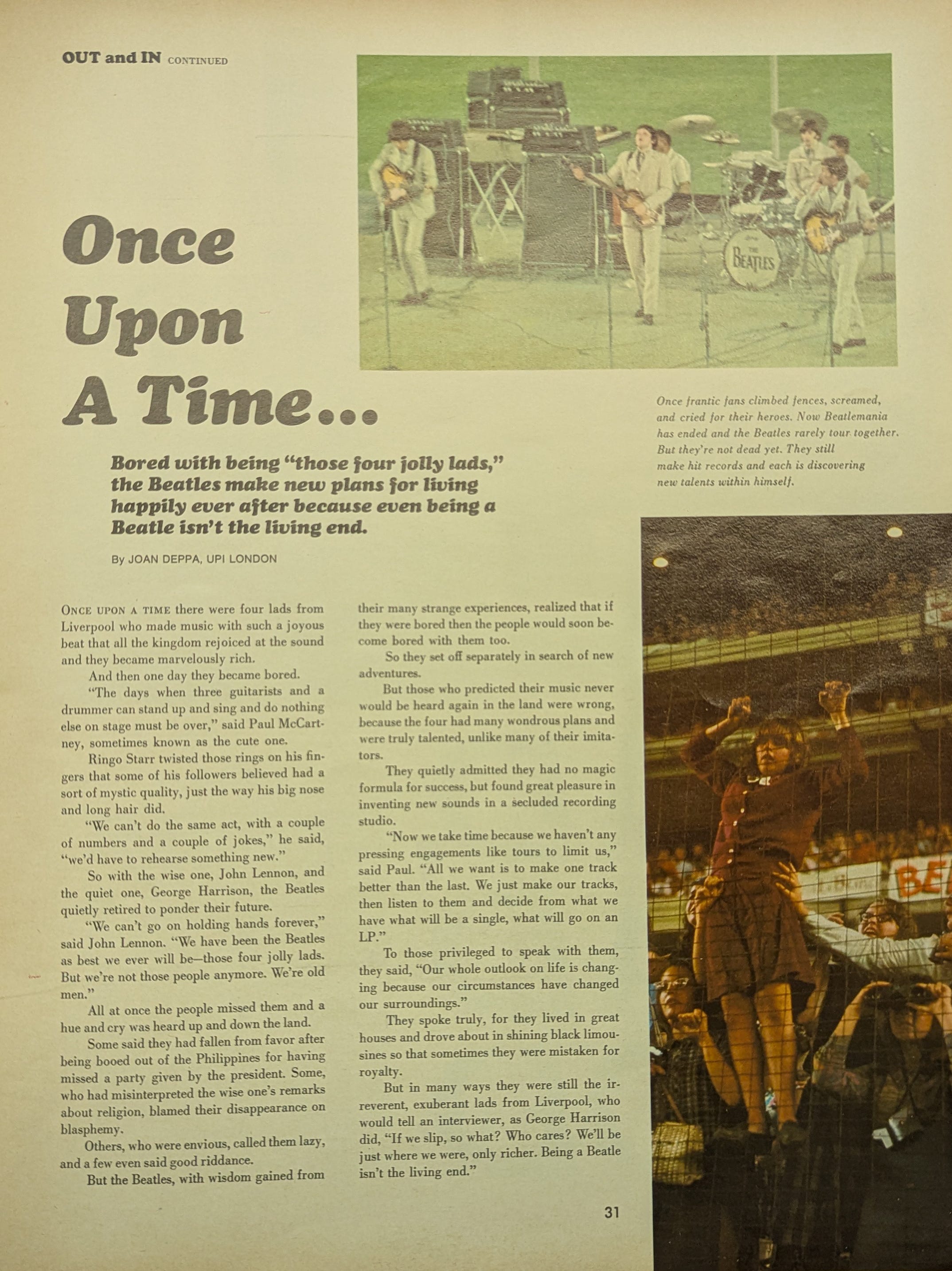
Another striking example is the November 13 1966 cover of Punch Magazine, which features The Beatles with their instruments rendered as saints in the stained glass arch of a church window, evoking the iconic arched ceiling of the Cavern. (NOTE: Punch is primarily a humour magazine, but the cover illustration is probably not intended as irony, as it’s consistent with a serious, contemporaneous review of Revolver that echoes the mythological overtones of the cover.)
Derek Taylor, Fifty Years Adrift, Genesis Publications, 1984.
A footnote bonus. A postcard of the Riviera Idlewild from the 1960s — notice that it’s a “hotel” rather than a “motel.” Nonetheless, I chose to refer to the Riviera Idlewild Motel throughout the text to offer one final tangible example of the way mythology blurs detail.
All of the primary sources remember it as a motel — and a motel, of course, is more interesting, more countercultural than a hotel when it comes to secret initiation rituals. In other words, “motel” makes for a better story, which is probably why that detail, too, has been adjusted in the telling of the Riviera Idlewild version of the folktale of the Dylan story.