

Hi everyone,
Given my lack of dexterity over the past month, I decided to take the the opportunity to listen through an extensive online archive of Beatles radio interviews. Among them was this September 1964 interview between Beatles manager Brian Epstein and journalist Larry Kane —
Larry Kane: Brian, how did the discovery of the Beatles come about? How did they enter into your life?
Brian Epstein: I heard about them through, ah, a lad who was asking for a record by them at one of my stores, or my family’s stores, in October 1961. And uh I took up this matter to find out whether they had in fact recorded anything, and in the course of this I found out they’re a Liverpool group that I had actually heard of, ummm, sometime before. And I went down to see them, ah, in Liverpool at the Cavern Club. And it was there that I, ah, first saw them.1
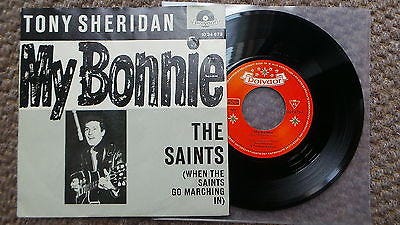
The story Brian is telling here opens with an allusion to what has become a Beatle folktale — that Brian was completely unaware of The Beatles until a customer by the name of Raymond Jones came into his NEMS record store in search of a copy of “My Bonnie,” which the Fabs had recorded in 1961 with Tony Sheridan in Hamburg. And (so the folktale goes), it was that request by Raymond Jones that brought the Fabs to Brian’s attention and motivated his fateful visit to the Cavern to see/hear them play.
We won’t go into the primary research on this folktale here. Suffice to say that — just as with the story of Dylan turning The Beatles on to pot at the Delmonico Hotel that we did a deep dive into in Seven Levels — the first person accounts of the Raymond Jones story are wildly contradictory. One witness claims to have personally known Raymond Jones. Another claims to have made Raymond Jones up, writing up a fictional request so as to have a reason to order the record. Another version insists there was never a Raymond Jones — real or fictional — at all. And so on the Raymond Jones story goes, in various permutations.
Raymond Jones, it turns out, is a real person, and you can read an interview with him on the Beatles Bible website.2 But that’s not why I’m singling out this interview quote. The more significant part of the story is that — and I’m far from the only person to point this out— it’s beyond implausible that Brian hadn’t heard of The Beatles until a customer came into the shop in search of the record.
NEMS was a major outlet for Mersey Beat, which featured so much Beatle content that it was reportedly informally referred to as the “MerseyBeatle.” What’s more, The Beatles were frequently featured on the cover.
By absolutely all accounts of those who worked for him, Brian was a micromanager who was obsessive about detail. Thus, it seems doubtful he wouldn’t have noticed who was on the cover of a popular magazine about pop music that he sold in his store which was largely dedicated to pop music. And more than that, Brian wrote a column for Mersey Beat, so it’s doubtful he didn’t flip through the pages — to make sure they got it right and maybe also for the ego gratification of seeing his name in print.
For these reasons, among others, the notion that anyone needed to inquire about the record for Brian to find out who The Beatles were seems very far-fetched indeed, in Liverpool in 1962.
Which brings us back to Brian’s Sept 1964 interview. Here it is again, so you don’t need to do the arduous work of scrolling up—
Larry Kane: Brian, how did the discovery of the Beatles come about? How did they enter into your life?
Brian Epstein: I heard about them through, ah, a lad who was asking for a record by them at one of my stores, or my family’s stores, in October 1961. And uh I took up this matter to find out whether they had in fact recorded anything, and in the course of this I found out they’re a Liverpool group that I had actually heard of, ummm, sometime before. And I went down to see them, ah, in Liverpool at the Cavern Club. And it was there that I, ah, first saw them.
This is the only version of the story I’ve found where Brian tells the events in quite this way. His telling of the story to Larry Kane appears to resolve the implausibility of Brian having first learned about The Beatles from Raymond Jones.
In this interview quote, Brian acknowledges that he had, in fact, heard of The Beatles before the Raymond Jones inquiry (“I found out that they’re a Liverpool group that I had actually heard of, ummm, sometime before.”).3 In the passage, Brian also shares that — here’s the key piece of information — it was only the recording in question that he hadn’t heard of until customers begin to ask for it.
Unlike the folk tale, this version of the story makes all kinds of sense.
“My Bonnie” was recorded in Germany in 1961. In 1962 — which is when the Raymond Jones story takes place — the record had been released only in Germany, where it made only minor inroads into the national charts. What’s more, The Beatles weren’t even the artists-of-record — it was a “Tony Sheridan and the Beat Brothers” release, with the name “The Beatles” appearing (at the time) nowhere on the record.4
In other words, being familiar with The Beatles wouldn’t in any way guarantee that Brian would know about the existence of “My Bonnie,” or that it was The Beatles backing Sheridan. And there’d be no need for him to know, until a customer requested the record.
This is another example of the way in which a story evolves from history into mythology — the details blurring, the less interesting parts shunted aside in favour of the parts that make for the best story (however implausible). Over time, Brian not having heard of the recording or known that it involved The Beatles morphed into Brian not having heard of The Beatles at all. And because that’s such an odd and improbable story, it’s more interesting than the actual story, and thus it became the story — but really the folktale — that has become part of the mythology.
Until next week.
Peace, love, and strawberry fields,
Faith 🍓
PS — With regard to the Sheridan/Beatles recordings, there’s also a whole thing about Polydor having hired a session musician overdub Pete Best’s drum parts because they weren’t up to standard. What I haven’t been able to determine is which version of “My Bonnie” is on Anthology — the one with Pete Best or the one with the session drummer.
The Beatles paid royalties to Best for the Anthology tracks he played on, but I don’t know if “My Bonnie” was one of those tracks.5 If anyone knows the answer to this — and more than that, if anyone has a link to the Sheridan recordings that are verifiably Pete Best rather than the session player overdubs — please do email Robyn. I’d be interested in comparing the overdubbed version with the Pete Best version — and I’m also happy to share both versions in a future update if anyone wants to do the same comparison.

Brian Epstein interview with Larry Kane, WKYC-TV Cleveland, September 15, 1964.
I’m not going to pull quotes for this, because the point here isn’t the individual stories, but that the primary research is, again, wildly contradictory.
That said, here’s an interview with the actual Raymond Jones — or at least the person who claims (with good credible supporting detail) to be Raymond Jones: https://www.beatlesbible.com/features/raymond-jones-interview/.
The inclusion of the “ummm” suggests that we’re getting Brian’s exact words here — which, as we talked about in detail in Seven Levels, matters a great deal when it comes to the credibility of primary source material.
That changed, of course, in 1964, during the first explosion of global Beatlemania, when Polydor released the recordings worldwide, with “The Beatles” prominently credited on the record.
Those royalties, btw, were generous and not strictly speaking necessary, since Best didn’t compose any of the songs and musicians are usually paid per session and don’t generally collect royalties from recordings.