

Hi everyone,
Thank you to all of you for being patient with me while I struggle to adjust to a life without my best girl. I’m taking it one day at a time. And thank you to all of you IRL who have been gracious about my grouchiness and mood swings and many other less than lovely things. Despite what poets and fanfic writers might have us believe, grief is not romantic. It’s messy and ugly and there is no graceful way through it.
But I am finding my way back, and this week, I want to share a few very scruffy initial thoughts on “Days We Left Behind,” in case they might be helpful to those of you who are deconstructing the lyric.
Specifically, I thought it might be useful to take a close look at the part of the song that’s (rightly, imo) getting the most attention — the so-called “middle eight” that Paul has explicitly told us is about him and John—
"Songwriters, you know, and writers in general, what else can you draw on besides the past? I mean you could do the present, but still a lot of the past in that. So anyway, this is the past. It's just a lot of memories of Liverpool for me, and that involves a little bit in the middle about John, Forthlin Road, which is where I — the street I used to live on."1
Before we do that, though, a caveat—
I haven’t yet taken a close look at — much less considered — the full lyric of “Days We Left Behind,” or the wealth of imagery in the two videos released alongside the song.
Analyzing part of a song without considering the whole song is, obviously, less than ideal. Generally speaking, any individual part of any song is best considered in the context of the whole song (and ideally the whole album and even more ideally, the whole of an artist’s work). This avoids what Grail scholar Jessie L. Weston calls “criticism by isolation” — aka, interpreting the meaning of a single element of a larger work on its own without considering its relationship to the larger work.
What’s more, even a surface listen/watch suggests that “Days We Left Behind” is a piece of sophisticated lyrical work. I suspect there’s enough subtext, metaphor and symbolism in it to justify the kind of deep dive we did for “Bless You.” Alas that will have to wait until another day, since I don’t have quite the bandwidth to do that just now (which is also why the question about “However Absurd” is still pending, my apologies to the person who asked it 326 years ago…).
All of which is to say that — to paraphrase Shakespeare — discretion is the better part of valor, and I should probably keep my lyrical interpretations to myself until I’ve considered the whole song. And mostly I’m going to do just that.
But while there are hard limits to what we can do without considering the whole song, I think there are a few things we can notice about the middle eight, just based on how language works.
So this week — perhaps because I’m a bit addlepated by various things — I’m going to cast scholarly prudence to the wind and give it a go.
Okay, then. Here’s the “middle eight”—
We met at Forthlin Road
And wrote a secret code
To never be spoken
I stand by what I said
The promise that I made
Will never be broken
As per usual with McCartney and/or Lennon, the wordplay here is tricky to parse and not at all as simple as it might appear on first glance.
My initial thought was that the promise…that will never be broken is directly related to the secret code to never be spoken. Essentially, “I, Paul, promised you, John, that I would never reveal our secret code, and I will never break that promise.”
That fits grammatically. And John has acknowledged at least once that The Beatles used a secret code to communicate in public—
'We talk in code to each other as Beatles. We always did that, when we had so many strangers round us on tours. We never really communicated with other people. Now that we don't meet strangers at all, there is no need for any communication. We understand each other. It doesn't matter about the rest.”2
The existence of a secret Beatles code isn’t especially revelatory or conspiratorial, nor is it unique to the Fabs.
Public figures often have a system of verbal and nonverbal signals that they use to communicate with their inner circle while in public. There’s no reason to think The Beatles would be an exception to this — though I’d guess/hope a Fab code would be a bit more inventive than the usual “if I scratch my nose, it means I’m bored with the person I’m talking to so please come interrupt me” sort of code that high-profle people usually use with their teams.
The thing is, though, I doubt this is the kind of code that Paul is referring to in “Days We Left Behind.”
The “secret code” Paul writes about is self-evidently personal to Paul and John, and clearly holds a deep emotional significance for Paul and presumably for John. Whatever the secret code is, it seems all but certain it refers to something just between the two of them, rather than a more general “Beatles thing.”
And indeed, there are clues in the research that suggest that John and Paul had a separate secret code of their own.
There are, for instance, oblique references from those who spent time with them that John and Paul together often seemed to inhabit a world from which everyone else was excluded. For example, here’s what one of their teenage friends in Liverpool once observed about Paul and John together—
“On one occasion that still resonates for those involved, the Quarry Men went to a party in Ford, a village on the outskirts of Liverpool, out past the Aintree Racecourse. ‘John and Paul were inseparable that night, like Siamese twins,’ says Charles Roberts, who met them en route on the upper deck of a cherry red Ripple bus. ‘It was like the rest of us didn’t exist.’ They spent most of the evening talking, conducting a whispery summit in one corner, Roberts recalls.” 3
Roberts’ recollection certainly suggests that Paul and John’s relationship was intimate and exclusionary enough to inspire the creation of that sort of code, starting in the early days in which “Days We Left Behind” is set.
Obviously, given Paul has specified that this code was secret, we probably wouldn’t recognise the use of such a code if we heard or saw it in action. That’s rather the point of having a secret code. But it might be that we get occasional glimpses of it.
We’re probably witnessing a bit of the John/Paul code in Get Back — in those cryptic exchanges between the two of them that they seem to understand just fine, but that those around them (including us) don’t. These cryptic exchanges include inside references, nonverbal gestures and lots of eye contact — and perhaps most notably, snippets of song, which we’ll come back to in a minute.4
We might also be seeing an example of a secret John/Paul code in the “spider hands” clip from the June 1964 Adelaide press conference, where it’s obvious that a silent conversation is going on between John and a somewhat reluctant Paul.5
Watch their hands, their body language, and their eyeline. (Beyond the obvious, it helps if you turn down the volume.)
And, of course, Paul wrote a whole song about just such a secret code in 1986 —which could be about Linda, except it’s not clear why Linda would need a secret code to tell her lawfully-wedded husband that she wants some private time.
All of this is to say that it seems highly likely that Paul and John did indeed have a literal secret code between them. And it’s possible that the Forthlin Road promise in “Days We Left Behind” is simply Paul’s promise never to reveal that secret code to the world.
That is certainly possible. But I’m having all kinds of trouble buying it, because it seems more than a little lightweight, given the context.
In the middle eight, Paul is making a promise to John — and more than a promise, essentially a life-long vow — originally made in private and now, sixty years after the fact, reaffirmed in public. And that promise — that vow — is the emotional centerpiece of the song Paul chose to feature on what looks to be his most personal and confessional album — an album that promises “new revelations” about “the story before the story.”
Whatever this promise is, it’s clearly an important touchstone in Paul’s relationship with John. Maybe even a defining one, given it’s a life-long vow. So is Paul really telling us that the most important promise he made to John — the vow he made and is now reaffirming with the whole world as his witness — was never to tell anyone what spider hands means?
I mean, maybe, but…
Another possibility is that the secret code isn’t so much a literal code as a euphemism for their romantic relationship (assuming there was one) — “I, Paul, promise you, John, that I’ll never tell anyone about our secret love affair.”
This is, I think, the interpretation we’re most likely to reach for if we’re considering the middle eight through the frame of the lovers possibility. But I think this interpretation might be a bit of confirmation bias — seeing what we’re expecting to see, rather than what’s really there. And that confirmation bias/expectation is probably due to the presence of the word “secret” alongside the words to never be spoken in the overall context of a (possible) hidden love affair.
The problem is that to get this interpretation to work, we have to ignore the “code” part of “secret code.” Because “code” doesn’t fit this interpretation, if what’s being promised is never to reveal a secret relationship. Two people in a relationship might have a code, but the relationship itself isn’t a “code” — it’s, well, it’s a relationship.
To get the “I promise I’ll never tell anyone about our secret love affair” interpretation to work requires turning a blind eye to this discordant use of the word “code.”
But I hope it’s self-evident that ignoring words in a lyric just because they don’t fit our interpretation of the song is a bad idea. And it’s an especially bad idea to ignore words in lyrics when we’re dealing with Paul McCartney — one of history’s most accomplished songwriters, who’s been playing with double meanings and misdirection in lyrics (and in interviews) since before most of us were born.
What helps us out here is the word “wrote,” as in we wrote a secret code.
In this context, “wrote” initially seems an odd word to pair with “code.” Yes, technically one can write a code (and here Paul’s obviously talking about a cipher rather than computer code, although you can of course write that kind of code, too). So is Paul telling us that he and John literally sat down one afternoon at Forthlin Road with a notebook and wrote out a list of words and signals with which to communicate covertly in public?
Again, maybe. But it seems beyond unlikely that this kind of literal secret code would carry so much emotional weight sixty-plus years after the fact that Paul is reaffirming his promise to keep it secret.
Paul and John writing out a literal secret code also seems unlikely just for its formality.
If there was a “talking privately in public” kind of code between them — and probably there was — it seems far more likely that such a code would have developed organically over the years, as with any two people who’ve been in a relationship for a long time. The code would likely be the result of a shared history of inside references and experiences, rather than a deliberate “let’s sit down and write out a code” situation.
But of course, there’s a whole other meaning of “wrote,” when we’re dealing with Lennon and McCartney at Forthlin Road (along with the “cheap guitars” of the opening verse). And that meaning isn’t odd at all. In fact, it’s iconic.
So iconic, in fact, that the image of John and Paul writing together at Forthlin Road is perhaps the single most iconic image of the Lennon/McCartney partnership.
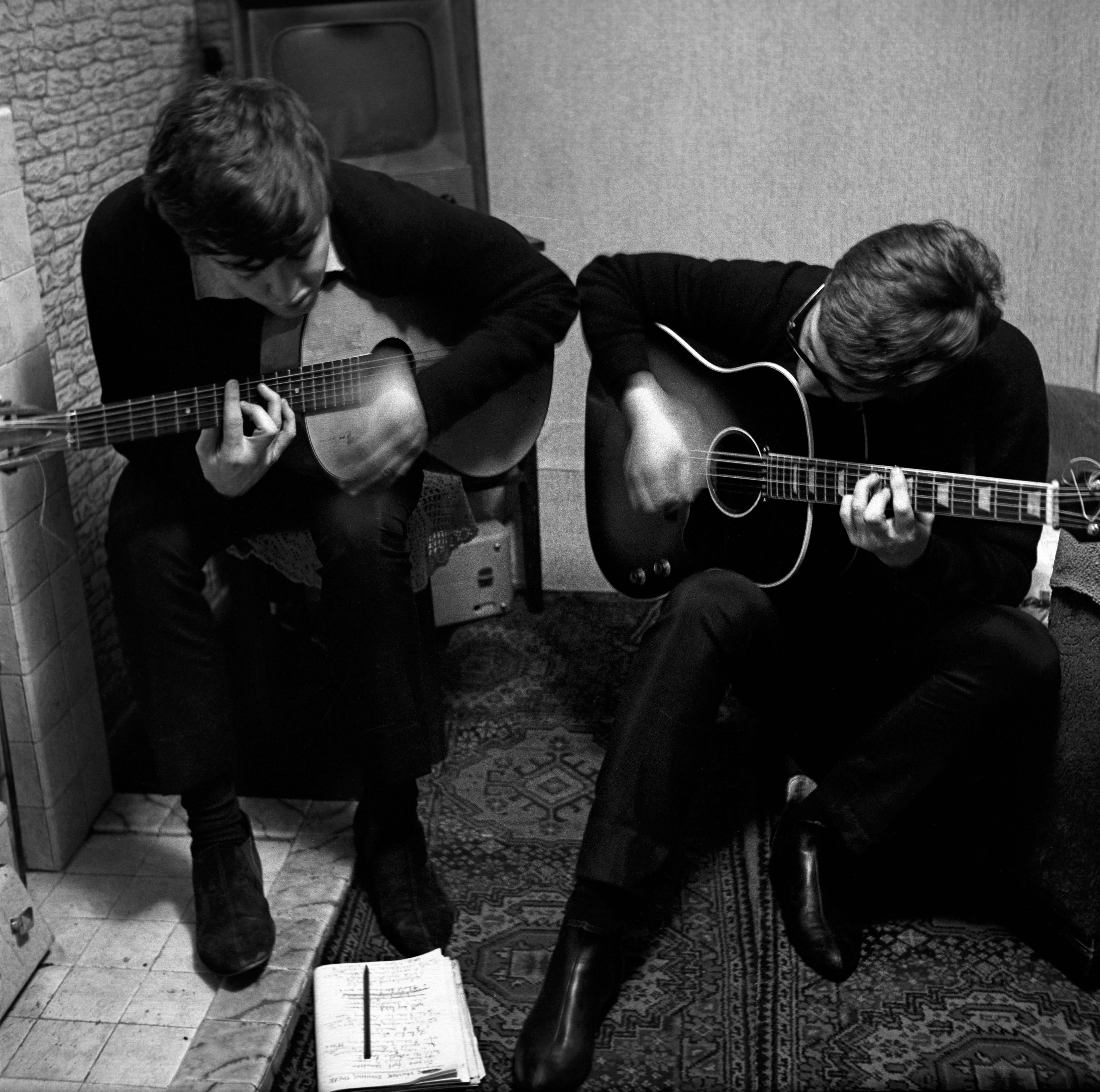
The context in which Paul has set his reference to the secret code — Lennon, McCartney, Forthlin Road, cheap guitars (in the opening verse), and writing — suggests to the point of certainty that the “secret code” Paul’s referring to is — obviously — in their songs.
This wouldn’t be a particularly big revelation. We talked at length in Part One of Beautiful Possibility about how there is overwhelming research to suggest Paul and John used their songs as a way to have a private conversation in public — which is exactly the function of a secret code.
And as we also talked in Part One, Paul and John seem to have communicated through song not just during and after the breakup, but throughout the entire history of their relationship — and still today, given we’re talking about Paul’s latest song written for John.
The next line — to never be spoken — makes it even more certain likely that the secret code refers to the songs of Lennon/McCartney.
Here’s that line in context—
We met at Forthlin Road
And wrote a secret code
To never be spoken
I stand by what I said
The promise that I made
Will never be broken
One interpretation of to never be spoken is the one we already talked about — Paul is promising isthat he will never reveal the secret code. But, again, I’m not sure that’s what’s actually happening here, for the reasons we already talked about, and also because within the structure of the middle eight, to never be spoken isn’t referring to the promise — it’s referring to the secret code.
And if the “secret code” is the songs of Lennon/McCartney — which it seems virtually certain that it is — then to never be spoken takes on a whole different meaning — because generally speaking, songs aren’t spoken, they’re sung.
It’s possible that to never be spoken is Paul is telling us (but really singing to us) that he and John immortalized their love story in their songs, and that the “secret code” is the truth of their story in those songs — a code that’s never spoken, but only sung. And more than that — a code that’s relatively easily decipherable for anyone motivated to look carefully at the deeper meaning and subtext of the songs of Lennon/McCartney.
And further, it’s possible that in this middle eight, Paul is letting us know that he’s decided to share some “new revelations” — whatever they might be — not in a spoken interview or a book or a documentary, but in the way that Paul McCartney has told us for decades is his preferred way of sharing the details of his life — in his music. And this is perhaps why he’s chosen “Days We Left Behind” as the introductory song for The Boys Of Dungeon Road.
So what then of the promise never to be broken?
Well, obviously, if the secret code is concealed in the songs of Lennon/McCartney, then by definition, the promise…that will never be broken can’t be to never reveal the code — it’s already been revealed in the songs. And it’s not like Paul’s steering us away from that code — he’s explicitly directed us to look for the truth of his life in his songs.
Here he is in 2002 in his introduction to The Lyrics—
“Over time I came to see each song as a new puzzle. It would illuminate something that was important in my life at that moment, though the meanings are not always obvious on the surface. Fans or readers, or even critics, who really want to learn more about my life should read my lyrics, which might reveal more than any single book about The Beatles could do.” (emphasis added)
If the promise Paul made to John was that he wouldn’t reveal the secret code, and if the secret code is in the songs, then telling us to go look for their story in the songs would be breaking that promise. And Paul tells us explicitly in the middle eight that he’ll never break that promise.
If the “secret code” is in the songs — which it very much seems to be — then the promise can’t be to never reveal the secret code. It’s already been revealed — for those who are willing — and Grail-fluent6 enough — to look.
So what is the promise that Paul is standing by?
Well, Paul doesn’t tell us that — at least not in the middle eight. And much as I would love to know, that’s probably how it should be because, of course, the promise is in all likelihood a private matter between Paul and John. Paul is already generous in even telling us of its existence.
But an artist can’t help but reveal themselves in their art, whether they intend to or not. And it seems virtually certain that a promise so consequential that Paul is reaffirming it sixty years after the fact is going to find its way into his songwriting. And that means that there are almost certainly more clues to the nature of that promise in other Paul McCartney songs. And Paul has directed us to look at his songs for the truth of his life, which means anything we find there is something Paul has given us permission to find.
Again, I haven’t had the opportunity yet to do a thoughtful search to see how the promise might appear in Paul’s catalogue of work — though that’s now been added to the “to do” list for researching Part Two of Beautiful Possibility. But the song that comes to mind immediately is “Get Enough” from the 2019 Explorer version of Egypt Station.
Here’s the opening verse—
There was a time when we walked by the docks
I told you I’d need you all of my life
And watching the chugs rolling by, together
Do you remember?
Do you remember the lights on the shore?
How they reflected the rain on the road
I believed that you loved me alone, it was real
Do you remember?
The docks were Liverpool’s defining geographical feature during Paul and John’s teenage years when Paul lived at Forthlin Road — certainly they were how Liverpool was most known to the rest of the world (before the Fabs, that is). Given Paul has not , to my knowledge, made a home in a city in which working docks are even a noteworthy feature since leaving Liverpool in 1963, it seems likely he’s writing about and to John.
While there are lots of reasons one might make a lifelong promise to someone we love, erotic and romantic fidelity is by far the most common motivation for such a promise. If “Get Enough” is indeed written about/to John, it suggests that Paul’s promise to John may simply have been, “I’ll love you forever” — which, of course isn’t a simple promise at all, and even more so if you’re a teenage boy in love with another boy in Liverpool in the 1950s.
And to push speculation just a step further, a pledge of fidelity and eternal love is, of course, the vow most commonly pledged in our culture, the only vow most people ever formally make — usually in the form of a wedding vow.
And while a legal wedding vow wouldn’t have been available to Paul and John at any point in John’s lifetime and for the majority of Paul’s lifetime, lovers — even secret ones — have throughout history pledged eternal love to one another in serious, binding ceremonies, whether that union was sanctioned by society or not.
Again, just speculation, for the beauty of it, and because Paul has invited us to do so.
Given Paul’s promise of a confessional album, they may well be more clues to the nature of the promise on The Boys of Dungeon Lane. We’ll need to wait to see what other revelations Paul chooses to share with us.
Whatever the specific meaning of the promise, one thing is sure—
This middle eight, all on its own, ought to dispel any lingering doubts that Paul and John’s relationship — romantic/erotic or otherwise — was intense, committed, long-term, and emotionally intimate.
In Part Two of Beautiful Possibility (and maybe even a bit sooner than that…😉), we’ll continue to explore the way in which that shared intimacy shaped the story and music of The Beatles, and thus our world and all of us.
Until next week.
Peace, love, and strawberry fields,
Faith 🍓
Oh, and also—
And about “Now And Then”—
We’re gettin’ there. Now let’s just put 1 + 1 together…

Paul McCartney, text message March 29, 2026.
John Lennon interviewed by Hunter Davies, The Beatles, Heinemann, 1968.
Charles Roberts interviewed by Bob Spitz, The Beatles, Little Brown, 2006.
A reminder here that Get Back was heavily and sometimes… creatively… edited by director Peter Jackson and his team. To requote a footnote from Part One of Beautiful Possibility—
Peter Jackson had a difficult challenge in editing the sixty-plus hours of raw footage into a coherent narrative. And in doing so, his editing is occasionally a bit too creative.
For example, the “flower pot” conversation is presented as being a secretly-recorded private conversation between John and Paul, but the original Nagra audio tapes show quite clearly that the director, Linda and — of course — Yoko were also present. A truly private conversation between John and Paul would, I suspect, have gone quite differently, and perhaps especially in January of 1969. It also would have been a brazen violation of privacy for the film crew to record John and Paul without their consent, which is why it’s ultimately a good thing that’s not what it was.
The episode in which George quits has also been edited to obscure the actual sequence of events as depicted on the Nagra sound tapes, making it seem as if George quits because of his disagreement with Paul over “Two Of Us.” We’ll get to that in Part Three of Beautiful Possibility.
This creative editing does call into question what else might have been played with in Jackson’s editing of Get Back. And it means we need to be careful in considering lengthy exchanges and cutaway shots, which might not have happened in the order in which they’re shown in Get Back.
The companion book, which purports to contain transcripts of the sessions, has also been significantly edited — which means that while Get Back is an invaluable resource for Beatles scholars, it’s also, in this way, yet another unreliable source of primary research. But when it comes to reliable source material from the Get Back sessions, the Nagra sound tapes are the only extant unedited version of those sessions, and thus the most reliable primary source.
—
And now back to our footnote for this piece — despite the creative editing, there is more than enough material in Get Back that shows the cryptic exchanges between John and Paul to suggest the presence of a secret code, deliberately created or otherwise. It’s perhaps most obvious in episode two, in and around the Peter Sellers cameo.
George is at least somewhat privy to this exchange — but only as an observer. Neither Paul nor John so much as look George’s way while the two of them are “talking.”
a term coined in Part One of Beautiful Possibility that for our purposes here means sensitive to emotional subtext