

Hi everyone,
This week, more from the radio interview archive I’ve been working my way through.
You’re no doubt familiar with the infamous “more popular than Jesus” quote that John gave journalist Maureen Cleave in 1966, and the resulting outrage among the religious zealots in the southern US during the 1966 tour.1
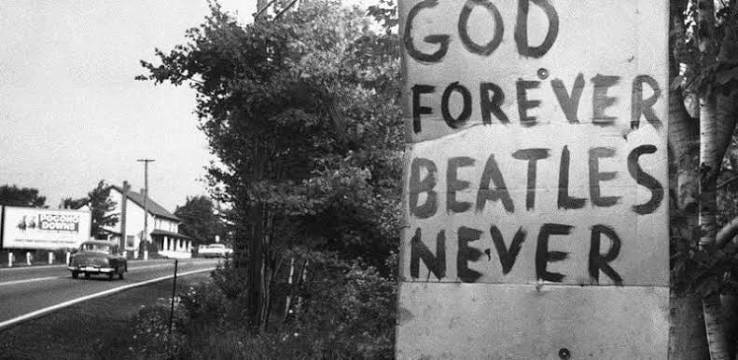
But what you might not know — I certainly didn’t — is that this sort of close encounter with American religious extremism wasn’t new for The Beatles. What happened in 1966 nearly happened in 1964 — and not once, but twice. And not to John.
Our (short) story begins on August 15 1964, when the Saturday Evening Post published a cover story on The Beatles written by Al Aronowitz (yep, that Al Aronowitz). The story included these remarks by then-Beatles publicist Derek Taylor—
“It’s incredible, absolutely incredible… Here are these four boys from Liverpool. They’re rude, they’re profane, they’re vulgar and they’ve taken over the world. It’s as if they’d founded a new religion. They’re completely anti-Christ. I mean, I’m anti-Christ as well, but they’re so anti-Christ they shock me, which isn’t an easy thing. But I’m obsessed with them. Isn’t everybody? I’m obsessed with their honesty. And the people who like them most are the people who should be outraged most.2
Oh lordy lordy, as Ringo might say. Derek Taylor is without question a skilled and intuitive publicist, but this is not one of his finest moments. Putting aside that it’s a stretch (and then some) to call The Beatles “rude, profane and vulgar,” you don’t have to be a skilled and intuitive publicist to know that referring to anyone — much less the “mop top” 1964 Beatles — as the anti-christ is perhaps not the best way to frame the joyful revolution of Beatlemania, especially in the US and especially in 1964 and maybe especially in the very suburban middle class Saturday Evening Post.
Taylor must’ve caught hell from Brian Epstein for this quote and rightly so — colourful as it is — because the bear of American religious extremism was (as they say) poked. Three days after the Post cover story was published, journalist Larry Kane interviewed evangelical preacher Edwin Teaman—
Teaman: We do evangelistic work. We preach the Bible across America.
Larry Kane: And what do you have against the Beatles as such here?
Teaman: Well, we read an issue of the Saturday Evening Post, August the 15th, the issue of 1964, and their press agent said that they were anti-Christ, vulgar, profane, and rude.
Larry Kane: And this is the reason you’re out here?
Teaman: Yes, we believe in Jesus Christ and we don’t believe that the young children should be following these ones that are anti-Christ and are profane and vulgar.
[Teaman pauses to introduce himself, then the interview continues with Kane noticing Teaman’s protest sign—]
Kane: I notice you have a word up here, idolatry. What do you mean by that?
Teaman: Idolatry is anything that’s put ahead of God, anything that a man worships.
Kane: And you believe that the Beatles fans out here are worshiping them as such in place of a God?
Teaman: Many are, because even, as the Saturday Evening Post even said, many fall out under their presence and this is idolatry worship.
Kane: Thank you very much, sir.3
I haven’t researched deeply into what was happening with Teaman, but the background noise and Kane’s reference to the word “idolatry” as being displayed — presumably on a picket sign — suggests that Teaman was leading a public protest against The Beatles in reaction to the Derek Taylor quote.
You might have noticed that this situation has all the signs of blowing up into what happened in 1966 — record burnings, boycotts, the works. But the situation doesn’t blow up. It’s likely there is more press coverage than the single interview I found in the archive, but overall, Teaman’s protest seems to have been the end of the matter. And that means that in 1964, the lead publicist for The Beatles got away with calling the Fab Four the anti-christ in one of the most widely read and conservative magazines in the country and for the most part, no one said a word about it.
But fast-forward a couple of weeks to September 3 1964 at the press conference in Indianapolis—
Reporter: Paul, some anti-religious comments have been attributed to you. Do you have anything to say concerning those?
Paul: Which were they? Which anti-religious comments were they, sir? [Notice the “sir” — this is part of that subversive Trojan Horse of respectability that we talked about in Part One of Beautiful Possibility. More on that in a minute.]
Reporter: I can’t remember an exact phrase. One indicated that you didn’t believe in religion, that it was all right for others, but perhaps not for you.
[I don’t know exactly which comments the reporter is referring to, because again, I didn’t do a deep dive into this. But it’s possible he’s talking about this undated press conference also from the 1964 tour—
Reporter: What is your opinion on the atom bomb?
Paul: I know the bomb is ethically wrong, but I won’t go around crying, I suppose I could do something like wearing those “Ban the Bomb” things, but it’s something like religion that I don’t think about. It doesn’t fit in my life.4
Obviously, in 1964 The Beatles were still babes in the woods in their understanding of the issues of the day and especially relative to talking to the press about them. And if this exchange is what the reporter is referring to, it’s small potatoes compared to Derek Taylor’s anti-christ remarks. But let’s return to the Indianapolis press conference where Paul is asked about his comments—]
Paul: Well, it— it wouldn’t been an anti-religious, uh, comment, because that’s the point. And y’know. If anything, I’m agnostic, and so I’m not anti-religious.
John or Ringo (?): You look all right to me. (laughter)
Paul: No, but if anything— I’m not religious, but I’m not anti-religious, that’s the whole point, y’know. I’m not atheist, but I am agnostic, so it probably sounded anti-religious, but the whole point is I don’t know, and I don’t pretend to know, y’know, so, uh, I can’t say anything for or against it. Interesting question.5
Notice that the reporter has characterized Paul stating that he doesn’t know for sure if there is a God as “anti-religious.” The reporter seems to be fishing for some sort of headline-grabbing scoop (as reporters do). He doesn’t get one out of Paul’s answer, but a month later, Playboy picks up the scent—
PLAYBOY: You guys seem to be pretty irreverent characters. Are any of you churchgoers?
JOHN: No.
GEORGE: No.
PAUL: Not particularly. [then maybe remembering Indianapolis] But we're not anti-religious. We probably seem anti-religious because of the fact that none of us believe in God.
[Perhaps sensing the danger, John comes to Paul’s rescue—]
JOHN: If you say you don't believe in God, everybody assumes you're anti-religious, and you probably think that's what we mean by that. We're not quite sure what we are, but I know that we're more agnostic than atheistic.
PLAYBOY: Are you speaking for the group, or just for yourself?
JOHN: For the group.
GEORGE: John's our official religious spokesman. [🤔😎]
PAUL: We all feel roughly the same. We're all agnostics.
JOHN: Most people are, anyway.
RINGO: It's better to admit it than to be a hypocrite.
JOHN: The only thing we've got against religion is the hypocritical side of it, which I can't stand. Like the clergy is always moaning about people being poor, while they themselves are all going around with millions of quid worth of robes on. That's the stuff I can't stand. [This is more or less what John says in the 1966 Maureen Cleave piece, before the “more popular than Jesus” part.]
PAUL: A new bronze door stuck on the Vatican.
RINGO: Must have cost a mighty penny.
PAUL: But believe it or not, we're not anti-Christ.
[It’s not clear if Paul is referencing Derek Taylor’s quote in the Post article or just stating a general principle. But it doesn’t matter much, because Ringo undoes any spin control that might have been accomplished with—]
RINGO: Just anti-Pope and anti-Christian.
PAUL: But you know, in America—
GEORGE: They were more shocked by us saying we were agnostics.
JOHN: Then they went potty; they couldn't take it. Same as in Australia, where they couldn't stand us not liking sports.
PAUL: In America, they're fanatical about God. I know somebody over there who said he was an atheist. The papers nearly refused to print it because it was such shocking news that somebody could actually be an atheist...(sic) yeah... (sic) and admit it.
RINGO: He speaks for all of us.6
All of this is more or less the same as what John said in his 1966 “more popular than Jesus” interview. And it’s not just John, it’s all four of them. Again, the stage is set for a blow-up.
But again, there is no blow-up, which is why this update has no dramatic finish. And that’s the point worth making here — both of these incidents came and went, and the Fabs concluded the 1964 tour without any scandals, having redefined the toppermost of the poppermost and lighting the fuse for a revolution that would weaken the cultural and institutional power of the church like nothing before or since.
So what’s different in 1964 vs 1966? Why didn’t “The Beatles are the anti-christ,” “we probably seem anti-religious because of the fact that none of us believe in God,” and “we’re not anti-religious, just anti-Christian” blow up in 1964 the way “we’re more popular than Jesus” did in 1966?
The answer to that question is complicated enough to require a much deeper exploration than we have bandwidth for in a scruffy update. But I suspect a big part of it is rooted in the mythology we talked about in Part One of Beautiful Possibility.
1964 was the beginning of global Beatlemania and the very beginning of what would become the Love Revolution. The Beatles were still perceived by most people — including the press — as harmless “mop tops” who were going to fizzle out and fade away after a few months, replaced by the next pop group to make the teenagers scream.
And while we’re here, remember that — as we also talked about in detail in Part One — that “mop top” image was key to sparking the Love Revolution. The subversive image of the harmless, clean-cut Fab Four with their tailored suits and stage bows singing about wanting to hold hands is how the Love Revolution was able to Trojan horse its way into suburban living rooms (via magazines like the Saturday Evening Post) to reach the eager eyes, ears and hearts of the pre-teens and teens who would amplify that revolution into the world-changing cultural earthquake that it became.
That “harmless mop top” image is why in 1964, virtually no one realised there was a revolution sparking right before their eyes. The Establishment wasn’t yet perceiving The Beatles as a threat to the old order of “suffer now/rewards later”/”might makes right” mythology that we talked about at length in Part One — a mythology rooted in institutional Christianity (which is, remember, different from the actual teachings of Jesus).
But by 1966, it was clear to anyone who was paying even a little bit of attention that the times they were a’changing. What started as Beatlemania had ignited into the fastest moving and most dramatic cultural revolution in recorded history (see Part One of Beautiful Possibility) — and the Establishment was starting to clue in to the rising threat to its power. And when the Establishment feels threatened (which they perpetually do because they perpetually are), they tend to go after the truth-tellers for saying out loud what the Establishment does not want said out loud.
In 1966, that truth-teller was John Lennon — by then one of the most influential and important voices in the world — pointing out that The Beatles (but really the Love Revolution and the values it embraced) were more popular than the Christianity-inspired “suffer now/rewards later” mythology that had formed the foundation of Western culture since around 300AD.
Sixty years later, evangelist Edward Teaman is lost to history, beyond his single interview with Larry Kane. And with each passing year, The Beatles become more important and influential.
What I’m suggesting here is that in the battle between “might makes right/suffer now rewards later” and the Love Revolution, it’s love that endures. It’s maybe the most important lesson the Sixties taught us — that love is the only thing that’s ever truly changed the world.
Maybe something to think about, on this October morning.
Until next week.
Peace, love, and strawberry fields,
Faith 🍓
“Christianity will go. It will vanish and shrink. I needn’t argue about that; I’m right and I’ll be proved right. We’re more popular than Jesus now; I don’t know which will go first – rock ‘n’ roll or Christianity. Jesus was all right but his disciples were thick and ordinary. It’s them twisting it that ruins it for me.” (John Lennon interviewed by Maureen Cleave, The Evening Standard, March 5, 1966.)
Saturday Evening Post cover story, Al Aronowitz (yep, that Al Aronowitz from Seven Levels), August 1964, quoted in As Time Goes By, Derek Taylor, Straight Arrow, 1973.
full quote: “It’s incredible, absolutely incredible,” says Derek Taylor, the Beatles’ press officer. “Here are these four boys from Liverpool. They’re rude, they’re profane, they’re vulgar and they’ve taken over the world. It’s as if they’d founded a new religion. They’re completely anti-Christ. I mean, I’m anti-Christ as well, but they’re so anti-Christ they shock me, which isn’t an easy thing. But I’m obsessed with them. Isn’t everybody? I’m obsessed with their honesty. And the people who like them most are the people who should be outraged most. In Australia, for example, each time we’d arrived at an airport, it was as if De Gaulle had landed, or better yet, the Messiah. The routes were lined solid, cripples threw away their sticks, sick people rushed up to the car as if a touch from one of the boys would make them well again, old women stood watching with their grandchildren, and as we’d pass by, I could see the look on their faces. It was as if some saviour had arrived and all these people were happy and relieved, as if things somehow were going to be better now.”
NOTE: It’s tempting to think maybe Aronowitz misquoted or embellished this quote to be more provocative — you might recall from Seven Levels that Aronowitz is the same journalist who may (or may not) have falsely claimed to have been present when Dylan turned the Fabs on to pot. But Taylor’s inclusion of the quote in his own book, It Was Twenty Years Ago Today, suggests Aronowitz was quoting him accurately. Not surprising, given the quote is vintage Derek Taylor.
Larry Kane interviews evangelist Edwin Teaman, WFUN-AM Miami/San Francisco, August 18 1964. (NOTE: I don’t know if this is the correct spelling of the evangelist’s name, and it’s not worth the time to research it.)
An unsourced transcript of this press conference includes the following information: “An undated 1964 North American press conference. Since Paul mentions an incident occurred in Chicago, where they played on September 5, and quotes the exact name of Detroit stadium, where the Beatles played on September 6, this conference was gave between 7 and 20 of September. The group flew back to England on 21 September, and the first question indicates that the Beatles just arrived somewhere in US to play.”
I haven’t been able to track the date down beyond this, but if it is between September 7 and September 20, then this takes place after the September 3 Indianapolis press conference in which Paul is asked about his “anti-religious comments.” If so, that means there’s a third press conference in which Paul also makes “anti-religious” comments. And yet, the situation still doesn’t blow up.
WISH-TV - Indianapolis, Indiana State Fairgrounds Radio Building, 7:00 PM press conference, September 3, 1964.
The Beatles interviewed by Jean Shepherd, October 28, 1964, published in Playboy magazine, February 1965.