

Hi everyone,
In Seven Levels, we talked in detail about the impact of the song “Yesterday” on the musical history of The Beatles. And we also talked a lot about how the critical and popular acclaim bestowed on “Yesterday” from the time of its first release seems to have been pivotal in shaping (and ultimately fraying) the relationship between John and Paul.
This week, I want to share a few more bits from the radio interview archive I’ve been going through — because “Yesterday” surfaces frequently in press coverage of the 1965-66 era. [🚨ALERT: Much of this update probably won’t make a lot of sense if you haven’t yet listened to/read Seven Levels, or at the least, Unscrambling Yesterday.]
First up is this clip from a 1966 interview with John on the set of “How I Won The War”—
Interviewer: “You know, it’s marvelous, John, the last couple of years, the wonderful wonderful songs that have come out of you and Paul, and that really have established you in the complete universal audience as what you always were — great songwriters, you know. “Michelle” and “Yesterday,” you know, just wonderful standards. As you know, everybody’s done them from Count Basie to Ella Fitzgerald. It must be a great satisfaction for you. [NOTE: “Yesterday” is, of course, generally said to be entirely written by Paul. And while John contributed to “Michelle,” it, too, seems to have been primarily composed by Paul. Despite this, John is gracious in his reply—]
John: It is, you know. It’s great. It’s— it’s great doing them. See how they do it, too.
Interviewer: Because you know, I remember the first time we met, and as always when a new group cracks through, the skeptics, the doubters and so on. But finally, the proof which was always there, finally everybody realized, hey wow, these guys really are great songwriters, something that you knew all the time.
John: Well, we didn’t know. You don’t know till— till it happens.
[The interviewer then pushes his point with—] Interviewer: But nobody thought you could write songs like “Michelle” and “Yesterday.”
John: No, because they were too busy just looking at the Beatle image, you know.
Interviewer: More ballads like that coming out, you think?
John: Yeah, there’s usually— they’re always there, you know. They just come out. [John’s “they just come out” is likely a reference to both Paul’s having dreamed the melody for “Yesterday” and also more broadly, the prolific creative unfurling that Paul is in the midst of, that we talked about in Seven Levels.]
Interviewer: You like the soft things like that or—?
John: Yeah. I like it—
Interviewer: Getting romantic in your old age.
John: Always had a bit of romantic in me, y’know.
Interviewer: They’re so haunting, y’know. And I believe it’s only the beginning, isn’t it, John? For songwriting.
John: I hope so. We’re both still fairly young, especially as musicians, or songwriters.
Interviewer: Where’s the inspiration come from? Or is it just craftsmanship? Can you just sit down at a given time and say we have to write now, and out it comes? [Remember here that when this interview takes place, John is struggling with his own creative process, so this question is almost certainly landing quite differently for John than the interviewer presumably intends.]
John: Well, sometimes it comes out, you know, sometimes they say, now you must write and now we write. But it doesn’t come some days, and we sit there for days, just talking to each other, messing around, not doing anything.1
[John’s either not letting on that his line of questioning is (almost certainly) painful for him, or the interviewer isn’t Grail-fluent enough to notice, because he continues with—] Interviewer: How was “Michelle” written?
John: (audible sigh) Well, Paul had this idea about writing a bit with some other language, with French in it. and he just sort of had a bit of a—I don’t know, a verse, and a couple of words and the idea. I— I think we had some other name or something. Oh, we used to call it— we used to talk double-dutch French (sings in faux French) like that. So we had that and he just brought it along and we sort of started fiddling around trying to get a middle eight, and we pinched it a little bit from somewhere and stuck it in the middle eight and off we went.
Interviewer: What about “Yesterday”?
John: “Yesterday” is Paul completely on his own, really. We just helped finishing off the rhythms around it, you know, tidying it up.2
This interview is an especially blatant example, but it’s part of a larger pattern. Over and over again in 1965-66, when journalists and critics talk about the extraordinary leap in the songwriting craft of Lennon/McCartney during this period, it’s Paul’s songs they bring up — "Michelle” and “Eleanor Rigby,” and always, always, “Yesterday.”
There is, of course, nothing at all wrong with this. It’s beyond dispute that all three of those songs are masterpieces. The problem is that with an occasional exception of “Tomorrow Never Knows” and “Norwegian Wood” (where they ask only about George’s sitar), I’ve yet to encounter an interview from this time period in which John is asked about a song for which he was the primary composer. And it’s not like there isn’t a wealth to choose from, including “In My Life,” “Girl,” and, well, virtually everything else John wrote on Rubber Soul and Revolver.3
What I’m suggesting here is that once upon a time in 1965-66, it was in a small way the opposite of the distorted narrative of “John/more vs Paul/less” that we talked about at length in Part One of Beautiful Possibility. Instead, it was the opposite — at least from John’s point of view, it must have felt like “John/less vs Paul/more.”
But unlike the way the press fueled the distorted “John/more vs. Paul/less” narrative during the breakup, in 1965-66, the media’s interest in Paul’s songs was almost certainly benign ignorance, and thus done with the best of intentions. Certainly the journalist who interviewed John on the set of “How I Won the War” thought he was offering John the highest respect for his craft.
This is because up until after the breakup, John and Paul faithfully honoured their covenant to share co-credit for every song, regardless of who contributed what. Because of this, unless they were told otherwise by either John or Paul, journalists would have no way of knowing that the three songs they continually cited as the best of Lennon/McCartney were primarily written by Paul.
As we also talked about in Part One of Beautiful Possibility and especially in episode 1:7 (“The Measure of a Man”), this model of partnership/collaboration was a very good thing for the world — John and Paul’s fidelity to their shared credit was the antithesis of the distorted, “John vs Paul” narrative of competition and bitterness and rivalry that came in the aftermath of the break-up.
But while the shared credit was in many ways beautiful and transformative, it was in some ways maybe not such a good thing for John, at least not in 1965-66. Because now’s a good time to point out that this interview and many similar interviews took place during the same time period we talked about in Seven Levels, when John was struggling to keep pace with Paul’s (possibly cannabis-fueled) creative unfurling, and when his best plan for that was to hurl himself into a dangerous spiral of drug abuse and other self-destructive behavior as a way to supercharge his own creative process.
There’s no reasonable way that the press coverage of “Yesterday” (and “Michelle" and “Eleanor Rigby") didn’t add fuel to that toxic cocktail.
There’s more, too. Later in the same interview on the set of “How I Won the War,” there’s this exchange—
Interviewer: When are you gonna be doing another tour, do you know?
John: No idea. I know we’ve got music to write soon as we get back. And Paul’s just signed us up to write the music for a film. So I suppose it’s off the plane and into bed and knock knock knock, get up and write some songs.
Interviewer: A film that’s not your own?
John: Yes.
Interviewer: Very exciting.
The film that the interviewer is referencing here is almost certainly “The Family Way,” a 1966 romantic comedy starring John and Hailey Mills. But as far as we know, Paul had not, in fact, signed up the “us” of Lennon/McCartney to write the score, as John seems to believe. Quite the contrary — Paul (along with George Martin) was already writing the score — without John — while John was away filming “How I Won The War.”
John doesn’t seem to know this, though, based on his answer in this interview. And that means that this part of the story is yet another piece that doesn’t quite add up, because here’s Paul’s version of events, from a 1995 interview—
Interviewer: [The Family Way soundtrack] was actually the first time you would officially compose outside the Lennon-McCartney tandem.
PAUL: Yes, and you know, it’s funny. That’s true. It’s funny because talking to Yoko recently, you know, you talk about all these things that happen way back in history. It turns out John was not pleased; but I didn’t know ‘til a year ago that he wasn’t pleased. He always told me, “Fine.” ‘Cause he’d been acting in a film – he did a film called How I Won The War – so we started to do little solo thing, just for a change, just for a break, and so I assumed, I asked him, “Is it okay with you?” He said, “Yeah, fine, fine.”
But Yoko told me that he was actually a little bit put off by that, because he hoped probably that I would say Lennon-McCartney will write this together. But to me it seemed a good opportunity to get away of what I did normally. But Yoko just told me apparently John was a little bit hurt about that. Which is sad. But we did actually talk about it. He just never told me at that time. He probably just covered up.
Interviewer: Because that was the first time we could read: music composed by Paul McCartney?
PAUL: Yeah, that’s right. For me it was very interesting, because it allowed me something of my own. You know, like women these days want to get away from their husbands, get a life of their own. It was a bit that. Because with The Beatles, it was a bit like a marriage. It was quite good to just get away do something of my own. I think if I’d known John was disturbed, I would have just asked him to join me. We could have done that.4
We’re getting John’s version of the story contemporaneously as it happened, but as we’ve discussed, John is an unreliable narrator — though somewhat less so during the Beatle years than after. We’re getting Paul’s version three decades after the fact (and through Yoko, who as we’ve also discussed, is also an unreliable narrator). All of which means we’ll probably never know for sure how the invitation to write “The Family Way” score went down or to whom it was extended.
What we can be very confident of is that John had no hand in writing the score itself — if he had participated, it’s certain Paul and George Martin would have mentioned that, and equally certain that the score would be credited to “Lennon/McCartney” rather than just Paul.
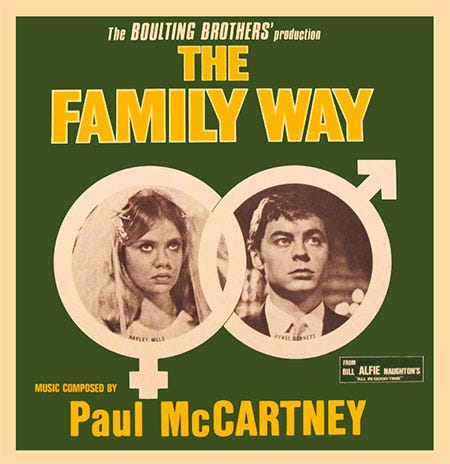
However it happened that Paul (and George Martin) wrote the score, the relevant point here is that given the “Paul McCartney wrote the score!” publicity surrounding the film — not to mention that the love theme from the movie went on to win the Ivor Novello 1968 Best Instrumental Theme — this whole situation would inevitably have added more fuel to John’s creative insecurity. And exponentially more so, if John truly thought “The Family Way” was a Lennon/McCartney project, only to return from the wars (so to speak) to find Paul (and George Martin) having composed the music without him. As with Paul’s dreaming of the melody to “Yesterday,” it seems all-but-certain that John interpreted Paul’s writing the score on his own — along with the Novello Award — as “proof” that McCartney didn’t need Lennon.
You know what else maybe added fuel to John’s “Yesterday”-fueled creative insecurity?
Shortly before the “How I Won The War” interview, journalist Jerry Bishop asked George (Harrison) to name his favourite Beatles song of all time. George’s answer? You guessed it —
“‘Yesterday.’ Which is the one where Paul sings with violins and it’s very lovely.”5
It’s not completely clear if George is being ironic here (“Opportunity knocks for Paul McCartney of Liverpool…”6), but even if he is, the audio suggests that John may have been present to hear George’s answer — and it’s not at all clear that John, in the shape he was in at the time, would have recognised it as irony. I’ll leave you to contemplate the effect that might have had on John’s creative confidence — but I will suggest that it’s perhaps not a coincidence that John spent much of his time on the set of “How I Won the War” working on “Strawberry Fields Forever.” He likely felt he had something to prove — to the world, to Paul, and perhaps most of all, to himself.
And finally there’s this, from a March 1967 BBC interview for the Ivor Novello Awards (for which “Yesterday” won song of the year)—
Interviewer: Give us the inside story on “Yesterday,” John Lennon.
John: Uh, this is John saying I don’t know anything about that one. Hand you over to Paul—
[But contrary to John’s claim, here’s what Paul tells the interviewer—]
Paul: This is Paul taking up the story. Staying in a holiday villa in Corsica, strumming away on a medieval guitar. I thought (sings) “scrambled egg...”. but I knew I could finish it. And eventually I took it back and with the ancient wisdom of the East, John came up with (sings) “yesterday...”. and I thought, that’s enough of a story for that one.7
Is this Paul doing some damage control for John’s benefit by suggesting — at an awards ceremony for the song — that it wasn’t a solo composition? Maybe — we’ve talked a lot in both Beautiful Possibility and Seven Levels about Paul’s role as the John Whisperer. But I’m not convinced.
First, John would obviously know it wasn’t true if it wasn’t true, so it’s hard to see how Paul telling the press John contributed to a song he didn’t contribute to would do anything but make John feel worse. And second, this isn’t the only suggestion we have that “Yesterday” might not be as solo a composition as it’s evolved to be in the traditional story. Here’s John in 1965—
“[“Yesterday”] was around for months before we finally completed it. Paul wrote nearly all of it, but we just couldn’t find the right title. Every time we got together to write songs or for a recording session, this would come up. We called it “Scrambled Eggs” and it became a joke between us. We almost had it finished, we had made up our minds that only a one word title would suit — and believe me, we just couldn’t find the right one. Then one morning Paul woke up and the song and the title were both there — completed. I know it sounds like a fairy tale — but it is the plain truth.”8
I don’t have an explanation for these two quotes — both contemporaneous to the time period, one from John and one from Paul, and both saying the identical thing. Did John — perhaps in his distressed, creatively insecure, drug-addled state of mind — somehow forget that he contributed to the lyrics for “Yesterday”? And did Paul forget, too, in the years after that infamous line in “How Do You Sleep?” and after being on the defensive about it for decades prior?
I don’t think it’s likely we’ll get the answer to this mystery. And I don’t think we’ll ever know for 100% sure who wrote what relative to “Yesterday” — and indeed, any other Lennon/McCartney song. And I’m grateful for that — while it makes tracing their story in their lyrics that much more challenging, I nonetheless think that’s the way it ought to be, when it comes to the sacred dance of creative partnership.
And finally, before we sign off for the week…
As I mentioned in a footnote in Seven Levels, John’s quote above re: the origin story of “Yesterday” suggests that the story about Paul dreaming the song in the attic bedroom of the Asher house might also be not quite accurate. Here’s an edited version of that footnote—
I’m not planting a flag on this, but there’s an intimacy in John’s casual use of “Paul woke up,” and an easy way of talking about “Yesterday”as a joint composition that hints — ever so subtly — at the possibility that Paul was with John when he woke up from his dream — and that the “attic of the Asher house” version might be a bit of mythologizing “to protect wives and girlfriends” — which Paul has cited as the motivation for The Beatles having fictionalized a third to a half of their story.9
Like I said, it’s a subtle inference on John’s part, and not something I’d draw any conclusions from or suggest with any kind of certainty whatsoever.10
Nonetheless, something to ponder, on a Monday morning.
Until next week.
Peace, love, and strawberry fields,
Faith 🍓

John’s answer here is markedly different from Paul’s often-told story that he and John never once came away emptyhanded from a writing session. There’s probably no way to determine which version of this part of the story is true — or whether John is perhaps referring to his solo efforts here rather than his joint songwriting sessions with Paul. But I will offer that as someone who has engaged in the creative process virtually all of my life, and has for much of that time worked with a brilliant and trusted creative partner, I’m skeptical that even two geniuses can have that perfect a track record, especially when one partner struggles with lifelong creative insecurity.
John Lennon interview with Fred Robbins on The Set Of How I Won The War, Assignment Hollywood, October 29, 1966 (Note: This archive, while extensive, is not reliable when it comes to dates and I haven’t verified this date. So please don’t re-quote this without first verifying that it’s dated correctly. That said, since filming in Spain took place between September and early November 1966 and the interview is clearly taking place on that set in Spain, the date is at the least ballpark accurate, which is all we needed for this update.)
I say “primarily written by Paul” or “primarily written by John,” but a reminder that in an important way, there is no such thing as a Lennon/McCartney song, together or solo, composed by only one of the two. We talked about why that is here: https://www.beatlesabbey.com/p/rabbit-hole-theres-no-such-thing
Paul McCartney interview with Michel Laverdière, MPL offices, London, May 23rd, 1995.
The Beatles interview with Jerry Bishop, The Beatles Talk LP- Side 2, August 30 1966 interview with Jerry G. Bishop. (Again, the date is probably not accurate, but again, for our purposes here, it doesn’t really matter.)
A reference to George’s dead pan introduction to Paul’s first public performance of “Yesterday,” on Blackpool Night Out.
Brian Matthews interview with Lennon/McCartney, The Ivor Novello Awards for 1966, BBC Radio, broadcast March 20, 1967.
Melody Maker, November 13, 1965.
“During an interview with Paul McCartney, he explained how nearly forty years ago the Beatles agreed on a “version of the facts” that would serve as their story, and they stuck to — and embroidered upon — it ever since.” (The Beatles, Bob Spitz, Little Brown, 2006.)
From Seven Levels, Chapter 2 (“Of Emperors and Princes”) https://www.beatlesabbey.com/p/chapter-2-of-emperors-and-princes