

Hi everyone,
This week, I’ve been haunted by a 1991 article in Musician magazine — an in-depth exploration of Paul’s creative process in writing Liverpool Oratorio, his first full-length classical piece.
The article is centered around an extended and startlingly candid interview with his collaborator on the project, British composer/conductor Carl Davis. Davis’ interview is so candid, in fact, that I’m surprised that Paul still seems to have a good relationship with him.
It’s a two-part piece, spread over two issues of the magazine. And imo, the full piece — and especially part 2 (Oct 1991) — is a must-read for anyone who wants to understand Paul McCartney after the breakup — and especially after 1980. Davis’ unique perspective as arguably Paul’s most serious collaborator since John provides a remarkable and poignant insight into the damage that the “John/more vs Paul/less” distorted narrative has done to Paul’s self-confidence as a collaborative partner.
(The evolution of “John/more vs Paul/less” and the damage that it’s done to our world — and especially to Paul — is a central theme of Part One of Beautiful Possibility, and especially episodes 1:8/1:9.)
There are download links to the full versions of both parts of the article at the end of this update. And below you’ll find an excerpt of the most relevant passages. (⚠️PLEASE NOTE: What follows is not a continuous excerpt nor is it the full article — it’s a cut-up piece, constructed out of relevant passages, arranged into a coherent order.)
Until next week.
Peace, love, and strawberry fields,
Faith 🍓
McCartney Settles the Score
(excerpted from Musician Magazine Sept/Oct 1991, written by Dennis Polkow)
So what was the actual working process between McCartney and Davis that produced the Liverpool Oratorio?
“I began by playing some ‘Hey Jude’-style chords on the piano,” says Davis, “and he said, `No, no, no, absolutely not, forget it. I want more dissonance than that.’ So he started singing and tried to convey an aural picture to me of what he imagined. I tried to get it out of him, so that it would all be very McCartneyish. Then I said, ‘ I’ll take it home and flesh it out.’”
McCartney would have none of it: “I told Carl, ‘No, we can’t do it like that because it’s going to be too much input from you. Let me be with you through every little second.’ He said. ‘ It’s going to be really boring? ‘ It won’t be, I’ve done this before. I like it. I sat with George Martin arranging the string quartet for “Yesterday,” the strings for “Eleanor Rigby” and things like that.’ So I sat with Carl through eyerything—through the arrangements, through the texts, through the violin solo. I didn’t actually let him have one minute on his own. I thought if he did, it would start to become more his work. He was happy to do it that way. but he kept warning me how boring it would be. ‘You’ll have to just sit there while I write these 30 bars,’ he’d say. yeah, that’s great. no problem.’ It was very interesting to me and very educational, actually. I learned a lot.”
It became increasingly clear to Davis that his own role in the work was going to be larger than he had at first anticipated. Not only was McCartney largely unfamiliar with the classical tradition, but he didn’t read or write a note of music.
“The music I write I don’t actually write down,” McCartney says. “I don’t notate music. I can hear it, think it, orchestrate it. But when it comes time to actually write it out I have a sort of musical dyslexia. I just can’t associate those little dots with what I hear in my head; it just seems like two different worlds.”
“No big thing,” was Davis’ gung-ho response to McCartney’s reluctance to learn to read and notate. “I told him, ‘Look, I could teach you everything there is to know in about 48 hours; there are really only about 12 things to learn. It’s easier than typing.’ He wouldn’t have any of it and kept saying, ‘No, no, I really, really don’t want to.’ Why?’ ‘Well, I kind of want to preserve my innocence. I really want to wonder at all this.’
“I kept telling him, ‘But you’ll be able to express yourself so much more clearly,’ but he was adamant. I even thought of giving his 13-year-old son a few lessons in the hope that Paul would be lurking about and catch on. He’s absolutely fascinated by it, but terrified at learning it. That photograph in the program with us both at the piano is him riveted by my writing things down in notation, just riveted. I kept saying, it’s no process at all, it’s just five lines and this is the C, the E and the G on the lines, and between the lines are D, F, A and C. If you write an open note with a stem, it’s two beats, without one it’s four beats. It’s just a language.’ He’d say, ‘Oh no, no.’
“Paul frankly did get very uptight that because everyone knew that I was the one conducting, I was the one who [notated the score]. He got terribly worried — which comes over him in waves — that people will think that he did not play a major part in this and that it was all really me. But in fact, that is not the case. We tried to make it as much his work as possible.”
“We certainly didn’t want this to be thought of as ‘McCartney arranged by Davis,’” says Davis. “I let him take the lead, which was very difficult for him because he still suffers from the aftermath of the Lennon collaboration, of having this highly critical loved-hated friend and colleague. He feels that with the martyrdom of Lennon, Lennon is given the credit for all of the writing and innovation of the Beatles, and Paul suffers from this. I know, after spending two and a half years with him, that the McCartney songs are his own, and that he is his own man.
“I think a lot of this is his reading, ‘Lennon was the interesting factor of the Beatles, it was Lennon that was innovative,’ which is really not the truth. He carries that wound, that burden in that nothing he does can now be equal with anyone.”
“I feel in his black moments,” [Davis said.] “he somehow dumps that on me, and I’m not really competitive in this situation. I’ll say, ‘How should this go?’ and push and pummel him. I did some really naughty things like, ‘Okay, Paul, it’s time for the hit single, right now.’ To see him back away looking extremely frightened while I was being sadistic was fun. That’s how I got ‘Save the Child.’ I hope the world thinks like I do, that it’s really something.”
As Davis’ role as McCartney’s collaborator grew, he assumed that they were writing the “Liverpool Oratorio” by McCartney and Davis. Here, Davis was in for a surprise. McCartney insisted that the piece be called ‘Paul McCartney’s Liverpool Oratorio’ by Paul McCartney and Carl Davis. “It’s something that Paul insisted on and that I’ve had to live with,” admits Davis. “It was, in a sense, the contract breaker. He felt that he had to be the primary element in it, that people had to perceive him as driving the vehicle.”
But doesn’t calling it that indicate a certain — ”Worry, I know,” [Davis agrees.] “I wish he hadn’t done it, because it hurts him as well. At the time when it came up, I didn’t see a way of arguing it, and of course, McCartney is a name to conjure with. McCartney above the title will attract more attention to the work and will make more noise commercially, so I live with it. He felt very strongly that that was how it had to go. It was a question at the contractual stage of there being no movement possible on that. It was really up to me. I’ve actually reached a psychological stasis: I live with it. But I can tell that in some ways it’s an equal worry for him, because he has to keep justifying the title. I think it’s a pity.”
“What I’m hoping is that the composing process was so joyous — and we did so enjoy working together — that we can actually get past this. It’s the only thing between us that is difficult. I think a lot of this is his reading, ‘Lennon was the interesting factor of the Beatles, it was Lennon that was innovative,’ which is really not the truth. He carries that wound, that burden in that nothing he does can now be equal with anyone, and people have to know that his was the decisive voice in all of this. So I’m patient about it. You have to let him come around, and realize that it’s not going to hurt the work. It’s very strange for a writer to use his own name in a title, except ironically. It’s very tricky, and it simply has to do with what he needs.”
“And,” adds Davis, with an obvious heartfelt affection, “I like him. That’s the other thing, I actually like him. Past all of this, he’s a good-hearted man. The causes he supports and the things he wants out of life are really very benign, helpful and civilized.
“The really courageous and wonderful thing about McCartney is that he strives to maintain a certain normality in his life: the family, his wife, the children, a day-to-day routine of living a very simple life. Sometimes, of course, when he’s rolling and you have the big tour going on or this kind of event, you are aware of the reserves he can draw upon professionally, and then it’s something else. But in his day-to-day life, it’s not grandeur, it’s simplicity. In a way, thinking about the work we’ve done, that is the message: family life and being together, a very simple basic appeal for normality. He is very entwined with being near the people that he loves, and can’t abide separation from them.”
[Jerry Hadley, who sang Shanty in Liverpool Oratorio, had this to say about working with Paul]—
“[Leonard Bernstein] was not afraid of sentiment, in the best sense of the word, and neither is Paul. I’m not talking about heart-on-the-sleeve, overly saccharine kind of sentiment, I mean real honest, human sentiment. Also, Paul has one of the keenest musical minds I have ever encountered. He has one of the most profoundly clear visions of what he is creating of anybody I’ve ever met, on a level equal to Lenny’s. In the essence of creativity, perhaps it’s the clarity that all the greats have had. West Side Story did not happen by accident. The ‘Liverpool Oratorio’ and the great McCartney pop songs did not happen by accident. These people don’t flail in the dark.”
What McCartney isn’t saying out loud, at the moment, is how much the climax of the piece is similar to what actually happened to him and his wife Linda (the Yorkville role of Mary Dee, sung by te Kanawa) as newlyweds immediately after the breakup of the Beatles. Those were the days when McCartney wouldn’t get out of bed, would go out on nightly drunken and drug rampages, all the while expecting his first baby. “I was the most miserable I had been since the death of my mother,” he says of that time.
Also not so obvious is that McCartney has penned a gorgeous black-spiritual-like piece for mezzo-soprano that intones the last words spoken to John Lennon as he lay dying of gunshot wounds in the back of a New York police car-”Do you know who you are?”
McCartney gets a bit choked up at one point when he reveals, “Not a day goes by when I don’t think of John. He would have loved the spirit of doing this after 30 years of rock ‘n’ roll; he would have loved the idea of risking such a huge gamble.”
[Davis recalls,] “One day we were passing by a church [near Penny Lane] when he said, ‘Here’s the Church of St. Barnabas — I sang there as a choir boy.’ There are hidden depths and things he does not admit to.”
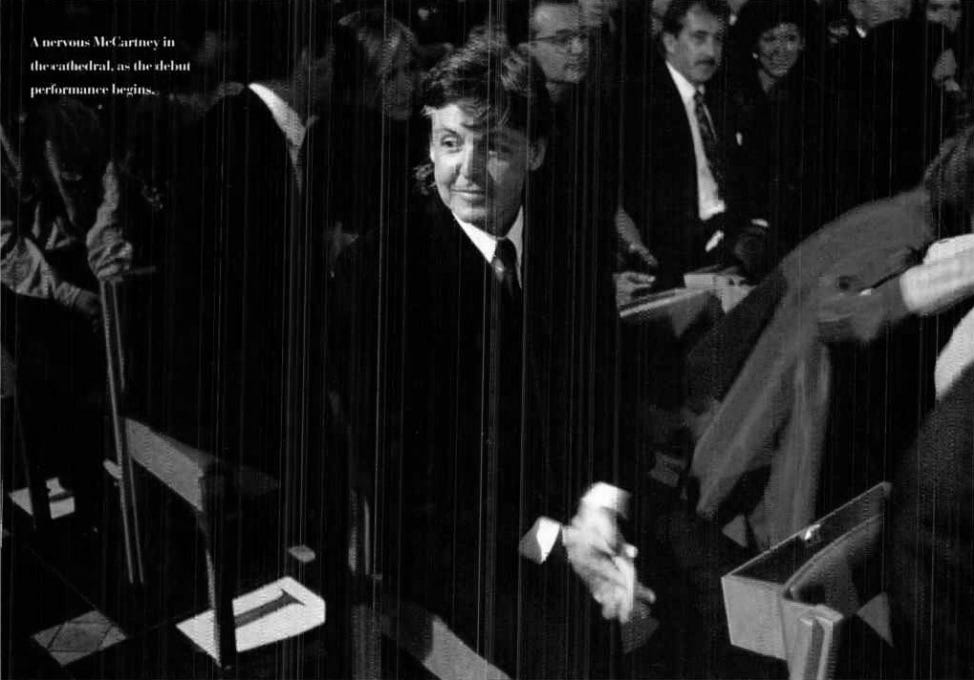
McCartney may have been able to make St. Barnabas, but he couldn’t get into the Cathedral choir because he couldn’t sight-read. Thirty-eight years later, a much larger audition looms over him in the same building. And Paul McCartney, for the first time in many years, is again forced to face a novice’s fears.
Faith note: A big thank you to writer Dennis Polkow for his work here. Other than Davis’ unsettling comment about how “fun” it was to have frightened Paul during the creative process (which is Davis, not Polkow), this is an unexpectedly Grail-fluent — aka emotionally sensitive — article, especially given it was written in the darkest years of the distorted narrative.


Further reading/listening:
A Micro-Rabbit Hole on why it’s not unusual that Paul doesn’t read/write formal musical notation—

An exploration of the damage the distorted narrative has done to Paul McCartney (and how we can help to heal that wound)—

