

Hi everyone,
This week, I thought I’d share a little collection of unrelated things that caught my attention as I continue to research Part Two of Beautiful Possibility.
First, this quote, from music writer Jeff Fitzgerald—
Jazz in the 1950’s was to society as a negative is to a photograph, born of the same elements but quite different in makeup and appearance. The music began to take on a restlessness, reflecting an undercurrent of trepidation lying just beneath the surface. Jazz became more cerebral, more introspective, more likely to get you some leg from a Vassar College undergrad. It was the music of a generation in transition, searching for its identity in a world populated by increasingly invisible, intangible perils. In a world living under the shadow of the atomic bomb and the creeping menace of Communism (not to mention the constant threat of Rock Hudson movies), and an increasingly automated society feeling the control of its own daily existence slipping away with the push of every button, it is perfectly logical that the music should reflect that nameless angst. And that’s as close to real insight as you’re likely to get out of me.1
We didn’t talk much about how jazz fits into the musical/mythological timeline that we laid out in Part One of Beautiful Possibility, but this is more or less what I might write, if I were to write backwards into that era — minus the Rock Hudson reference.
What the above passage hints at is the likely reason the beatniks connected much more deeply to jazz than to rock-n-roll — jazz was popularized initially as the direct expression of the lived fear/death trauma of two world wars, whereas early rock-and-roll was more the reaction to that trauma from the children born to into the post-war world. Put another way, one might say jazz was the expression of the fear/trauma and rock-and-roll was (among other things) the distraction from the fear/trauma.2
And this, in turn, causes me to wonder if we might be on the cusp of a resurgent interest in jazz, or if there’s something else happening in popular music today that’s expressing collective, widespread fear/trauma in the same way jazz did back then.
I for sure wouldn’t plant a flag on my off-the-cuff analysis of Fitzgerald’s quote — I’m not researching jazz for Part Two (or for any other reason), and I only happened on this quote in a book about the advertising revolution of the 1960s (The Real Mad Men: The Renegades of Madison Avenue and the Golden Age of Advertising, Andrew Cracknell, Running Press, 2012.). But it’s an interesting passage that brings up interesting thoughts for me, and I hope maybe also for you.
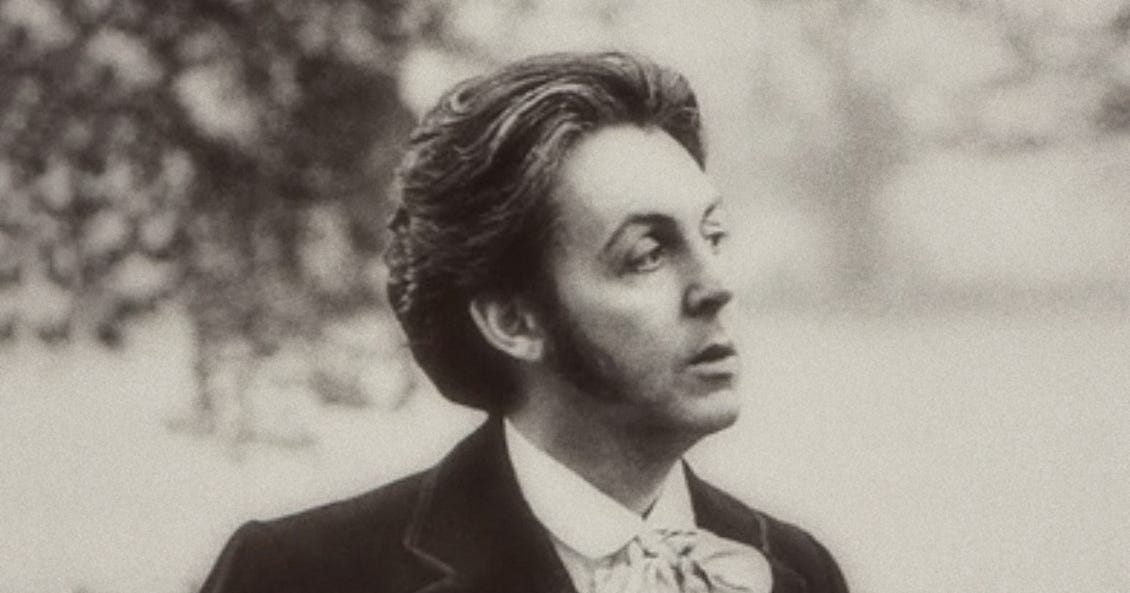
In addition to reading about 1960s advertising, I’ve been working through Paul McCartney interviews from the Northwestern archive.
Here’s Paul in 1985 telling us that John told him that he wrote “Jealous Guy” for Paul. A not-insignificant moment of candor, given it’s the only time I can remember Paul revealing this.
[The breakup] was a weird time. The people who were managing us were whispering in our ears and trying to turn us against each other and it became like a feuding family. In the end, I think John had some tough breaks. He used to say, ‘Everyone is on the McCartney bandwagon.’ He wrote “I’m Just a Jealous Guy,” and he said that the song was about me. So I think it was just some kind of jealousy, I had to try and forgive John because I sort of knew where he was coming from. I knew that he was trying to get rid of the Beatles in order to say to Yoko, ‘Look, I’ve even given that up for you. I’m ready to devote myself to you and to the avant-garde.’ I don’t know if it’s true. One thing I’m really glad about is that I didn’t answer him back. It’s very difficult to do that when someone is attacking you. But I would have felt sick as a dog now if I had.3
We haven’t discussed “Jealous Guy” in detail yet, but as I suggested in Part One of Beautiful Possibility, given its context and when we consider the breakup through the softer gaze of the Grail (aka sensitivity to emotional subtext), it seems fairly obvious that John wrote the song for Paul.
And how lovely and telling it is, that “Jealous Guy” shares an album with “How Do You Sleep?”, showing us that even in the worst of their estrangement, things were far more complicated — and more loving — than the distorted “John vs Paul” narrative claims. Which, of course, is what both John and Paul have said about the post-breakup era, even in interviews at the time.
It’s curious that this is the only example I’ve found so far in which Paul explicitly acknowledges that John told him “Jealous Guy” is written for him, especially given what a powerful antidote that is to the distorted narrative. Then again, maybe it’s not so curious that Paul stopped telling this story, given “Jealous Guy” is a song about romantic/erotic jealousy.
(John’s personal jealousy of Linda is well-documented and discussed in detail in episode 1:6 of Beautiful Possibility. And John’s creative jealousy of Paul is discussed in “Unscrambling ‘Yesterday'.”)
For our next item, I just finished reading Beatles biographer Hunter Davies’ 2018 memoir, A Life in the Day: Memories of Swinging London.
Those of you who are familiar with Part One of Beautiful Possibility might remember our discussion of Hunter Davies in episode 1:8 — about how not long after John’s murder, Paul called Davies to express his distress at having to deal with the distorted “John/more vs Paul/less” narrative, thinking he was confiding in a trusted friend, but in actuality Hunter Davies was taking notes without Paul’s consent which he used to write a tabloid article entitled “The Private Pain of Paul McCartney,”4 after which he added his mocking and derisive account of the call as a coda to a new edition of what-was-supposed-to-be an authorized Beatles biography.
I was a little bit concerned when I shared that story that maybe my own confirmation bias meant I wasn’t giving Davies enough credit. Maybe I was assuming the worst relative to his actions. Maybe it was a misunderstanding — Davies thinking the conversation was on the record and Paul thinking otherwise. When you have a friend who’s also a journalist, it’d be easy for a situation like that to get confusing.
Well, here’s a quote from that memoir of Davies that I just finished reading, in which Davies shares his journalistic method when it comes to handling sensitive material—
When they say this is off the record, and then tell you something juicy, you nod and put down your pen. Then later, when they say they love children and always help old people across the road, instead of writing that down you write down the juicy bit they came out with earlier.5
So, not a misunderstanding. How do you sleep, Mr. Davies?
And finally, on a lighter note, as anyone who does any kind of deep research knows, sometimes we find little gems that we have absolutely no purpose for, but that are too good to let languish in a research folder.
Here’s Paul in 1997—
On our farm, I’ve got some woods. I’m being accused now of harbouring killer pigs. It turns out there are killer pigs from Ashford, thirty miles away. These wild boar got away from a zoo, and they’re flourishing. They have this thing called Chestnut Coppice, where you put it down every twenty years, and then you don’t go in there for twenty years, it just grows up — so the boar love it. Anyway, I won’t shoot ‘em. Because I don’t fancy shooting them. Plus I haven’t got a gun. I could snare them, but what you find is that local people get really crazy, like as if I’ve invented these pigs. They say they kill lambs, but I’ve got a lot of sheep and I don’t think they’ve killed any of mine… But a fox’ll kill a sheep. It’s nature. Even though I’m a veggie, I understand that a hawk kills something. I don’t go, oh you naughty hawk. It’s his gig. But it’s not necessarily mine.6
I don’t know if this is intended as a parable, a cautionary tale, or an existential meditation on the brutality of life. But I do know this — anyone who thinks Paul McCartney is anything less interesting than a wildly eccentric and iconoclastic genius really hasn’t been paying attention.
Until next week.
Peace, love, and strawberry fields,
Faith 🍓

Jeff Fitzgerald, “The Genius Guide to Jazz,” AllAboutJazz.com, August 29, 2004.
We talked about all of this in detail in episode 1:1 of Beautiful Possibility.
Interview with Paul and Linda McCartney, Playgirl, February 1985.
Woman magazine, November 9, 1985.
A Life In The Day: Memories of Swinging London, Hunter Davies, Simon & Schuster, 2018.
Interview with Paul McCartney, Q Magazine, June 1997. (In the interests of accuracy, that there are many exclamation points in the original, which I’ve changed to periods. This is a legitimate edit because punctuation marks are subjective in the transcription of an oral interview. And as is usually the case, the story is a better read without them.)